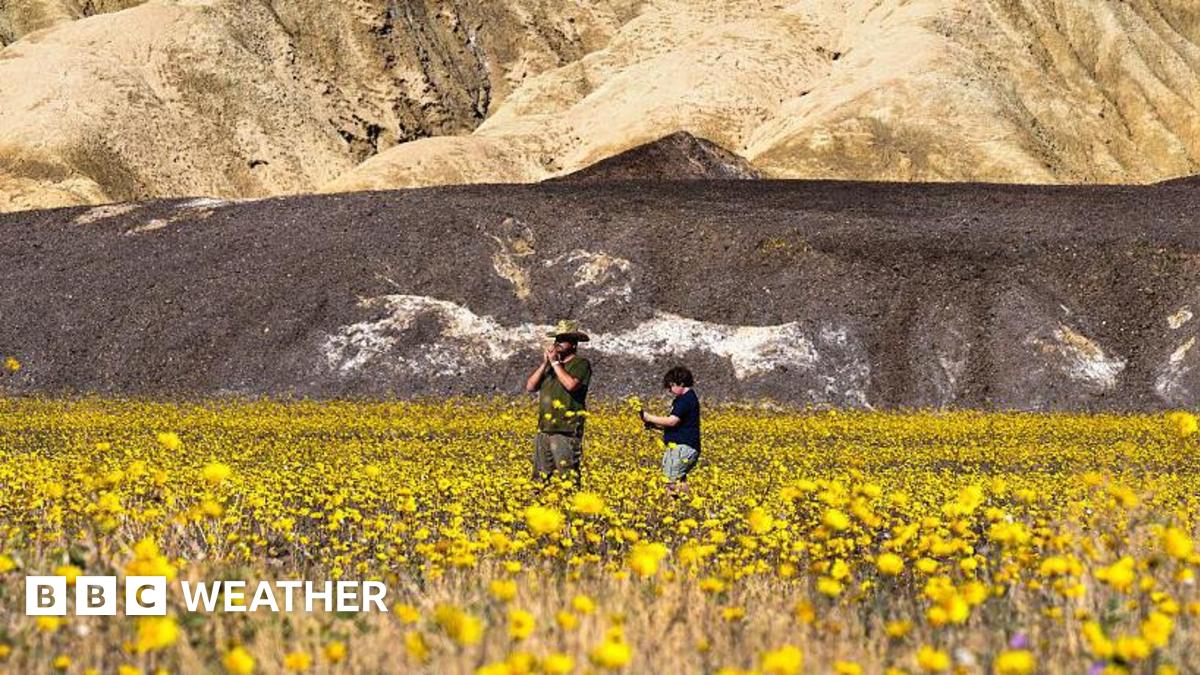
Image source, Will Lester/MediaNews Group/Inland Valley Daily Bulletin via Getty ImagesByJo WadeBBC Weather Published33 minutes agoDeath Valley in California - the hottest place on Earth and the driest place in North America - is currently carpeted in wildflowers in what is shaping up to be the best bloom in a decade.
The National Park Service (NPS) officially categorised this as an above-average bloom year on 22 February, with low-elevation flowers blooming throughout the park.
It is the best event the site has seen since 2016, with swaths of the desert transformed and covered in golden and violet flora.
Image source, Eric Thayer / Los Angeles Times via Getty ImagesImage caption, Pretty flowers bloom in the sunshine of Death Valley National Park in California in early March
The trigger was an unusually wet autumn. Record rainfall of 2.41in (6.1cm) hit Death Valley in the autumn of 2025, soaking seeds and washing off their protective coatings to trigger sprouting, followed by a dramatically wetter winter that provided the steady moisture needed for root development.
Image source, Will Lester/MediaNews Group/Inland Valley Daily Bulletin via Getty ImagesImage caption, A lone desert sunflower towers over a cluster of desert sand-verbena near Ashford Junction at the southern end of Death Valley National Park
The bright yellow desert gold is currently one of the most prominent flowers on display, alongside brown-eyed primrose, grape soda lupine and desert star.
Low-elevation flowers are expected to persist until mid-to-late March, with higher elevation blooms predicted from April through June.
Image source, Marli Miller/UCG/Universal Images Group via Getty ImagesImage caption, Spring flowers bloom against a backdrop of Telescope Peak, Death Valley National Park, California
While some have used the term "superbloom", the park itself is cautious about the label. NPS officials noted that although there are not as many flowers as in past superbloom years, there are far more than most years. Previous superblooms in Death Valley occurred in 1998, 2005 and 2016.
Rare pink daffodils might be growing in your garden - could you spot one?