play Live Sign upShow navigation menuplay Live Click here to searchsearchSign upANALYSISNews Analysis|Trade War‘Hostile, but hooked’: What’s behind the US-China trade truce extension?Some analysts say the truce extension is pure optics – others count it as a useful interim step towards a more durable deal.
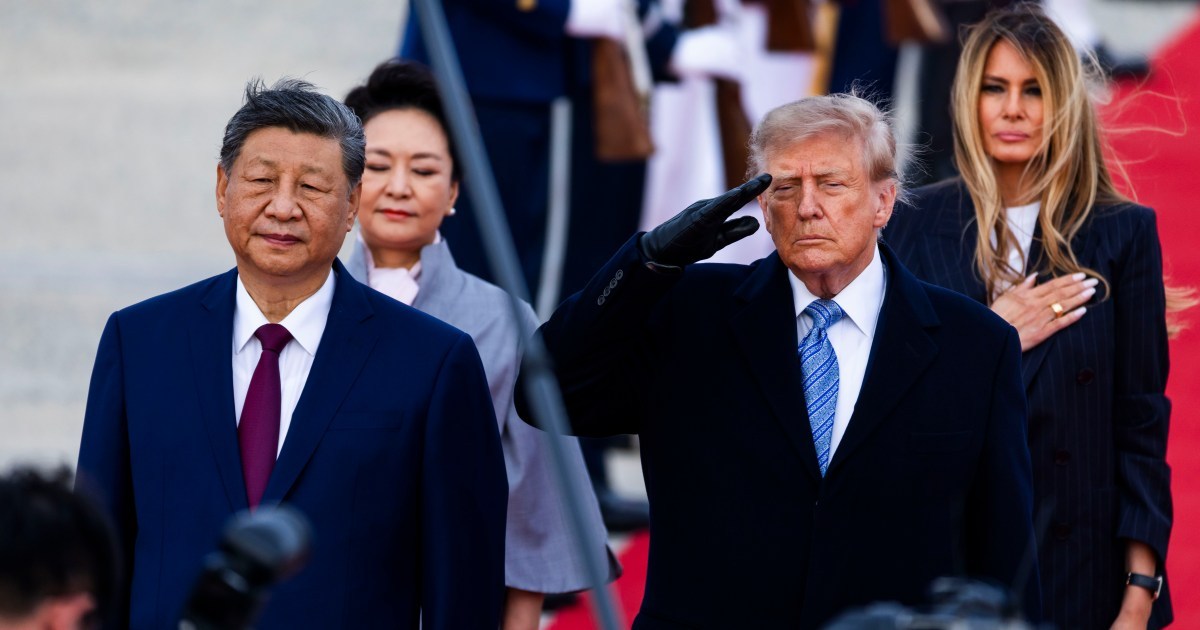
xwhatsapp-strokecopylinkgoogleAdd Al Jazeera on GoogleinfoPresident Donald Trump, centre, greets Chinese President Xi Jinping, left, upon his arrival at Joint Base Andrews, Maryland, USA [File: Jim Lo Scalzo/EPA]By Urooba JamalPublished On 24 Sep 202624 Sep 2026The red carpet was rolled out, and a trade truce was extended. Yet, beneath the pomp and pageantry of Chinese President Xi Jinping’s state visit with US leader Donald Trump on Thursday, Washington and Beijing remain locked in a much deeper strategic rivalry.
Xi arrived in Washington, DC on Wednesday evening for talks on Thursday, and Trump was there to meet him personally on the tarmac.
The meeting was the first state visit by a Chinese leader to the US in 11 years. But it is also the third time in less than a year that the two men have met face to face, as the two powers remain uneasily gridlocked in competition over AI, rare-earth metals, the question of Taiwan, and the Iran war.
Overhanging it all is the paused, but simmering, trade war between their two nations.
Almost as soon as Trump began his second term in the White House in January 2025, up went tariffs on Chinese goods as he accused China of facilitating the flow of fentanyl, a deadly drug, to the US. Beijing responded with its own levies, then restricted exports of valuable rare-earth metals which are crucial for the development and manufacture of everything high-tech, from smartphones to fighter jets. At one point, tariffs were heading towards 150 percent before being paused to allow time for talks.
Finally, the two leaders called a truce on the sidelines of the Asia-Pacific Economic Cooperation (APEC) summit in South Korea on October 30, and they met once more, in May, when Trump travelled to Beijing.
As Xi landed in Washington on Wednesday this week, the Trump administration announced that the two countries had agreed to extend an October 2025 truce which had offered some respite from the punishing tariffs, produced an agreement from China to buy more soyabeans from the US and delayed the ban on rare-earth exports from China until January 10. The prospect of a much-longed-for trade deal appeared to be in the air when US Treasury Secretary Scott Bessent told Fox News he had met Chinese Vice Premier He Lifeng before Xi’s visit to “see if we could do a bigger deal as opposed to just a series of smaller things”.
But analysts have, for the most part, shot down such hopes. Beyond tariffs, they say, the simmering conflict between the two powers now encompasses new US sanctions on buyers of Russian oil – namely China – and sweeping investment and research restrictions, never mind the intensifying race for dominance in artificial intelligence.
“The two-month extension isn’t a bridge to a grand bargain – it’s a temporary sandbag holding back a structural flood,” Beijing-based Einar Tangen, a senior fellow at the Center for International Governance Innovation, told Al Jazeera.
In fact, the truce is little more than “transactional theatre” – an attempt at good optics before the upcoming US midterm elections – Tangen said.
Trump’s deeply unpopular war on Iran has already inflicted severe damage to his chances in that vote. Democrats are leading in the polls amid concerns about the rising cost of energy, triggered by the war which the US started. Trump ultimately needs wins on other issues.
The current truce with China serves a purpose, therefore, but is fragile enough to be undone the moment political utility shifts for Trump, Tangen said.
“Success in January won’t be measured by what is solved, but by whether the knot is left tight enough to hold, but not kill,” said Tangen.
Phillippe Le Corre, professor of international relations and Asian studies at France’s ESSEC Business School, said the length of the truce extension indicates clearly that a more permanent deal remains out of grasp.
“The extensions are getting shorter and shorter, which means they haven’t found a common ground on many issues,” Le Corre told Al Jazeera.
“The two-month extension is a terrible outcome for the US. Nothing is resolved, and many Damocles’ swords are still hanging over Washington’s head,” he added.
Trump’s entire China policy, Le Corre argued, is in fact short-sighted. “That is bringing the world a lot of uncertainty,” he said.
Some analysts are more hopeful, but not much. Sun Chenghao, a fellow at the Center for International Security and Strategy at Tsinghua University in Beijing, described the extension of the trade truce as a “useful interim step”. It shows that both sides want to preserve the recent easing of tensions, which is meaningful progress, he said.
“From China’s perspective, a sustainable agreement needs reciprocal benefits and greater policy predictability,” Sun told Al Jazeera. “Additional purchases cannot indefinitely compensate for uncertainty over tariffs, technology restrictions and market access.”
The extension’s value, however, will depend on whether it produces “concrete commitments” from Beijing and Washington, Sun added.
There is motivation to get a deal done, analysts say. Any escalation in the US-China trade war will be costly for both sides.
But there is some way to go. A Congressional Research Service report in July 2026 noted that Chinese goods exported to the US still face tariffs of 36.5 percent, while US goods entering China are taxed at 31 percent.
Any higher, and they will raise import and manufacturing costs in the US, squeeze margins and increase pressure on consumer prices, said Sun. They would also hurt US farmers and industrial exporters, he added, just as the US faces pressure from the rising costs of its war on Iran, which have pushed it into a record national debt of $40 trillion two years earlier than expected.
“Washington is playing a high-stakes game of economic chicken with a $40 trillion debt load, an inflationary sword of Damocles, zero fiscal cushion to absorb a truce collapse and a dependence [on] Chinese industrial and manufacturing inputs,” Tangen said.
US consumers and the economy in general will find it tough to survive yet another inflationary shock from renewed tariffs “at a time when the federal budget already operates like a high-wire Ponzi scheme”.
Then there is the AI race, which no one can afford to lose. According to Jon Bateman, a senior fellow at the Carnegie Endowment for International Peace, a partial “decoupling” of US and Chinese technology ecosystems is under way. US policymakers have pushed to become less dependent on Chinese tech and “to secure America’s technological future in the context of a rising China”, Bateman writes.
But that will not help if there is a collapse in valuations of companies in the AI sector, which currently drive global stock markets. An AI valuation collapse, Tangen warned, “could trigger a financial tsunami that makes 2008 look tame – making technological decoupling meaningless as the world is plunged into a depression”.
Despite the trade war and Trump’s tariffs, China’s trade with other countries has risen sharply, with the country registering a $1.2 trillion global trade surplus last year. But an escalation of the trade war with the US would nevertheless spell increased pressure on export orders, employment in exposed industries and business confidence, said Sun.
Beijing does hold one crucial ace card – it is sitting on 60 percent of the world’s known deposits of rare-earth minerals, said Le Corre. It processes 90 percent of them, too. These are the metals that all countries need supplies of for semiconductors, technological components and the manufacture of weapons, to name but a few. Last year, China began to make use of that leverage by restricting exports of five of the 12 rare-earth metals it mines in April. Then, in October, it prepared to restrict seven more – until the trade truce happened. Plans for the export restrictions are not shelved, however, merely on hold.
“[China] understood this over the past year and they are certainly not going to give up on this,” said Le Corre.
“Washington is hostile, but it is hooked,” Tangen said. “You cannot threaten China with secondary sanctions on energy while desperately needing its rare-earths to fuel your military-industrial base.”
The path to a lasting US-China trade deal will be long and rocky. First, any new tariff reductions will need more coverage and duration, said Sun.
For a deal to last, it would also require “more predictable licensing and actual deliveries of rare earths and critical minerals; restraint in expanding technology restrictions; and market access reflected in regulatory approvals and completed transactions”, he said.
A durable agreement also needs regular consultations and a process for resolving complaints. If all this can be hammered out then, just maybe, there might be a chance, Sun said.
Tangen and Le Corre were less optimistic, however. “The US view of China as an existential threat has to change before there can be solutions,” said Tangen.
Le Corre, meanwhile, said that while China is a long-term planner, “durable is a word that can hardly be associated with Trump.”
The existing trade truce also risks breaking down if there are new unilateral tariffs, broader technology or mineral restrictions, or disputes over whether commitments have been fulfilled, said Sun.
Tensions over Taiwan, which China claims as its own territory, but for which the US approved an $11.1bn arms sale in December last year, could also trigger a breakdown in trade relations, the analysts said.
“Taiwan remains the ultimate low-probability, catastrophic-impact tail risk – where a single round of arms sales can snap a multibillion-dollar trade truce in an instant,” Tangen noted.