Fighting has resumed in Ethiopia's Tigray region. In an interview with DW, Horn of Africa expert Martin Plaut warns of possible regional spillover.
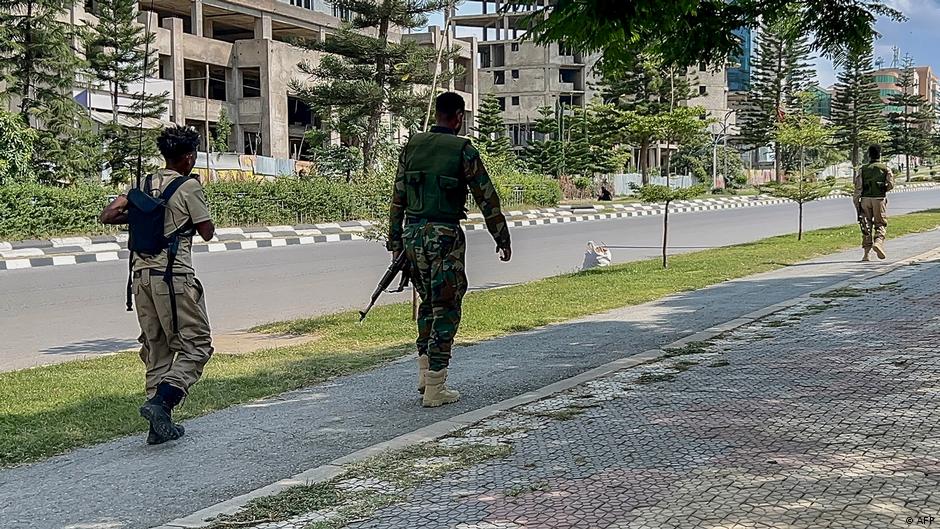
https://p.dw.com/p/5NCFpTigrayan forces seized three local airports and launched attacks in Ethiopia's Afar and Amhara regions with allies there this weekImage: AFPAdvertisementFighting has erupted again in Ethiopia's northern Tigray region. Tigrayan forces launched a major offensive on September 23, with fighting also reported in the neighboring regions of Afar and Amhara.
The escalation threatens the fragile peace established by the 2022 Pretoria peace agreement, which ended the previous Tigray war between Ethiopia's federal government in Addis Ababa and the Tigray People's Liberation Front (TPLF).
But the central question is bigger than the return of war to Tigray: could the conflict connect with the wars and rivalries already destabilizing the Horn of Africa and the Red Sea?
Martin Plaut, British journalist and Horn of Africa expert, argues that the conflict could spill beyond Ethiopia's borders.
"If a conflict were to spill over, it is quite possible that a conflict involving Eritrea and Ethiopia could then involve Sudanese forces as well, which could drag the whole region into a war," he told DW in an exclusive interview.
Why northern Ethiopia is seeing growing violence once againTo view this video please enable JavaScript, and consider upgrading to a web browser that supports HTML5 video
Jalale Getachew Birru, a senior analyst for East Africa at the Armed Conflict Location & Event Data Project (ACLED), also stresses that the conflict cannot be viewed in isolation. ACLED is an independent conflict-monitoring and research organization that collects and analyses data on political violence and armed conflict around the world.
“The Ethiopia[n] case is not [an] isolated case for the Horn of Africa. It involves the neighboring countries as well, and it’s being displayed across the Horn of Africa countries," Birru told DW.
Her assessment points to a broader regional dynamic: Ethiopia's conflict is unfolding alongside shifting alliances and competing interests in neighboring Sudan and Somalia. ACLED's current analysis likewise places the renewed Tigray conflict within a wider pattern of instability across the Horn of Africa.
The risk is not based on a single regional alliance. It comes from the fact that several conflicts are already geographically and politically connected, Birru noted.
The African Union (AU) also expressed deep concern about the possibility of further destabilization.
In a statement on September 23, AU Commission Chairperson Mahmoud Ali Youssouf warned that new political and military alliances risk reversing the progress made since 2020.
The AU called for an immediate end to actions that could escalate tensions, renewed direct talks under the Pretoria agreement and restraint by Ethiopia's neighbors. It also tasked former Nigerian President Olusegun Obasanjo, the AU's High Representative for the Horn of Africa, with supporting diplomatic efforts.
The AU's intervention reflects concerns that the crisis could have wider regional implications, including the possibility that it could interact with conflicts beyond Ethiopia's borders.
The TPLF recently joined six other Ethiopian armed groups in an alliance seeking to remove Prime Minister Abiy Ahmed's government. Among them is the Amhara Fano movement, which fought against the TPLF during the previous war.
The alliance is not a unified military force. Its members have different political objectives and territorial interests. But its formation could leave the Ethiopian government facing several fronts at once.
The fighting in Afar, a northeastern Ethiopian region bordering Eritrea and Djibouti, is particularly significant. The region contains the main transport corridor linking landlocked Ethiopia to Djibouti, through which much of Ethiopia's international trade passes. Sustained fighting there could therefore threaten a vital economic lifeline.
During the 2020–2022 Tigray war, Eritrean troops fought alongside Ethiopian federal forces against the TPLF. Since then, relations between Addis Ababa and Asmara, Eritrea's capital, have deteriorated. Ethiopia's ambitions for access to the Red Sea have added to Eritrea's security concerns.
"The war could certainly escalate, and Eritrea could become involved," Plaut said.
Ethiopia has accused Eritrea of supporting armed groups opposed to the government, while Asmara has denied such allegations. The extent of any direct Eritrean involvement remains difficult to establish independently.
Sudan has been at war since 2023 between the Sudanese Armed Forces (SAF) and the Rapid Support Forces (RSF). The conflict has drawn in regional powers and created one of the world's largest humanitarian crises.
Plaut argues that Ethiopia and Eritrea are already indirectly involved on opposing sides.
"The Ethiopians are on the side of the RSF and Hemedti," he said, referring to its commander Mohamed Hamdan Dagalo. "There has been strong evidence that there is a base in western Ethiopia which is supplying and training RSF fighters," Plaut added. DW has not independently verified that claim.
Explainer: How did Ethiopia's Tigray war start?To view this video please enable JavaScript, and consider upgrading to a web browser that supports HTML5 video
The United Arab Emirates (UAE) has faced allegations of supporting the RSF, which it denies. Plaut identifies Eritrea, Egypt and Saudi Arabia as supporting the Sudanese Armed Forces.
"So both Eritrea and Ethiopia are already playing a role, indirectly, in the war," he said.
If Ethiopia and Eritrea were to enter direct hostilities, Sudan's rival forces could have incentives to exploit the new situation, Plaut noted. Fighting could put additional pressure on Sudan's eastern frontier and alter supply routes and military calculations.
Plaut sees the danger of a chain reaction: "Because you have the UAE backing the RSF and you have the Saudis backing the Eritreans and the Sudanese Armed Forces, this could all multiply and you could get one conflict leading into another."
"So the whole thing becomes a generalized conflict in the region," he said.
The Bab el-Mandeb Strait, one of the world's most important shipping chokepoints, connects the Red Sea with the Gulf of Aden and the Indian Ocean.
Eritrea and Djibouti lie on its western side, Yemen on the eastern side. The war in Yemen has already shown how insecurity around the Red Sea can disrupt international shipping and draw in outside powers.
Eritrea's location and its control of the port of Assab give it strategic importance far beyond Tigray. Any major deterioration in Ethiopia-Eritrea relations could therefore affect the wider security architecture of the Red Sea.
Saudi Arabia and the UAE have also developed extensive political, economic and security interests across the Horn of Africa. Their interests overlap in some areas but diverge in others, particularly over Sudan.
None of this means that a regional war is inevitable. There is no evidence of a single military alliance stretching from Tigray to the Gulf. Ethiopia's armed groups have competing interests, Eritrea may avoid direct intervention, and Sudan's warring parties have their own priorities.
But conflicts do not need a common command structure to become interconnected.
Ethiopia's broken Tigray peace deal opens old woundsTo view this video please enable JavaScript, and consider upgrading to a web browser that supports HTML5 video
The Tigray war killed hundreds of thousands of people and displaced millions. The Pretoria agreement stopped the large-scale fighting, but many of the political and territorial disputes underlying the conflict remained unresolved.
Today, Tigray is again at war while Ethiopia faces several armed movements, Eritrea is a potential military actor, and Sudan is already engulfed in civil war.
Plaut warns that the humanitarian consequences could again be severe.
"There's certainly a danger of this becoming an extremely bloody conflict," he told DW. "After all, six hundred thousand people died in the last one in Tigray."
But he does not predict that the previous death toll will necessarily be exceeded. "Let's hope that it doesn't go in that direction," he said.