Video We need the Save College Sports Act | Don't @ Me w/ Dan Dakich Pearl expects the bill to pass the Senate today or tomorrow.
The people who oversee the Post Office now want to run college sports ... what could go wrong?
The United States Congress has been called upon during the most important moments in American history to make difficult decisions about the future of our country.
We have navigated wars, economic downturns and national disasters.
THE CRAIG CARTON SHOW–UNFILTERED, UNAPOLOGETIC AND UNMISSABLE. DOWNLOAD HIS DAILY PODCAST NOW!
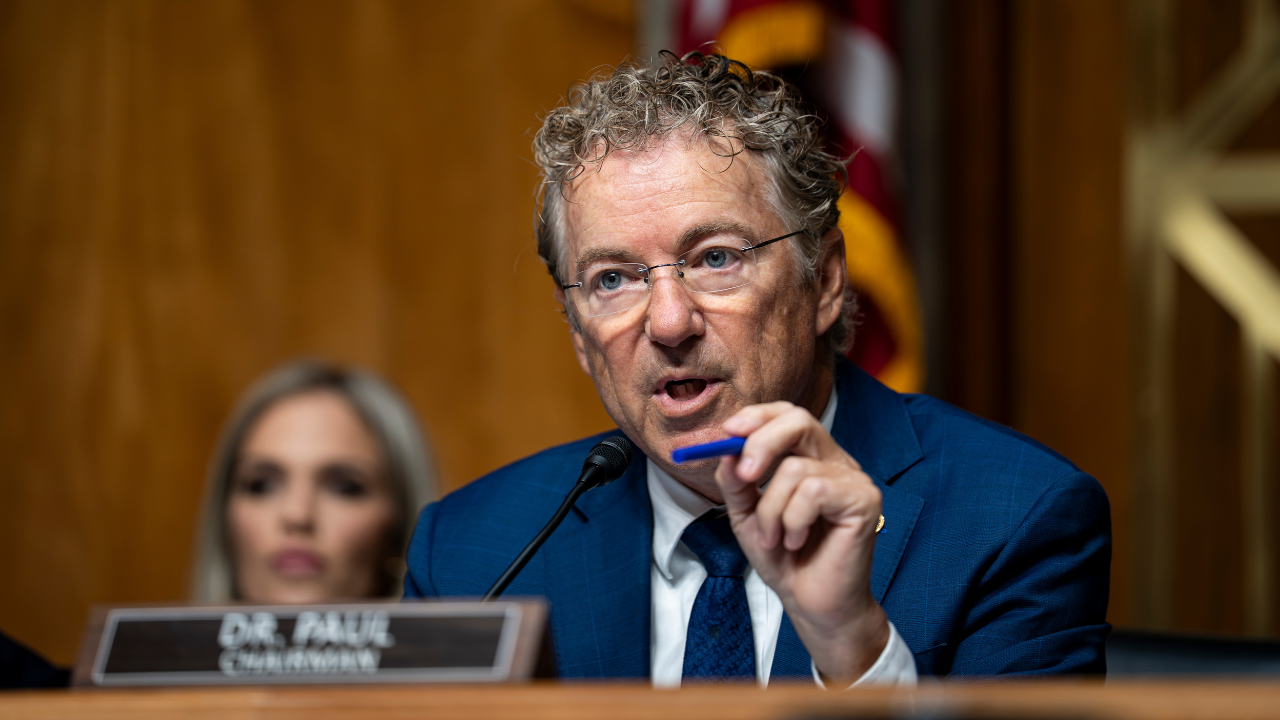
Senator Rand Paul, a Republican from Kentucky and chairman of the Senate Homeland Security and Governmental Affairs Committee, speaks during a hearing in Washington, DC, US, on Wednesday, July 29, 2026. Anthony Fauci declined to testify in a Senate committee hearing on his role in the US response to Covid-19, invoking his 5th Amendment rights. (Al Drago/Bloomberg via Getty Images)
These are the kinds of nationwide issues that a federal government should address. The Founders never intended for the federal government to usurp the authority of your local school board or your homeowners’ association. I don’t think it ever occurred to them that Congress would one day be charged with dictating the rules for college sports.
And yet, with gas at over $4 a gallon, a persistent war with Iran and $40 trillion in debt, the Senate decided the most urgent thing it should do is dictate how college sports are run from Washington.
It came to this decision, of course, after acknowledging that government caused the very problems this bill purports to fix. This is the exact scenario the great Harry Browne described when he said government "knows how to break your legs, then hand you a crutch and say, ‘See, if it weren’t for government, you wouldn’t be able to walk.’"
I come to the floor today to offer an amendment that would avoid the federal takeover of college sports. Unlike the underlying bill, my amendment rejects the idea that politicians should run college sports. My amendment would put the trust in the schools, students, coaches and conferences to run their own sports.
My amendment accomplishes this goal simply by granting an antitrust exemption so that college athletes and schools can make their own deals, without unelected judges or politicians micromanaging every detail of compensation and eligibility.
Jason Russell, a journalist with Reason magazine perhaps summed up this bill’s federal takeover of college sports best when he wrote:
"The backers of the bill believe politicians, not the NCAA, should decide how many transfers are allowed. They think politicians, not conferences, should set a compensation cap on how much schools can pay athletes. They think politicians, not athletes and businesses, should get to decide what is a legitimate private contract. They think politicians, not the colleges, should decide how many schools are in the Big Ten and SEC. They think politicians, not coaches, should decide when a coach is allowed to leave a job.
"They think politicians, not athletes or agents, should get to decide what agent fees are. They think politicians should empower medical personnel, not athletes or coaches, to have "autonomous, unchallengeable" power to decide if an athlete plays or sits.
"They even think politicians, not the NFL or broadcasters, should get to decide when professional football games are on TV. They think politicians should have a say in the length of the college football season."
Quarterback Arch Manning #16 of the Texas Longhorns passes the ball during the college football game the Texas Longhorns and the Ohio State Buckeyes on September 12, 2026, at Darrell K Royal-Texas Memorial Stadium in Austin, TX. (Photo by David Buono/Icon Sportswire via Getty Images) (David Buono/Icon Sportswire via Getty Images)
CLICK HERE FOR MORE OUTKICK SPORTS COVERAGE
This bill is the culmination of a slow march towards federal control of college sports that began almost one-hundred and forty years ago in the courts.
In 1890, Congress enacted the Sherman Act. The Sherman Act is a piece of antitrust legislation. But, quite quickly, antitrust became a weapon against businesses of all sizes.
One of the most ridiculous examples of antitrust as a weapon of government control came in 1967. In Utah Pie Company v. Continental Baking Company, the courts determined that a bakery violated antitrust law by selling its pies too cheaply.
Not long after, in 1969, the government sued IBM for dominating the computer market by innovating too quickly. That case ultimately ran on for thirteen years before the government finally dropped it, saying that it was "without merit."
The logic of antitrust became so contorted that the Federal Trade commission accused cereal makers of maintaining a shared monopoly on the theory that the brands blocked competition by being so popular that they flooded store shelves with their products. After 10 years of litigation, the FTC dismissed the case, ruling that staff failed to prove the shared monopoly charges.
Antitrust laws granted the courts the ability to intrude on private contracts and dictate how people should run their businesses. And courts have grown increasingly comfortable using that power, increasing the scope of antitrust law with each case.
For over one-hundred years this country has left regulation of college sports where it belongs: with the institutions and individuals that participate in college athletics.
Until 1984, college athletics were excluded from antitrust law because antitrust didn’t deal with noncommercial, amateur pursuits. But in 1984 the Supreme Court decided that the NCAA couldn’t impose television broadcasting restrictions on college football games.
Rather than recognizing that there may have been an underlying reason for the restrictions, the courts threw out the restrictions and began the slippery path we are on today.
That case established college athletics as a commercial enterprise, but it wasn’t until 2015 that the courts really sank their fangs into college athletics.
In 2015, the courts finally decided that the NCAA could not require students to maintain their amateur status by refusing payment for use of their name, image and likeness. The court decided that eligibility rules for a private association are best decided by the government, not the members of the association.
Since 2015, a flurry of cases has decided issues as parochial as how much individual athletes are paid out of broadcast revenues and how long student athletes are eligible to play.
Robert Woodyard Jr. No. 0 and Nicholas Rodriguez No. 5 of the Missouri Tigers hit Isaiah Marshall No. 8 of the Kansas Jayhawks in the first quarter of a college football game on Sept. 11, 2026, at David Booth Kansas Memorial Stadium in Lawrence, Kan. (Icon Sportswire via Getty Images)
Government has shirked its real duties — deciding issues of national importance — to focus on something it knows nothing about.
As important as college sports are to students and institutions, they aren’t something Congress should micromanage. Athletes and institutions should be free to make choices about who they want to work and play for, and what rules they should be subject to.
This bill manages to interfere with college athletics at nearly every level. It limits the ability of certain employees to freely leave one school and accept a job at another. It decides how students may go about licensing their name, image, and likeness. It even decides when transfer students are eligible to play.
The bill actually forbids a return to the historic model of amateur sports where athletes are not paid.
The bill would also set up a Commission on the Future of College Athletics, a legislative commission that would recommend new rule changes to Congress in the future. It seems that we already have an institution dedicated to preserving the future of college sports: the NCAA.
Congress should not mire itself in another endless cycle of solving problems it caused. It especially shouldn’t become the chief rulemaking body for something like collegiate athletics.
CLICK HERE TO DOWNLOAD THE FOX NEWS APP
That is why I am offering an amendment that would actually solve the problems faced by college sports. My amendment would reverse previous interference and prevent future interference by exempting collegiate sports from antitrust laws.
This would ensure conferences, colleges and athletes are free to negotiate and enter into agreements that benefit everyone, without the heavy hand of government dictating what parties can offer or accept. It would also prevent Congress from imposing rules governing such minutiae as eligibility for transfer students and the thresholds for reporting name, image and likeness income.
I love college sports as much as anyone, which is why I think the best way we can protect college sports is to stop sticking our nose where it doesn’t belong.
Republican Rand Paul represents Kentucky in the United States Senate. He is the author of "The Case Against Socialism" (Broadside Books, October 15, 2019).