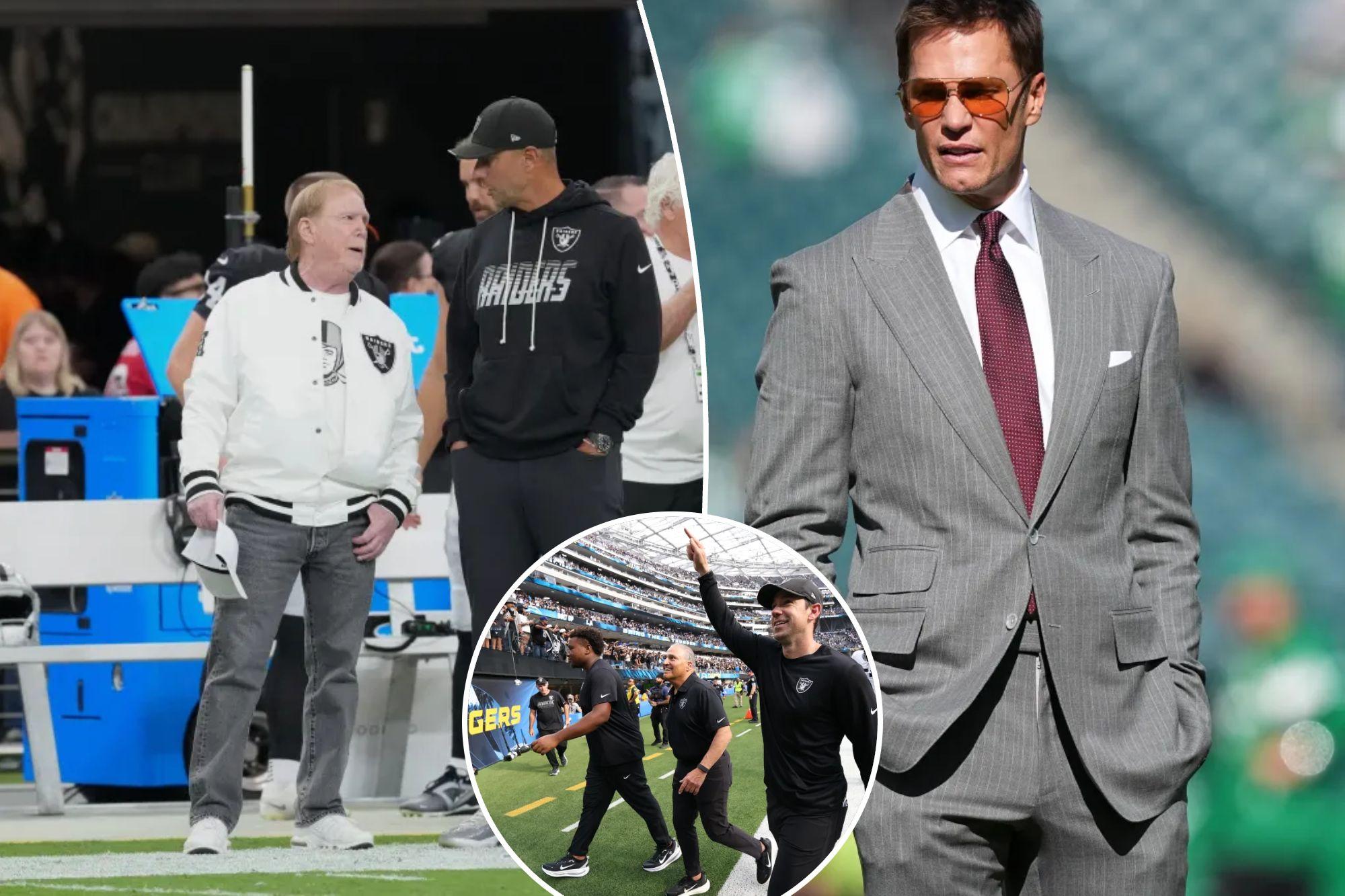
Add The California Post on Google Before the Raiders could surprise the NFL with a 2-0 start, they had to settle on a vision, then bring together the people and resources to make it work.
That process reaches beyond Klint Kubiak’s hiring, Fernando Mendoza’s arrival or even the partnership between Tom Brady and John Spytek.
Since inheriting the franchise from his late father, Davis has always acknowledged that he knew what he didn’t know. His challenge was finding the right people to fill those gaps and giving them the means to make a difference.
It has taken more than a decade, a move from Oakland to Las Vegas, and the construction of Allegiant Stadium for Davis to put his stamp on the franchise.
But as the Raiders head to New Orleans seeking their first 3-0 start in five years, his larger vision is coming into focus: an organization equipped to win on the field and thrive off it.
That includes a succession plan designed to provide stability should he decide to sell, a front office and coaching staff working in closer step than the Raiders have seen in decades, and a potential franchise-caliber quarterback in Mendoza.
Forbes valued the Raiders at $2.42 billion in 2018, just before they left Oakland for Las Vegas. Its latest estimate is $10.3 billion, more than four times that figure. Estimated annual revenue of $887 million places them among the NFL’s top-five revenue-generating teams.
The NFL’s financial boom helped. But Las Vegas and Allegiant Stadium fundamentally changed the Raiders’ business.
Davis has also expanded the ownership group to include Egon Durban, Michael Meldman, Brady, Tom Wagner and others, bringing an infusion of capital, business expertise and influential relationships. In 2022, he hired Sandra Douglass Morgan, an accomplished attorney and respected business leader with deep Nevada roots, as the team’s president.
He also put a succession plan in place, giving Durban the option to acquire controlling interest should Davis decide to sell.
The Raiders have the resources to support their ambitions, and Davis has assembled the leadership to turn those advantages into lasting success.
That is where Brady, whose ownership stake essentially makes him the football operations leader, and Spytek, his handpicked general manager, come in. And it hasn’t taken the former Michigan teammates long to put their imprint on that side of the building.
Spytek was always going to be the GM after the Raiders moved on from head coach Antonio Pierce and GM Tom Telesco after the 2024 season.
His friendship with Brady began as teammates at Michigan. Their paths crossed again in Tampa Bay, where Spytek was a respected front-office executive when Brady arrived and helped the Buccaneers win a Super Bowl.
That process led to an important and expensive first lesson, And proof that seven Super Bowl rings do not make anyone immune to a costly miscalculation.
But he wasn’t Brady’s first choice and pointing that out provides a glimpse into how TB12 thinks.
After firing Pierce, and prior to officially hiring Spytek, Brady targeted then-Lions offensive coordinator Ben Johnson, a rising offensive mind who could develop a young quarterback and grow with a rebuilding team. Brady’s influence took that pursuit further than anyone expected.
But Johnson ultimately chose Chicago, where Caleb Williams was already waiting.
The Raiders pivoted to Carroll, betting his experience and championship pedigree could speed up their turnaround.
The plan was for the 73-year-old Carroll to help establish a winning culture and a sound foundation, then hand it off to a successor in three years.
Instead, they paired a coach determined to win immediately with a roster that needed substantial work. Carroll saw urgency. Spytek saw a process. They never found enough common ground.
That became a source of contention almost immediately.
The disconnect extended to an offense featuring coordinator Chip Kelly and line coach Brennan Carroll. The operation never developed the cohesion needed to overcome its personnel shortcomings.
Three wins later, the consequences were impossible to ignore.
To their credit, Brady and Spytek did not compound the mistake by stubbornly trying to make it work. They recognized the mismatch, pulled the plug and returned to the thinking that had made Johnson the first choice.
This time, they had something more compelling to offer.
The opportunity to draft Mendoza gave the Raiders a potential franchise quarterback to build around — and Kubiak, the hotshot offensive coordinator of the Super Bowl champion Seahawks, a reason to see Las Vegas as the place to build his future.
Suddenly, the coach, the GM and the organization were working toward the same future.
It was the vision Spytek laid out after moving on from Carroll, when he described what would guide the Raiders’ next move.
“We want a meticulous build that will set us up for years of success in the future, and we have a great opportunity to do that with everything that we have in front of us right now.”
There was a hiring philosophy in those words. A roster-building strategy, too.
Now, the Raiders are beginning to show what happens when ownership, management and coaching agree on the destination.
Kubiak also brought trusted assistants Andrew Janocko and Rick Dennison. Their familiarity with his teaching and expectations provided continuity last season’s staff lacked.
Signing veteran quarterback Kirk Cousins followed the same thinking.
His history with Kubiak gave the Raiders someone who understood the offense and could demonstrate its demands while Mendoza learned them.
How Cousins prepares, handles protections and works through reads can reinforce what Mendoza hears in meetings.
The idea was to accelerate two processes: Mendoza’s development and the Raiders’ return to competitive football.
Cousins’ limitations remain relevant. But if he helps the Raiders win while preparing his eventual replacement, that bridge will have taken them somewhere.
The supporting personnel decisions reflected similar purpose.
Tyler Linderbaum supplied an anchor at center. Spencer Burford addressed left guard. With healthy left tackle Kolton Miller, right guard Jackson Powers-Johnson and developing right tackle DJ Glaze, the line began looking capable of supporting the plan.
Telesco’s only draft with the Silver-and-Black delivered Brock Bowers, Powers-Johnson and Glaze. Whatever went wrong during his brief tenure, he left important building blocks.
Spytek’s selection of Ashton Jeanty added another piece. This offseason put better support around him.
Drafting a talented running back and creating conditions for his success are separate responsibilities. The Raiders are beginning to fulfill both.
Defensively, veteran free agents Kwity Paye, Nakobe Dean and Quay Walker gave Maxx Crosby experienced help. As importantly, the three newcomers are in the prime and under contract for at least three seasons. That is a departure from all those one-and-done veterans the Raiders plugged in nearly every season.
Draft picks Treydan Stukes and Zeke Masses add youth to develop around that core.
For too long, individual Raiders were asked to compensate for everything the roster lacked.
Davis need not supply every answer. He must position the right people to find them. Brady’s influence, Spytek’s judgment and Kubiak’s coaching must reinforce one another.
Money cannot improve a protection scheme or develop a quarterback. It can support investment in the people, facilities and systems that do.
Davis has spent years building that capacity. The responsibility now is using it.
Bowers will return. Mendoza’s opportunity will come. Better opponents will expose weaknesses that still need addressing.
But the Raiders finally appear capable of pursuing immediate progress without abandoning their longer-term purpose. That is what Spytek’s meticulous build should look like: decisions that help this Sunday without compromising the Sundays still ahead.
The resources are there. So is the ambition. Through two games, there is evidence of a football operation beginning to match both.
The people he brought together are making it a place where winning can last.