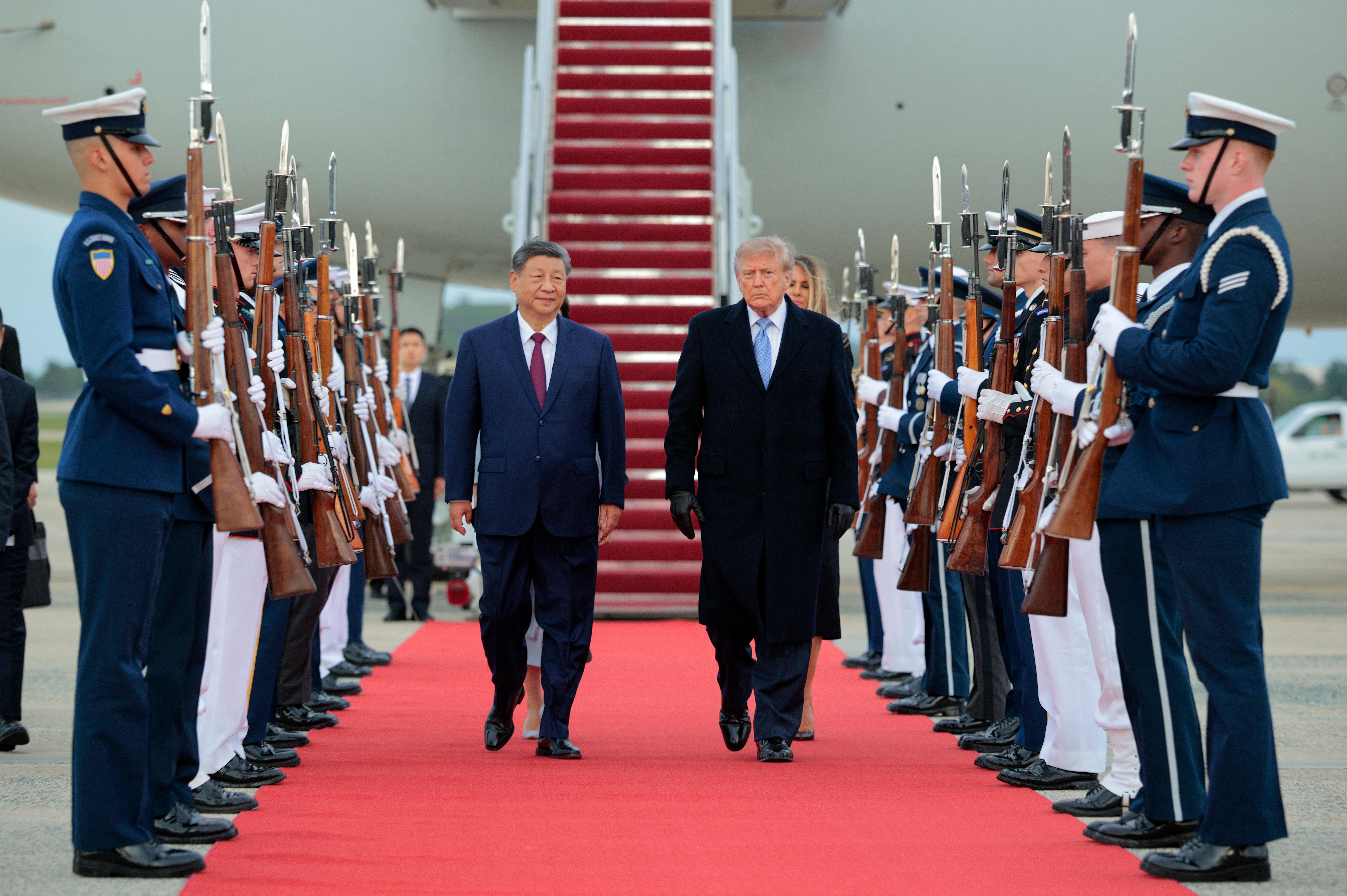
President Trump welcoming Chinese President Xi Jinping at Joint Base Andrews on Sept. 23, 2026. Photo by Chip Somodevilla/Getty Images See more of our coverage in your search results.
Add The New York Post on Google President Donald Trump was waiting, military honor guard and all, when Xi Jinping stepped off his plane Wednesday in Maryland.
It was the first time in both terms of Trump’s presidency that he personally received a visiting foreign leader on the tarmac at Joint Base Andrews.
A better question: Why is Trump flattering Xi’s ego by treating him as the world’s most important visiting dignitary?
A decade ago, such ceremonial pomp might have been taken as a sign of American weakness and Chinese strength.
China’s initiative to replace the dollar as the world’s reserve currency is failing.
Xi himself was basically sidelined at this month’s BRICS summit in India; he skipped the obligatory banquet and left a day early.
Media apologists claimed he was tired, but it’s more likely that he was just tired of being ignored.
Now, just two weeks later, the American president’s impressive show of hospitality — giving him “face,” as it’s known in Chinese culture — not only massages Xi’s ego, it also provides useful propaganda fodder for his captive audience back in China.
Trump, on the other hand, has cost China dearly.
He has radically reduced China’s inroads into the Western Hemisphere, ousting its agents from Venezuela and the Panama Canal.
With the Cuban dictatorship apparently unable to keep the lights on, and China now permanently shut out of Greenland, Beijing’s losses in the Americas appear certain to keep piling up.
Add to this Treasury Secretary Scott Bessent’s “Economic D-Day” sanctions on Iran.
These are disrupting China’s financial ties with the Islamist regime, even as Iran’s attacks on shipping in the Strait of Hormuz and its threat of tolls hammer Beijing’s energy imports: China already pays $25 a barrel more for oil than the rest of the world.
China’s leader also has major headaches back home — anemic consumer spending, a collapsing real-estate market, rising unemployment levels, an aging population and a national debt three times larger than our own (thanks, in part, to Trump’s tariffs).
Meanwhile some of Xi’s domestic problems, such as his ongoing purge of senior admirals and generals, are of his own making.
Whatever the cause of these mass ousters — both coup attempts and corruption come to mind — Xi is effectively decapitating and degrading his own military command and control system.
That’s good for us, but very bad for his planned future conquest of Taiwan: It’s hard to see how the communist leader successfully pulls off an invasion of the democratic island if he has no one qualified to command it.
It’s obvious, though, what Xi and his fellow communist leaders want from the United States.
Between their strident public demands and their covert influence operations in our country, they’ve practically given us a list.
They want us to stop the tariffs, stop drilling for oil, stop deploying weapons in space, stop building data centers, stop developing artificial intelligence and stop selling defensive weapons to Taiwan, Japan and the Philippines.
Ultimately, they want to stop America’s reindustrialization so that China, not the United States, dominates the future.
The fact that Beijing is ginning up anger against American AI and data centers, while moving at breakneck speed to develop and power its own AI systems, proves the case.
And despite the recent fearmongering from US politicians on both sides of the aisle, the bottom line is that our AI must be able to outsmart China’s in order to keep us safe.
A US-China agreement placing limits on AI development is an even worse idea: It would hamstring us and give Beijing an open field to dominate — for the simple reason that the CCP would inevitably violate the deal.
Having been burned by China over trade during his first term, I don’t see Trump making any significant concessions to Xi this week, on AI or anything else.
In fact, the administration’s stated goal for this summit is “strategic stability,” which is to say a continuation of the status quo.
Short of some dramatic shift, the trade and economic policies now in place position America to win the competition with China over time.
This is why Trump is gladhanding the communist dictator, smiling broadly and calling him his “old friend.” (Calling him America’s “Most Dangerous Adversary” would be more accurate, but the president can be very diplomatic when he needs to be.)
After all the feel-good rhetoric and photo ops, Xi will leave this summit the same way he came — empty-handed.
Steven W. Mosher is president of the Population Research Institute and author of “The Devil and Communist China: From Mao Down to Xi.”