To play this video you need to enable JavaScript in your browser.This video can not be played
Moment pilots eject as RAF jet crashes in Anglesey
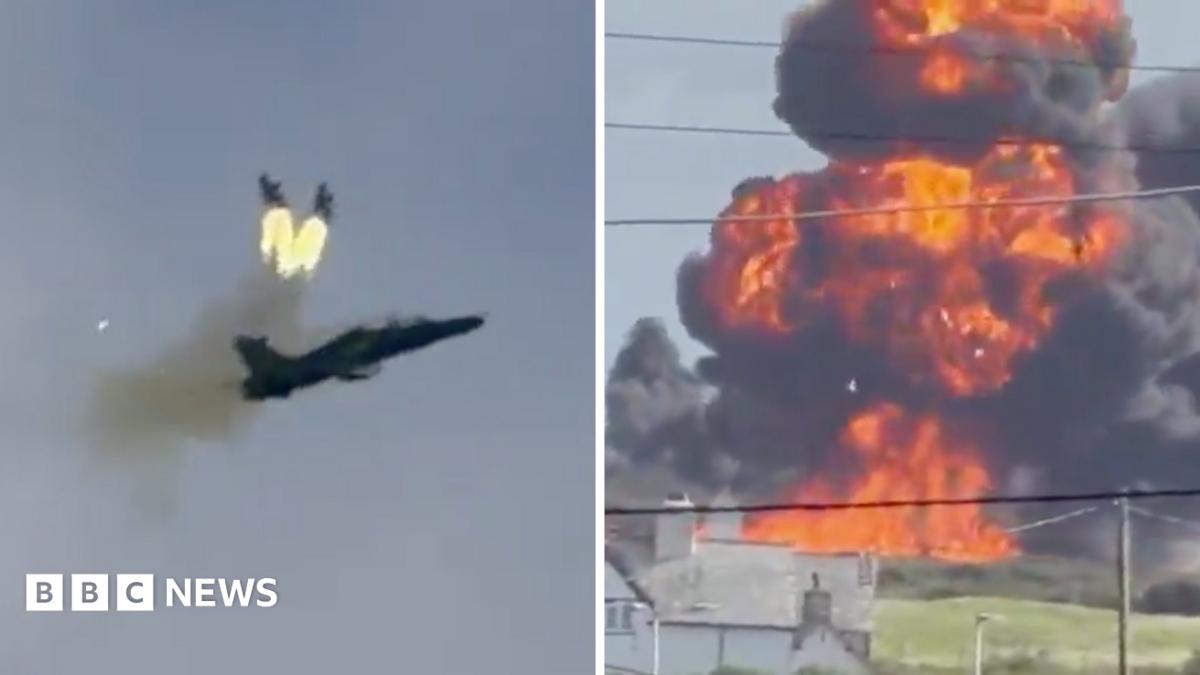
The RAF is investigating a crash involving one of its high-speed Hawk fighter jets after two of its pilots ejected and parachuted out of their plane moments before it crashed and burst into flames.
The RAF said that training on these jets had been "temporarily" paused as a "precautionary measure".
North Wales Police said the pilots, who had been flying a training aircraft, were being treated for minor injuries.
While an investigation is under way, here is what we know so far and what the crash footage shows us, according to one expert.
The Hawk T2 aircraft had been flying out of the RAF Valley base on Anglesey when it plummeted to the ground at nearby Pencarnisiog.
RAF Valley is used to provide both basic and advanced fast-jet training.
According to BBC Security analyst Mikey Kay, who also served in the RAF for 20 years, the area was "perfectly situated for training pilots" and was part of the "low-flying system".
According to the Ministry of Defence, there are 20 low-flying areas - also known as tactical training areas. They are located in central Wales, northern Scotland, the borders area of southern Scotland and northern England.
RAF Valley is also close to the Machynlleth Loop - a series of valleys between Dolgellau in Gwynedd and Machynlleth in Powys.
The loop, also known as the Mach Loop, is an attraction for aviation enthusiasts and photographers.
"These pilots they train in low level, they train in instrument flying, formation flying, general handling, so that area, the Anglesey area and its accessibility to all of those landscapes for the requirement of training is perfect," said Kay.
Image caption, The RAF plane crash happened near Pencarnisiog
The jet involved was Hawk T2 - a two-seat training jet by BAe Systems used for advanced jet training, and designed with similar controls to the Typhoon fighter jet.
According to the RAF, it comes with an advanced "glass cockpit", and the aircraft is also used for the "most advanced fast jet training for RAF pilots".
The older version of the T2, Hawk T1, is also used by the Red Arrows, which the BBC understands are also included in the pause. However, they were not due to fly again until Le Touquet Airshow in France this weekend. It is not known when the restriction will be lifted.
Kay, a former RAF pilot who grew up three miles away from RAF Valley, shared video on social media appearing to show flames rising from the rear of the T2 jet, external as it rolls down the runway.
As the jet climbs, the flames seem to disappear. It is not clear how long after take-off the pilot's ejection from the plane took place.
Kay told the BBC that the Hawks are non-reheated jets, which means they do not have reheat - also known as afterburn in the US. This is a secondary combustion system that injects raw fuel directly into a jet engine's exhaust stream behind the turbine, which gives the jet a big short-term boost in thrust.
It is different to an F18 or a Tornado where orange flames will come out of the jet, Kay explains.
"You never ever see flames coming out of the back of a Hawk," he said, adding that in the video, the flames can be seen coming off the side of the engine - where the main hydraulics system is, which controls how the plane flies - and not out of the engine.
Kay says that while it is too early to say, it is possible that the cause of the crash was not an engine failure.
Kay told the BBC that the video he shared on X also showed a red and white van parked on the side.
He said that van is not part of air traffic control, and it was actually spotters, and therefore did not have direct communication with the jet and did not have the authority to tell the jet to abort.
Kay said the van, however, does have a direct line to air traffic control, but "by the time that conversation has happened, the jet is already airborne".
A video of the crash shared on social media appears to show the two pilots ejecting from the aircraft before it nosedives, crashes and bursts into flames.
The footage shows a plume of smoke and fire erupting as the aircraft hits the ground, appearing to narrowly miss residential properties.
Kay - who hosts the BBC's Security Brief - described footage of the pilots ejecting being caught on camera as "quite remarkable" and said the pilots' ejection seat was "one of the big lifesavers in this whole story".
He said there are two options for ejection that can be taken in a T2 jet - which usually involves an experienced pilot trainer and a student.
One option involves both pilots ejecting individually by pulling a black and yellow ring placed between their legs on the jet, the second option is called "command ejection" where one pilot ejects both seats, with whoever sitting at the back going first.
According to Kay, once the pilot decides to eject the seats, it sets off a miniature detonation cord (MDC), a thin explosive line that is used to shatter the canopy of a jet in the event of an emergency.
"The aircraft seat is designed for the pilot to be able to eject at zero speed and zero height, and that will allow enough time for the parachute to inflate, and then the pilots hit the ground," he added.
"As far as I'm aware this is the first known case of this variant, the T2, ejecting pilots out of it," he said, adding that the safety record for these jets is "obviously very good".
RAF pauses fighter jet training after two pilots eject from plane before crash