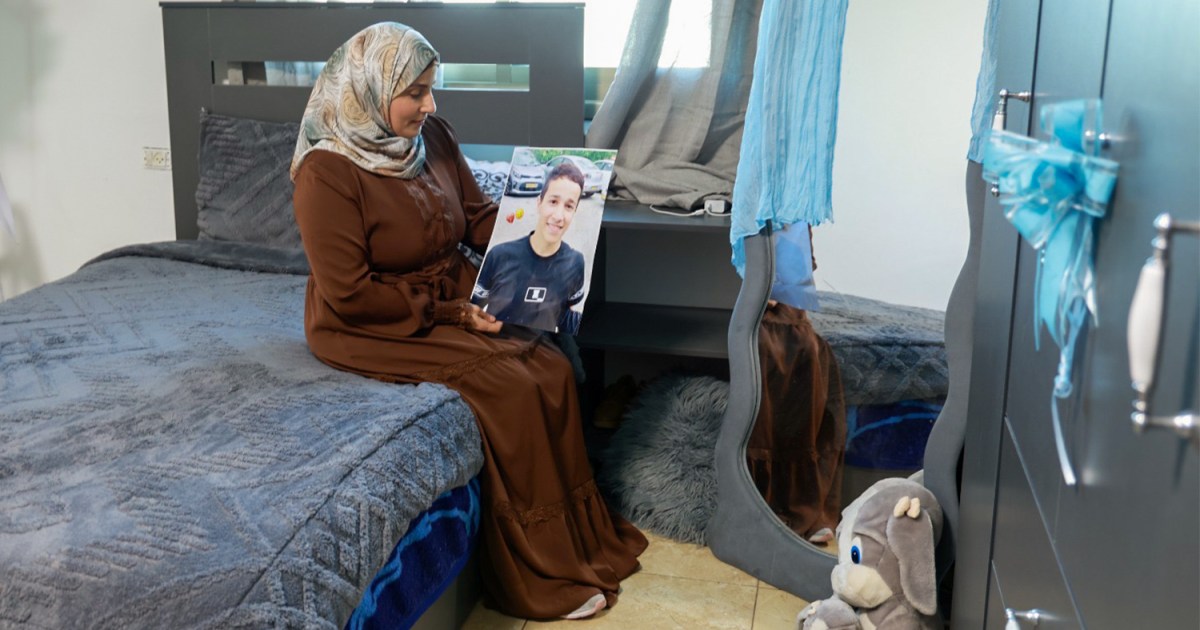
play Live Sign upShow navigation menuplay Live Click here to searchsearchSign upFeatures|Child RightsWhat Palestinian children endure in Israeli detentionEvery day, Fidaa Zalbani checks the room of her son, Mohammed, 17, tidying his bed and arranging clothes that remain untouched.
xwhatsapp-strokecopylinkgoogleAdd Al Jazeera on GoogleinfoFidaa is sitting on Mohammed’s bed after tidying his room [Ahmed Jalajel/Al Jazeera]By Fayha ShalashPublished On 23 Sep 202623 Sep 2026Every morning, Fidaa Zalabani checks the room of her 17-year-old son, Mohammed, in the Shu’fat refugee camp in occupied East Jerusalem, arranging clothes that remain untouched by the end of day.
Mohammed hasn’t set foot in his room since Israeli forces arrested him more than three years ago, but his mother repeats the same routine every morning.
He was arrested in February 2023 at the age of 13, accused of stabbing a soldier on a bus at a checkpoint at the Shu’fat refugee camp, two weeks after he saw his teenage friend killed by an Israeli soldier.
During the incident, a security guard opened fire, accidentally shooting the Israeli soldier who had been stabbed, who later died. Mohammed was subsequently sentenced to 18 years in prison, accused of causing the death.
For about two years, Fidaa said she has not been allowed to visit her son at Megiddo Prison in northern Israel, leaving her deeply concerned about his health. She also believes Mohammed and other child detainees have been subjected to beatings and other forms of mistreatment.
“The lawyer told us during several visits that the child detainees there go to sleep hungry most days; the guards allow no more than four loaves of bread for 13 prisoners, a situation that kept me awake worried about his condition,” she told Al Jazeera.
In September 2025, the Israeli Supreme Court found that the Israeli Prison Service has failed to provide Palestinian prisoners with adequate food – although the prison service, which is overseen by far-right National Security Minister Itamar Ben-Gvir – has rejected allegations of starvation.
Fidaa said Megiddo Prison had only recently begun allowing child detainees to bathe more than once a week, a privilege previously denied for more than two years. She said scabies and other skin diseases had spread among detainees amid overcrowding and poor sanitation.
However, Fidaa is most concerned about raids on prison cells, beatings of children, and the practice of tightly restraining them for hours at a time.
Palestinian prisoner advocacy organisations report that, based on available data and documentation, there have been approximately 1,900 arrests of Palestinian children from the occupied West Bank since October 2023, when Israel’s genocidal war on Gaza began.
Meanwhile, the number of children detained from the Gaza Strip remains unclear due to ongoing enforced disappearances and the difficulty of accessing information regarding their status.
Palestinian prisoner organisations report that 360 Palestinian children remain detained by Israel. Rights groups and United Nations bodies have documented reports of beatings, severe restrictions on food, medical neglect, solitary confinement, and other forms of ill-treatment of child detainees.
Ola Qatishat, 16, from Tammun in the northern West Bank, was talking to her sister, Asia, at midnight on May 24. She was excitedly discussing plans for a celebration to mark Asia passing her high school exams.
Then the Israeli army raided their home and arrested Ola, accusing her of incitement against Israel. The family have no more details about her charges and remain in shock about her detention.
“We chased after the military vehicle as they hauled her away, screaming, ‘She’s just a child! What are you doing?’ They threw a sound grenade at my mother and me to force us back. Since that day, we have wept over her absence,” Asia told Al Jazeera.
Ola loved school and, shortly before her arrest, had entered a mural-painting competition there. While in detention, she learned from her lawyer that she had won first place across the entire West Bank.
Her sister Asia passed her exams with distinction last July, but, with her sister detained in northern Israel’s Damon Prison, she said she felt no joy.
“The lawyer visited her a month ago and told us she had begun suffering from scabies due to a lack of hygiene and infrequent bathing; an officer stands at the bathroom door, telling each female prisoner, ‘You have five minutes; if you don’t finish bathing, I will come in and drag you out,'” Asia added.
The anxiety of Ola’s family grows daily as she remains in detention, awaiting her court hearing in October.
The conditions raise questions regarding adherence to the special safeguards guaranteed by international law for detained children, particularly as human rights organisations report harsh conditions within Israeli prisons.
Lawyer Lubna Tuma, from the Adalah Legal Center, told Al Jazeera that Palestinian children in Israeli prisons face total isolation from the outside world; when a child is brought to meet their lawyer, they are led in blindfolded, cutting them off from their surroundings and depriving them of sight and a sense of the space around them.
She pointed to an explicit policy of providing only the bare minimum of necessities, explaining that this refers to the minimum required to keep the prisoner alive, rather than what a child needs for growth and the preservation of their health and dignity.
“Under this approach, the Palestinian child is treated as a prisoner to be punished, rather than as a child entitled to specific rights and protections,” she said.
Muin Salahat, 16, from Beit Fajjar, south of Bethlehem, was released last June after spending 16 months in administrative detention, without ever knowing the charges against him.
During his detention, he contracted scabies but received no treatment, a fate shared by other child prisoners in Megiddo Prison. After his release, he developed severe skin lesions, keeping him awake at night.
His father, Ghassan, told Al Jazeera that he persisted in treating his son despite struggling to afford the medication. It took more than two months for Muin’s condition to improve.
Muin does not want to speak to the media, but his father said the effects of his detention remain apparent in his behaviour.
“When we sit down to eat, he leaves his plate untouched and drifts into a trance. Then, he starts talking about the terrible food in prison. Suddenly, he shifts to describing how soldiers would storm the cramped cells of the child prisoners and fire gas canisters for no reason, causing them to choke and collapse to the floor,” Ghassan added.
Muin is considering dropping out of school because all his friends have moved up to the 11th grade while he remains in the 10th.
His father, who is also his mathematics teacher, explains that his reluctance to continue his education is linked to the pain he still carries, even after regaining his freedom.
In an October 2025 submission to the UN Committee Against Torture, the rights group Defense for Children International-Palestine said 74 percent of 325 Palestinian child detainees whose testimonies it collected reported being subjected to violence.
Of those surveyed, 26 percent said they had been interrogated under duress, while 21 percent reported being held in solitary confinement for two days or more as a means of exerting pressure during interrogation.
Ayed Abu Qtaish, a child rights expert, told Al Jazeera that the psychological stress children endure during detention doesn’t necessarily end on their release; the effects can persist long after they are freed.
He said conditions inside detention facilities prevent children from leading a normal life while in custody, quite apart from the repression inflicted upon Palestinian detainees, including children.
This process leaves detainees in a state of constant state of hyper-vigilance and psychological exhaustion.
“These conditions have contributed to the prevalence of psychological disorders and mental health issues among detainees, and the impact of these experiences is more profound on children due to their young age and psychological vulnerability,” he concluded.