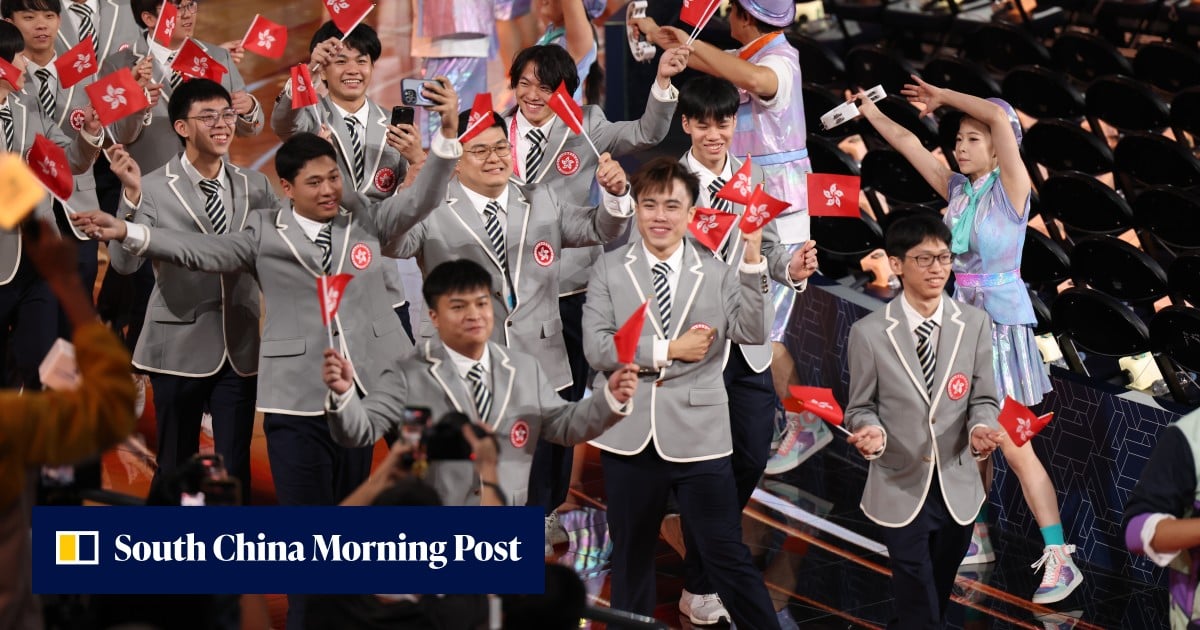
Hong Kong has sent its largest construction squad to WorldSkills, where nine young competitors are putting their trades to an international standard while offering a glimpse of how careers in the industry are changing
3-MIN READ3-MINAdvertising partnerPublished: 5:10pm, 23 Sep 2026[The content of this article has been produced by our advertising partner.]
Some former CIC competitors have returned to construction sites, stayed at HKIC as skills ambassadors or started businesses of their own, including former welding competitors. Among this year's nine competitors, very different paths have led to Shanghai.
A different path into construction
Huang Tsz-ho was studying social science at university when he put his degree on hold for a year and turned to joinery.
With no family tradition in the trade, Huang had encountered woodworking before, became interested and searched online for courses. When the opportunity to compete came up, he decided to see how far he could take the craft.
Practice could run for more than 10 hours a day. Among the hardest demands is interpreting technical drawings at speed. Shortly before competition begins, competitors can be given dozens of pages of dimensions, structures and assembly details, with about an hour to absorb the information before work starts.
The hours have changed how he approaches work. “I used to find it hard to stay on one job,” Huang said. “Now I can keep at it.”
Tse Yu-lok, Hong Kong's welding competitor, took another path. Already working and with welding experience, he entered the local selection competition and earned his place in the squad.
Pipe welding is among the more demanding parts, he said. “If the method is right, you don't need force. Pipes are harder.”
Competition welds are subjected to X-ray inspection, making quality beneath the surface particularly important to the score.
Preparation has included mock competitions, physical conditioning and sessions with a psychologist. Two days before the squad left for Shanghai, previous welding representatives also medallion, returned to share their competition experience and talk Tse through what to expect.
Training against the world
Preparation began roughly two years before Shanghai.
What impressed Cheng was sometimes less about the workbench than what happened around it. At some camps, competitors were up at 7am and training until 10pm. Young people once reserved or uncertain about their prospects gained confidence as their work improved, he said, making the experience more valuable than winning a medal.
Parents seeing the team off for Shanghai suggested attitudes were changing too. Cheng believes more families are coming to regard skilled construction work as a career with opportunities for advancement.
The jobs awaiting them are changing as well. Some construction operations can already be controlled remotely, while off-site production has changed where and how certain tasks are performed. Manual skills may therefore be the starting point for a career that increasingly embraces technology.
Teaching the machines
That connection between established skills and new technology was also apparent at the WorldSkills Expo, where the CIC presented an AI assistant for construction safety, MiC tracking and sensing systems, a remote-controlled tower crane, a welding robot and S960 ultra-high-strength steel.
Cheng sees craftsmanship and automation as complementary. Robots can handle repetitive tasks, but someone who understands the trade still has to teach a robotic arm how to work or an automated spraying system how material should be applied.
Over the next five years, he wants HKIC to train what he calls construction's “special forces”: tradespeople who can work with their hands, operate robots, read BIM models and provide the knowledge needed to train AI systems.
A career with somewhere to go
CIC has participated in WorldSkills since 1997 and received seven Medallions for Excellence, including two at Lyon in 2024 in joinery and welding.
Shanghai also provides a chance to compare training with international standards. Cheng has arranged discussions with specialists from countries including Korea and Canada on vocational education and career progression, bringing lessons back to Hong Kong on how young tradespeople can advance.