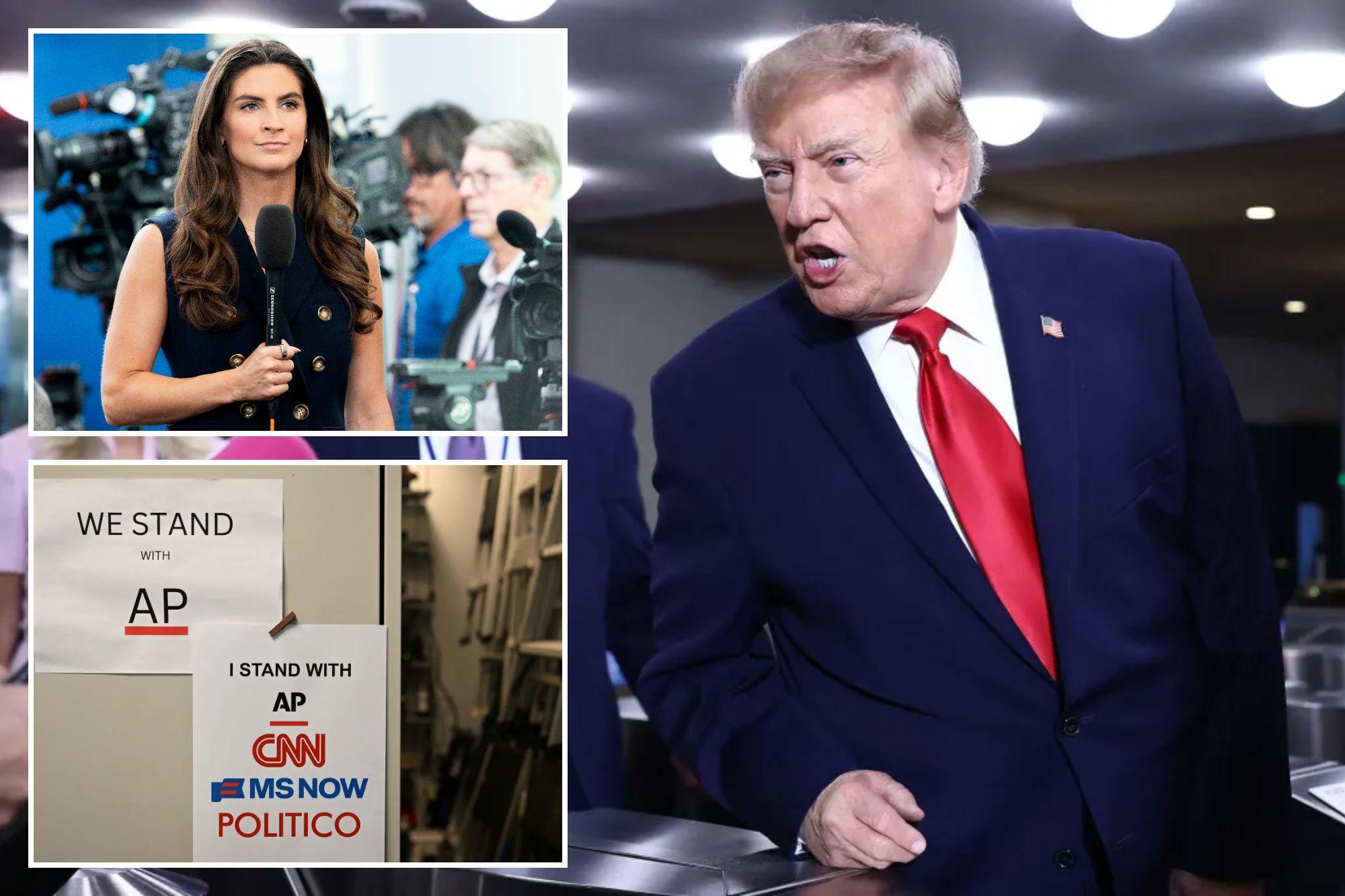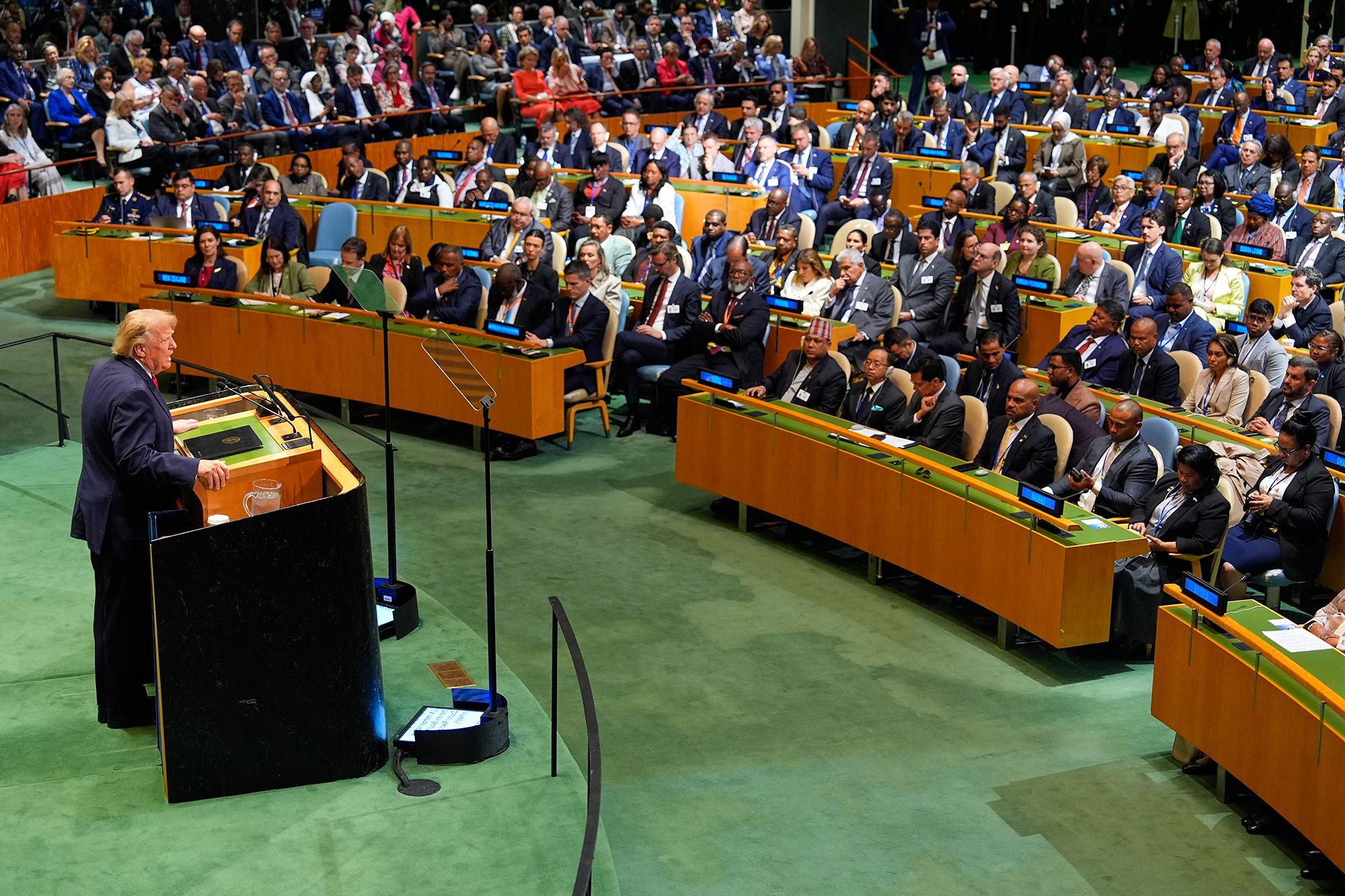
President Donald Trump speaks during the 81st session of the United Nations General Assembly at United Nations headquarters, Tuesday, Sept. 22, 2026. AP Photo/Yuki Iwamura See more of our coverage in your search results.
Add The New York Post on Google People not fully schooled in the ways of Donald Trump might have expected to watch a somewhat chastened and shrunken president address the United Nations Tuesday morning.
After all, the war in Iran has fallen far short of his promise of a quick and decisive victory.
And because the American economy has been battered by rising prices on food, fuel and pretty much everything else, polls are unanimous in saying the president is hemorrhaging support and predicting his party will get thrashed in the midterm elections.
But the Trump who spoke for almost 40 minutes from the General Assembly podium was anything but chastened and shrunken.
With the world’s eyes on him, he was as bullish as ever on America, the war against Iran and the distinctive differences his presidency has achieved at home and around the world.
In a key sequence aimed at both domestic and foreign audiences, he boasted that “While others have ignored threats, I have confronted them. While others have talked of courage, America has shown it. While others have promised strength, I have used it to make America the most powerful country in the world.”
He added that, while “Working with many nations in this room, we are solving decades of intractable challenges — and we are settling years of unfinished business.”
As sweeping as those claims were, they mere prelude to his main point: that Iran was and is the best example of a dangerous problem that gathered strength because others refused to stop it.
It was the first of many direct punches he would throw at his Oval Office predecessors, the UN and its members.
After correctly calling Iran “the world’s number one sponsor of terror,” he said, “From the first day I entered the political arena, I have been unwavering — I will never allow Iran to have a nuclear weapon.”
The boast has the advantage of being absolutely true because Iran and its terror proxies were main targets of his first campaign and first term in the White House.
At the time, the Islamist regime had reached the zenith of its power after gaining money, momentum and weaponry during the two terms of Barack Obama.
One of the permanent stains of his tenure is that Obama crafted a weak deal with the murderous mullahs that actually helped to fund their quest for nukes and their terror proxies.
Unfortunately, Trump is also right when he says that he and America largely stood alone when he took the oath in January of 2017.
From there, in a kind of confession, he added that he now has another big decision to make:
“Will a deal be made with Iran that lets them rebuild and create a far greater country than it ever was before, maybe one of the greatest in the Middle East or even the world?” he said.
“Or do I annihilate the Islamic Republic and do it quickly, never giving them a chance to kill and destroy people and countries again? Do I drive them into hell with no chance of survival and no hope of future greatness or generations?”
That, to put it mildly, is not the kind of brutally honest talk usually spoken in the halls of the East Side puzzle palace.
Moreover, Trump followed with another surprise: “I believe we’ll make a deal, right after the election,” he said of Iran. “Because it doesn’t make sense for them not to. They’re waiting to see how I do on the midterm election. What they don’t realize is that I’m not running.”
As if on cue, the president’s team said later that envoys Steve Witkoff and Jared Kushner had met with Iranian officials for three hours on the sidelines.
Trump told reporters it “was a very good meeting.”
Additionally, Secretary of State Marco Rubio confirmed it was possible Trump would meet with Iranian President Masoud Pezeshkian, who along with foreign minister, Abbas Araghchi, is in New York for the opening session.
“The president is open to a meeting with anybody,” Rubio told Fox News.
As I wrote Sunday, that with Trump and the Iranian leaders in the same building, it’s almost impossible to imagine he wouldn’t want and get a face-to-face meeting.
Trump has never met either man, but the author of the “Art of the Deal” retains the utmost confidence in his ability to settle disputes, in real estate and matters of war and peace.
Although Rubio’s comments fuel the notion the president wants a quick end to the war, Trump, by raising the possibility that a settlement might not happen until after the election, aims to buy himself political space at home.
So, too, does his decision to explain to the world audience why he launched the war in the first place.
“We are settling years of unfinished business. And we’re doing it well. There is no better example of a danger that was allowed to gather strength at the world’s peril than the number one sponsor of terror, the Islamic Republic of Iran,” he said.
“After giving Iran every chance for a deal, I took action to ensure that neither the United States nor any nation . . . would ever have to face such a nightmare.”
It underscored his role as commander in chief, but I found it striking that he did not mention that the US had partnered with Israel in the current war and in the 12-day conflict last year.
Most notably, however, Trump did reference both the 25th anniversary of 9/11, and the Hamas invasion of Israel on Oct. 7, 2023, as evidence that terrorism remains a threat to civilized nations everywhere.
He also recounted the back and forth in recent months since the cease-fire was reached in late April.
Ever since, Iran has continued to target our Arab allies in the region, several of which are home to American military bases.
The president’s central point was that he has offered Iran many opportunities to end the conflict, but has found no partner for peace.
Although he professes not to care about the impact on the midterms, Trump knows that a Democratic sweep of Congress would tie his hands for the remaining two years of his term.
It would also bog him down in probes of his family’s fishy business dealings and could lead to impeachment charges.
On the other hand, settling the Iran conflict could serve as an insurance policy for the next two years and his legacy.
Most significantly, a lasting truce would drive down oil prices, which would instantly lift the economy, both at home and globally.