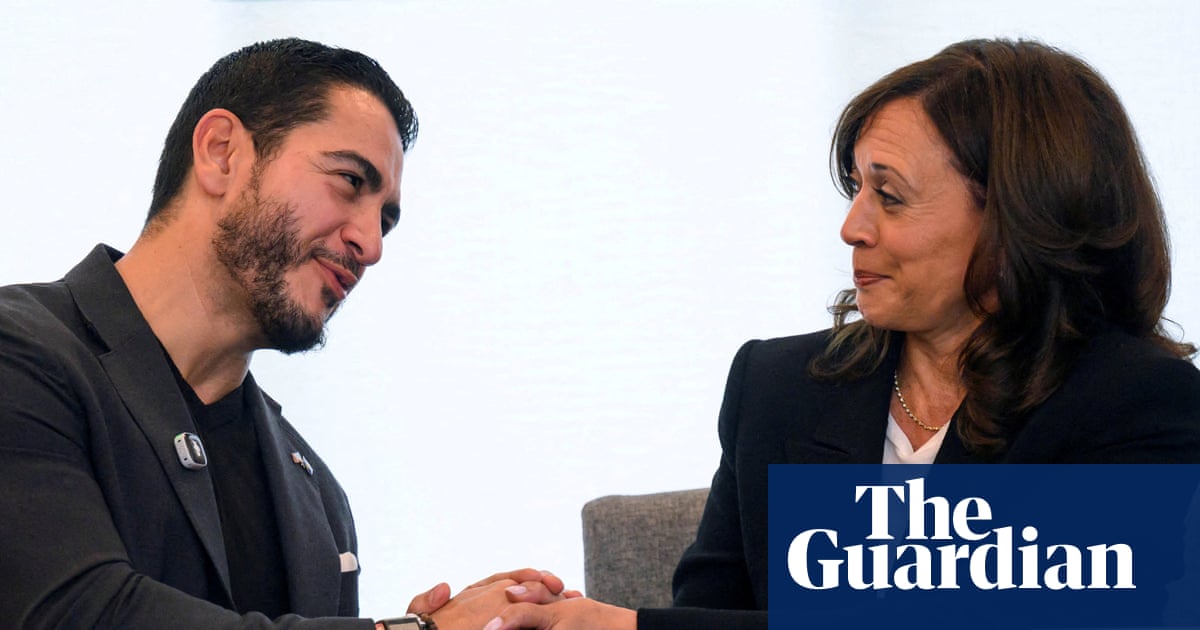
Abdul El-Sayed and former vice-president Kamala Harris in a roundtable discussion on reproductive health in Detroit, Michigan, on 22 September 2026. Photograph: David Guralnick/ReutersView image in fullscreenAbdul El-Sayed and former vice-president Kamala Harris in a roundtable discussion on reproductive health in Detroit, Michigan, on 22 September 2026. Photograph: David Guralnick/ReutersKamala Harris returns to Michigan to campaign for Abdul El-Sayed for Senate Former VP, who lost state to Trump in 2024 elections, is lending her popularity to unite fractured party
Kamala Harris returned to Michigan on Tuesday to campaign for Abdul El-Sayed, lending her popularity among Black voters to a progressive Senate nominee still working to unite a party fractured by a bruising primary – and the former vice-president’s loss to Donald Trump in the state.
Appearing with El-Sayed at a Detroit birth center, Harris used a roundtable on Black maternal health to frame that November’s contest against the Republican Mike Rogers as a fight over women’s access to care.
“Medicaid is the largest funder for maternity care in America. Donald Trump cut Medicaid funding by a trillion dollars,” she said, hammering Rogers for his support of the president’s agenda.
Harris also criticized the Trump administration for halting federal research funding it classified as diversity-related, including studies of fibroids and said the Senate should act as a check on the White House.
Read more“The United States Senate should be a stopgap on the abuses of this administration and I would suggest to you that the fellow sitting to my right would be one of them when elected,” Harris said, nodding to El-Sayed. The crowd murmured in agreement.
El-Sayed, a physician, thanked Harris for “uplifting the issues that we are here to talk about today”, adding his gratitude for her work on them.
The senate seat is open following the retirement of the Democratic senator Gary Peters and holding it is a must for the party’s path to a Senate majority. But even with a win in Michigan, Democrats would need to flip at least four Republican-held seats to control the chamber for Trump’s final two years in office.
El-Sayed, who backs universal healthcare and sits to the left of his party’s leadership, narrowly defeated the congresswoman Haley Stevens in August, following a bitter primary that divided key constituencies. Black voters in Detroit, the backbone of the Democratic coalition in the state, tended to favor Stevens, and Rogers has also been courting them in the city.
The joint appearance also papers over a rift between the Democrats. El-Sayed has called Israel’s military campaign in Gaza a genocide, a sharp break from the Biden-Harris administration’s military support for Israel, but a position that puts him in step with a growing share of the electorate.
A Quinnipiac University poll released this month found 38% of voters more sympathetic to Palestinians and 35% to Israelis, the highest share siding with the Palestinians since the university began asking the question in December 2001.
In Michigan, home to a large Arab American community, that shift has already shown up at the ballot box, and El-Sayed was part of it. In 2024, he backed the “uncommitted” movement, which urged Democrats to withhold their primary votes from Joe Biden in protest at US military aid to Israel. He endorsed Harris when she replaced Biden as the nominee later that year. Many of the movement’s supporters did not follow him and the state narrowly went to Trump.
The trip also comes amid speculation about Harris’s own political ambitions, as she mulls whether to run again for the White House. Michigan is set to hold the fifth contest on the Democrats’ revised 2028 primary calendar and Harris has further campaign stops planned in Nevada and Georgia.
Closing her remarks, Harris urged the room to remind voters “that they have power and voice in the outcome of this election, which will directly impact their lives in many ways”.