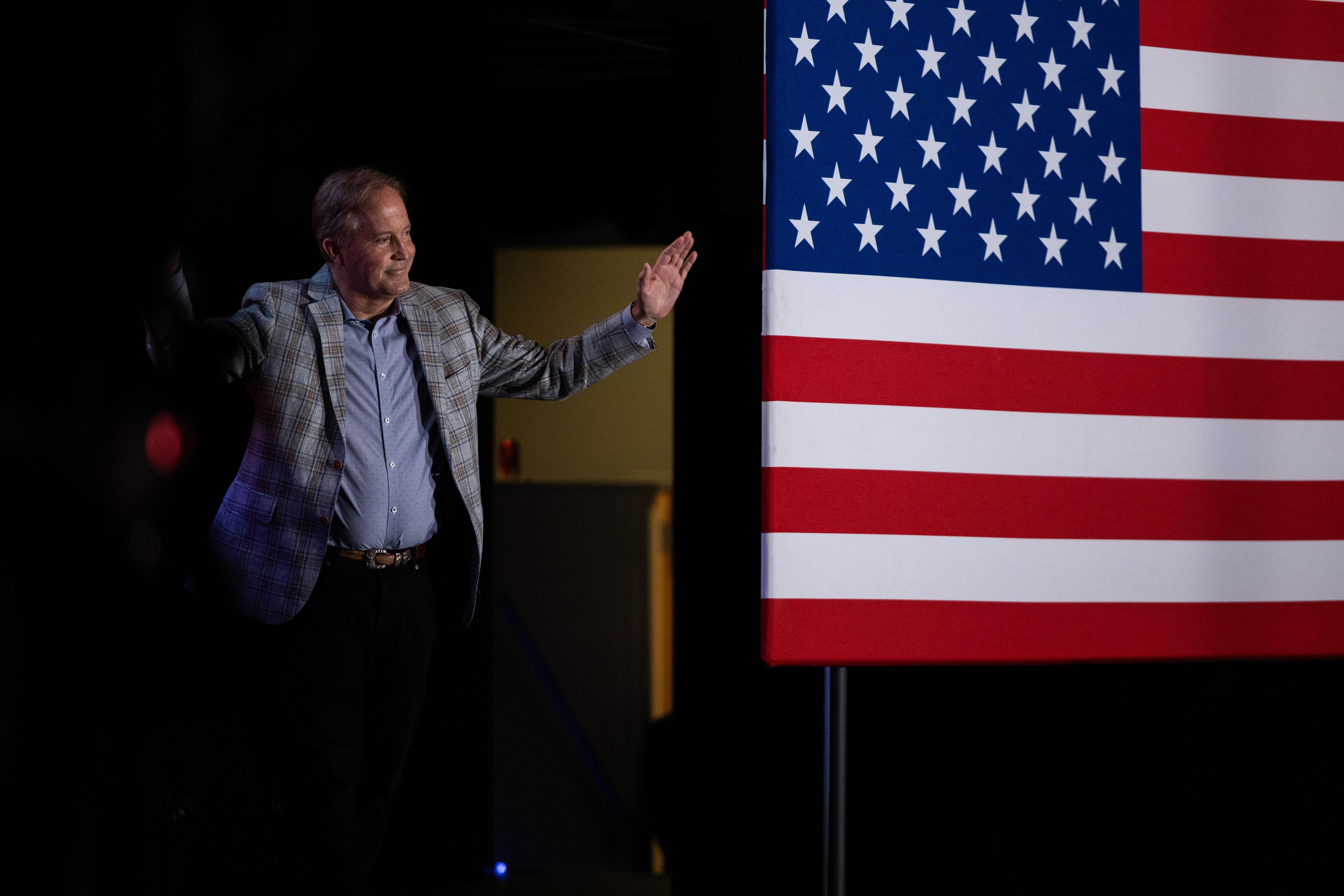
Texas Republican Senate candidate Ken Paxton greeting the crowd at a campaign stop in Houston on Sept. 21, 2026. Photo by Antranik Tavitian/Getty Images See more of our coverage in your search results.
Add The New York Post on Google This year’s midterms don’t just pit Democrats against Republicans — they also set Republicans against Republicans, and have Democrats at war with Democrats.
The coalition that better holds together is the one that will win control of the Senate.
Republicans have only a slim chance to keep the House of Representatives, but they head into November with a modest three-seat majority in the upper chamber — really a four-vote margin, since Vice President JD Vance would be the tiebreaker in a 50-50 split.
Headlines have been filled with tales of Republican infighting lately, but polls tell a more complicated story.
Democrats are having a tough time securing their leads in states like Minnesota and Michigan, while Republicans look anemic in GOP bastions like Kansas, Iowa and even Texas.
Some of these developments are so surprising, the first reaction is to think the polls must be wrong — and they often are.
But Michigan and Texas provide two clear pictures of intra-party turmoil, as Democrats drift toward the Democratic Socialists of America while Republicans settle scores between MAGA and the party’s old guard.
For Team Blue, Michigan should hardly be competitive right now: Democrats have held the Senate seat that’s at stake there since 1979.
Yes, President Donald Trump won the state in 2024, but midterms typically go against the president’s party, so Democrats ought to have an easy time retaining the seat Carl Levin and Gary Peters have kept in the party since Jimmy Carter was in the White House.
Yet recent polls have Abdul El-Sayed up only 2 percentage points over Republican Mike Rogers.
The Democrat’s troubles begin in his own party: Though polls predicted a double-digit primary win for El-Sayed, he finished less than a single point ahead of rival Haley Stevens.
Black and Jewish Democrats remain hesitant to back him even now.
Many black voters haven’t forgiven his unwillingness to support Kamala Harris in 2024, while his eagerness to accuse Israel of genocide and his association with leftist podcaster Hasan Piker trouble Jewish Michiganders.
Democrats alarmed by avowed socialists’ encroachments into their party also have reservations about El-Sayed, and Rogers is laboring to breach the partisan divide to bring these doubting Dems over to the GOP.
Yet Republican unity is brittle too, not least in the red state Democrats covet most: Texas.
The Lone Star State’s Senate race is as tight as Michigan’s — and in Texas, too, the Democrat leads the polls.
James Talarico is helped by the fact that the incumbent Republican, Sen. John Cornyn, is a sore loser who won’t lift a finger to help the man who beat him in the GOP primary, state Attorney General Ken Paxton.
Cornyn hasn’t actually endorsed Talarico, though his former deputy legislative director has signed on as the Talarico campaign’s deputy policy director.
But the old-guard Republican, who doesn’t vacate office until January, has become increasingly outspoken against other members of his party, including Vance, the heir apparent to the MAGA movement come 2028.
“The extremes of both parties — Republicans’ MAGA wing represented by JD Vance and the progressive left represented by Zohran Mamdani — have drawn closer to each other,” Cornyn posted on X, summarizing, and evidently endorsing, one journalist’s account of the “horseshoe theory” of left-right convergence.
Indeed, Cornyn’s view is more popular among pundits than with voters, to judge not only by his own fate at the ballot box but also by the drift of longtime center-right columnists like George Will.
Will recently went as far as to endorse the Democrats’ Senate nominee in South Carolina, Annie Andrews, against Republican Darline Graham.
There’s a different kind of horseshoe there, as one of the last century’s most prominent Republican-leaning pundits now takes the same side as El-Sayed in working to give Democrats control of the Senate.
At 85, Will is old enough to know political parties are a package deal, and empowering a South Carolina Democrat means empowering radicals like the party’s Michigan nominee too.
Trump triumphed two years ago because he did the opposite of Will: He kept the GOP intact despite its tensions, accepting old-guard fixtures as well as MAGA newcomers, and even expanding the coalition to include ex-Democrats like Robert F. Kennedy Jr.
Trump hesitated to endorse Paxton over Cornyn this year — and only did so once it was absolutely clear which way Texas Republicans intended to go.
Cornyn and Will, in the end, don’t have a problem with Trump.
They have a problem with Trump voters: ordinary Republicans, conservative Americans.
Trump’s talent for addition and multiplication is what the GOP needs to beat the odds in November.
Old-guard stalwarts who aren’t bitter and MAGA insurgents who aren’t mindless provocateurs can work together, and work out their differences later.
Will’s and Cornyn’s way leads straight to a Democratic Senate — and Sen. Abdul El-Sayed.
Daniel McCarthy is the editor of Modern Age: A Conservative Review.