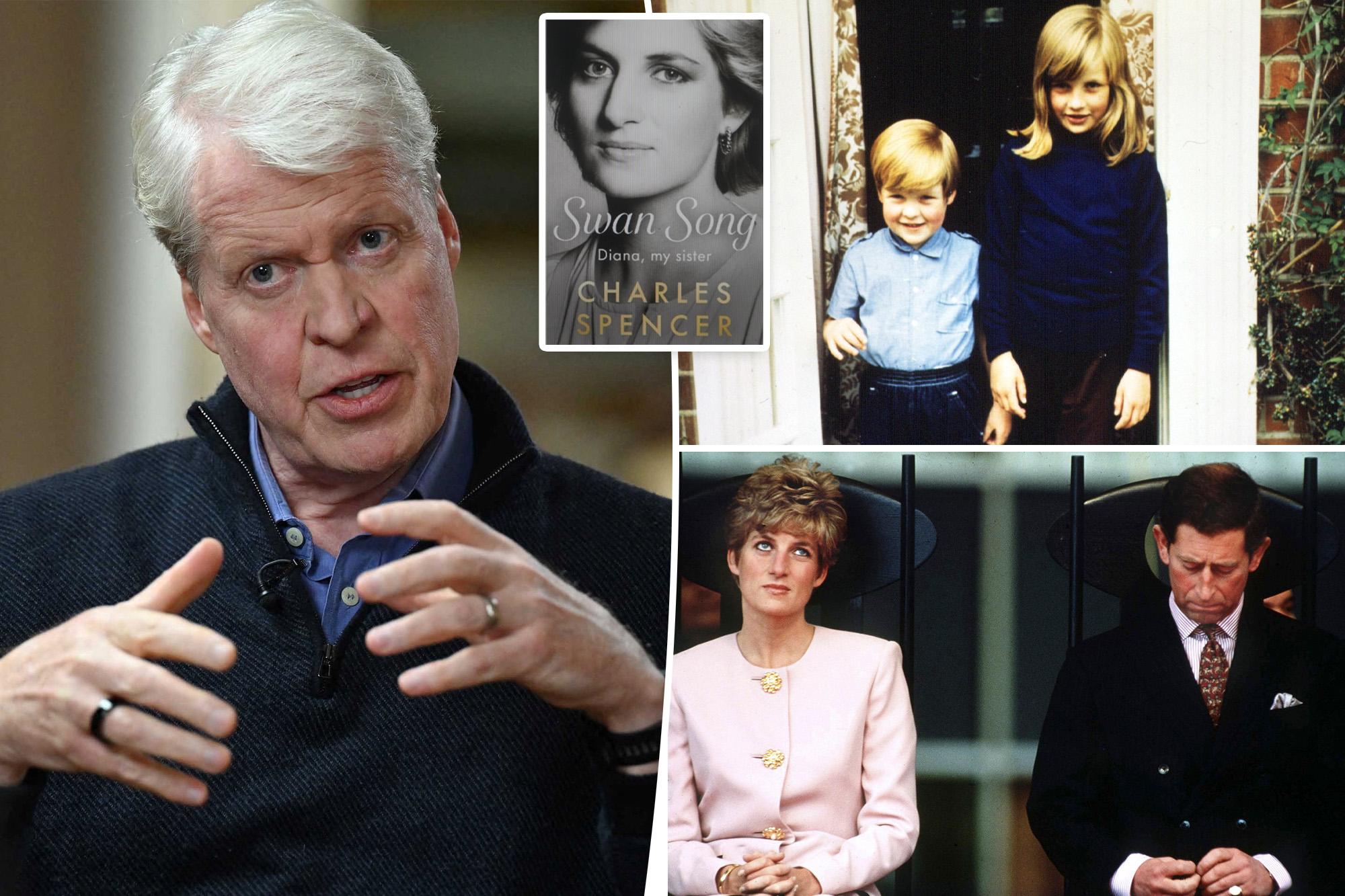
Add Page Six on Google Charles Spencer is spilling the royal tea.
Princess Diana’s younger brother’s book, “Swan Song: Diana, My Sister” is out today, in which he makes multiple bombshell claims about the royal family — particularly, about King Charles III’s allegedly callous treatment of his ex-wife and how he reacted to her tragic death.
Before the book’s release, Charles released a harsh statement about the tome, saying that grief had clouded Spencer’s judgment and memory.
“His Majesty is mindful that the pain of fraternal grief can cloud reason, affect judgment and color memory in ways others do not recognize, even many years after such a loss,” a rep told Page Six.
Read on for the biggest bombshells in Spencer’s book.
Spencer claims that growing up, he and his sister had two physically “abusive” nannies, whom they never reported to their parents — dad John Spencer, the 8th Earl Spencer, and their mom, Frances Spencer.
He claims one nanny would strike their outstretched palms with a wooden spoon, while another nanny — whom he deems the worse of the two — would sometimes smack their heads against a concrete wall outside the nursery bathroom.
“The result was dizzying, throbbing pain and bewilderment,” he writes.
Still, he says he and Diana were not “broken by the cruelty” and continued to be “strong-willed children.”
Spencer alleges that Charles “sounded giddily elated — like a lottery winner” during a shocking phone call he had with him after Diana had died from a car crash in Paris, France, in 1997.
Spencer claims that Charles also sounded “strangely matter-of-fact” when he informed him that he had already told his and Diana’s children, Prince William and Prince Harry, the heartbreaking news of her death.
“Looking back now, I suspect the prince’s first reaction must have been to think more of how this event might free him to marry the woman he loved, rather than appreciating the loss of one he did not,” Spencer writes, referring to now-Queen Camilla, whom Charles wed in 2005.
According to Spencer, his and Diana’s father initially had a “romantic connection” with Charles’ mother, Queen Elizabeth II, before the late monarch eventually married Prince Philip in 1947.
He alleges that the romance was ended by Lord Mountbatten — Philip’s uncle — who personally told his father to end the “nonsense” immediately.
“Perhaps Mountbatten was clearing the way for his nephew, Prince Philip,” he writes.
Spencer claims that his father stepped aside as commanded, but afterwards, “loathed Mountbatten with a passion.”
Spencer claims that much like Charles’ alleged cold response to Diana’s death, Elizabeth’s first reaction to Diana’s car accident was, “What is she up to now?”
The Queen had allegedly not yet learned she had passed away when the comment was made.
Want more celebrity and pop culture news? Start your day with Page Six Daily.
Spencer writes that some people close to Charles claim he wanted Elizabeth to abdicate the throne because he was frustrated at “being a middle-age man still wanting to reign.”
He claims that as a result, there was tension between Elizabeth’s staff and Charles’ staff during Diana’s funeral.
Spencer also alleges that on the day of his dad’s funeral, Charles told him he was “lucky” that his father died early. John died at age 68 of a heart attack in 1992.
He alleges Charles told him during an akward conversation, “You’re just so lucky — you know, inheriting when you’re so young!”
He claims Charles then proceeded to throw a tantrum about his parents treating him like a child despite him being 43 years old, even allegedly stomping his foot in emphasis.
Spencer claims Charles later threw another tantrum years later over him not wanting William and Harry to walk behind Diana’s coffin at her funeral, which Charles wanted them to do.
He claims they had an angry phone call, in which he accused the Spencer family of having “no sense of duty.”
“He unleashed down the phone what I have always taken to be his pent-up contempt for Diana, and his horror that the world was so bowled over by her death,” Spencer writes. “’Rest assured,’” he hissed, ‘we’ll forget her soon enough!’”
William and Harry were 15 years old and 12 years old, respectively, at the time, and ended up walking behind their mother’s coffin alongside Charles, Spencer and Philip.
Spencer says the last time he saw Diana was on her 36th birthday, when they ran into each other unexpectedly while having dinner at London’s Tate Gallery.
He writes that earlier that day, Diana made a comment about her home looking like a funeral parlor after a family member gave her flowers for her birthday.
He recalls Diana joking, “I’ve been so lucky! My house is so full of gorgeous flowers that the place looks like a funeral parlour!”
Spencer then observes, “Now here I was, just two months later, trying to write something suitable for her funeral.”
Spencer writes Diana was heartbroken when it became obvious Charles did not love her ahead of their wedding day.
He alleges that during Charles’ younger brother Prince Andrew’s 21st birthday celebration, instead of Charles spending time with her, he ignored her, leaving Diana “deeply hurt, confused and increasingly concerned.”
After the party, Spencer claims Diana told their dad that she could not marry Charles when he obviously didn’t love her, but he told her it was impossible to pull out at that point.
Later, Spencer alleges that Diana confided in a close friend that the day before her 1981 wedding to Charles, her husband-to-be bluntly told her that while he was happy to marry her, he was not in love with her.
“Diana had to absorb that hammer blow while also feeling certain that Prince Charles was entering their marriage with his heart elsewhere,” he writes.
Spencer muses that like him, his sister suffered from Rejection Sensitive Dysphoria (RSD), which he describes as intense emotional pain at being rejected or criticized.
He notes that negative tabloid reports greatly affected her and claims that in her later years, she drove herself multiple times to Beachy Head, the highest cliff in England, “while contemplating ending it all.”
He says her love for her sons is what stopped her.
Aside from Spencer believing Diana had undiagnosed RSD, he also says he’s “convinced” she had Attention-Deficit/Hyperactivity Disorder (ADHD).
He notes that Diana struggled with learning difficulties in the classroom growing up, but was never tested for anything.
He writes that as early as kindergarten, her teacher noted that she had a short attention span and was unable to focus. He says that her later teachers made similar observations about her, noting she had difficulty concentrating which “hampers her progress.”
Spencer alleges that Diana was so angry that their dad married his second wife, Raine McCourquodale, that she slapped him in the face.
According to Spencer, he and Diana had accepted their dad’s previous girlfriends after their parents divorced in 1969, but they “intensely disliked” Raine, whom he calls a “gold-digger.”
He alleges that after Diana found out about the 1976 secret marriage from reading a newspaper, she slapped their dad and said, “That’s for the pain you’re causing us all” — referring to her and her siblings.
Spencer alleges that after their dad suffered a stroke in 1978 and his health deteriorated, their stepmom blocked his children from him, instructing his nurses to stop them from seeing him.
Though he doesn’t name names, Spencer says Diana told him that “one of her powerful, ageing American suitors” wanted her as the ultimate trophy wife.
The politician allegedly told Diana that he for sure would win the presidency if she married him.
Charles writes that Diana was “titillated” by the idea of possibly becoming the First Lady of the US more than she was excited about the “elderly” man trying to win her affections.
Spencer claims that a friend who runs a PR agency told him that one of Charles’ right-hand men frequently asked him to spread lies about him to newspapers.
He also accuses a powerful editor of encouraging the outlet as well as other newspapers to attack him with negative press any chance they got.
Spencer says the stories damaged his reputation to the point where he repeatedly thought about suicide.
He writes, “I fell back on one thought: Diana had had it much, much worse, and she had kept going.”
After Charles, 77, hit back the allegations in the book, Spencer, 62, doubled down on his claims in his interview with the BBC, insisting he’s “telling the truth” about Charles’ alleged reaction to Diana’s death.
“I can tell you here and now, those are exactly the words he said,” he stressed.
“I was hyper alert to what he was saying and those are precisely the words that he said and I promise that to you now. Genuinely, that is what he said. I don’t hear him saying he didn’t say that.”
Your voice matters. Discussions are moderated for civility. Read our guidelines here
Community Guidelines Welcome to the Page Six Community! Our community is about connecting people through open and thoughtful conversations. We want our readers to share their views and exchange ideas in a safe space.
In order to do so, we've created a simple set of rules that will improve your experience.
Your post will/might be rejected if it contains:
User accounts will/might be blocked if we notice:
Thanks for reading our community guidelines. Don't forget, freedom of speech is not the freedom of reach!