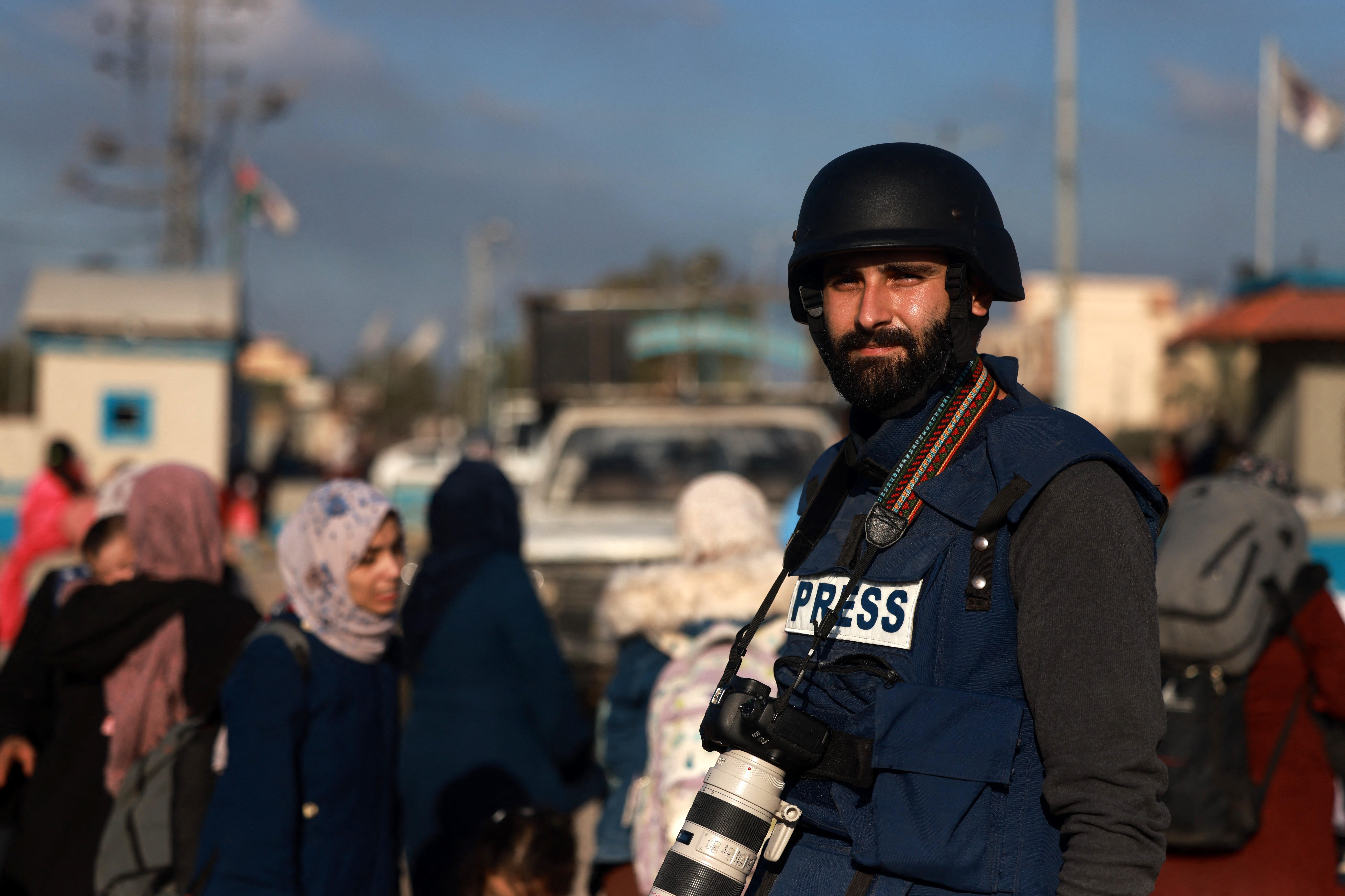
Palestinian photojournalist Motaz Azaiza, who has been documenting the impact of the war between Israel and the Hamas group in the Gaza Strip, stands in a street in the central part of the Palestinian territory on December 18, 2023. AFP via Getty Images See more of our coverage in your search results.
Add The New York Post on Google Journalist Motaz Azaiza’s new revelations exposing “SMART,” a Hamas-controlled group of reporters used to manage the media narrative about Gaza, reveal uncomfortable but important truths about nearly two decades of journalism.
The world has relied on a media ecosystem that forced journalists to operate within red lines set by Hamas — under threat of punishment if their coverage ever crossed the terror group.
That reality was too often lost by the time Gaza’s stories reached Western TV screens and newspaper pages — and it drove college-campus protests and breathless claims by so-called activists, as false allegations emerging from the coastal enclave were repeated as unquestioned facts.
But Azaiza’s revelation should come as no surprise: Ever since its violent takeover after Gaza’s 2007 civil war, Hamas has tightly controlled the narrative to influence the story that reaches the outside world.
Its goal has been to shape positive coverage of its iron-fisted rule and to legitimize its narrative of “resistance” — that is, violence against Israel.
In 2013, Hamas’ Interior Ministry brought Gazan journalists and social-media activists together for a workshop, coaching them on how to report news in Gaza.
Among the attendees was Abu Ubayda, Hamas’ infamous military spokesman and one of its most prominent propagandists, who was eliminated by Israel in 2025.
Hamas made it clear during the session that the press’ role is “no less important than that of the resistance on the ground.”
But the message was not only one of encouragement: The terror group made it clear that reporters would pay a steep price if they did not adhere to the Hamas line.
In 2016, Hamas arrested Mohammed Othman, a journalist working for al-Monitor, for exposing medical errors occurring in Gaza’s hospitals. Hamas later barred him from entering those facilities.
In 2019, Hamas detained 12 journalists for covering protests against Hamas’ rule and the economic situation in Gaza.
The repression of reporters hasn’t eased after Oct. 7, 2023, or during the war that followed.
In at least three cases during the war, Gazan journalists said Hamas fighters beat them or threatened them after they reported on locals who blamed the terror group for bringing destruction to Gaza.
The journalists said Hamas explicitly ordered them to stop reporting on local discontent.
It was intended to keep those voices from reaching international audiences, to preserve Hamas’ narrative that Israel alone was to blame for all Gaza’s problems, and to silence any Gazan saying otherwise.
That is what makes Azaiza’s account significant.
Beyond shaping the media reality in Gaza, reporters’ self-censorship distorted the picture the outside world saw.
Western media outlets relied heavily on local journalists for on-the-ground reporting, while often missing a crucial reality: Any criticism of Hamas was unlikely to make it on camera, and who feared crossing the terror group meant basic facts became hard to document.
By the time their material reached international newsrooms, the intimidation and coercion that shaped the information-gathering the information had all but vanished.
And the self-censorship hasn’t been limited to Gazan journalists: Regional Arabic outlets have done the same.
Al Jazeera has repeatedly cut off Gazans who criticized Hamas on air — hardly a surprise, given that Qatar, a financial sponsor of Hamas, owns Al Jazeera.
Israel has since revealed that several Al-Jazeera employees in Gaza were Hamas fighters masquerading as journalists.
The Qatari-funded network has long taken guidance from Hamas on how to cover Gaza.
A 2022 document showed how Hamas instructed Al Jazeera to lie about a failed rocket launch that killed Palestinian civilians, telling the network to avoid the word “massacre” and steer clear of criticism of Hamas.
A 2023 document further showed that Hamas moved to create a secure line for classified communications between the network and the terror group.
For nearly two decades, Hamas has operated a media ecosystem based on fear.
Journalists learned what they could say and what they could film.
Western audiences rarely saw those constraints, and some ended up absorbing Hamas’ preferred narrative.
That should force a reckoning among the activists and celebrities who swallowed claims out of Gaza whole, without asking who controlled what could be reported.
And a looming question remains: How many US and international media outlets rely on SMART “fixers” — locals who arrange for meetings and translate Arabic to English — in their reporting?
Ahmad Sharawi is a senior research analyst at the Foundation for Defense of Democracies.