Add The New York Post on Google FAYETTEVILLE, Ga. — By any objective measure, Sebastian Berhalter is young. He’s 25 years old, young enough that if he had a career outside of soccer, it would be in its early stages.
His career has hit its stride only over the past year, during which he broke into the United States men’s national team, played in the World Cup and earned a move to England’s Middlesbrough.
But here among the squad Mauricio Pochettino called in for the national team’s first camp after the World Cup, Berhalter is old. Practically ancient, in fact. You could call this Camp Cavan — as in Sullivan, the 16-year-old headliner — but with 12 players on the 28-man roster too young to buy alcohol, that might come off as a tad exclusionary.
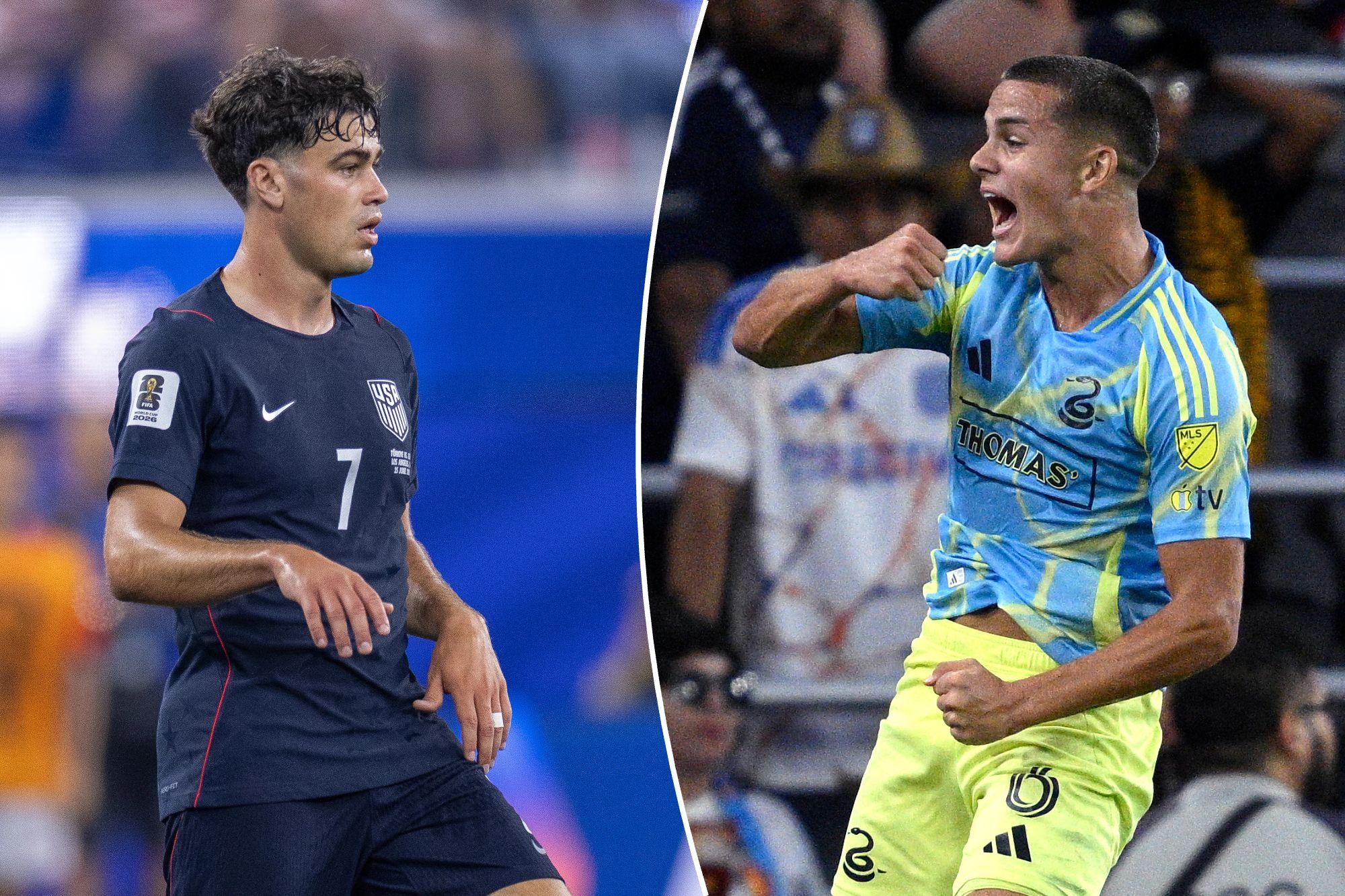
Cavan Sullivan (6) of the Philadelphia Union celebrates after scoring a goal against San Diego FC during the first half of a game at Snapdragon Stadium in San Diego, California, Sunday, Sept. 13, 2026. Getty Images The glut of teenagers meant that, when Berhalter and Gio Reyna sat for a news conference Monday morning, they did so as two of the older, veteran players in the group. That may sound strange no matter how many times one rereads it.
“I think older guy is actually a good way to put it,” Berhalter said. “I’ve only been part of the team for a year now, and it feels like I’m an older guy, which is crazy. It’s good. I think that’s something that I take in stride.”
Reyna, 23 years old with a career’s worth of narrative already in the books, was met with the particular oddity of watching striker Justin Ellis tell reporters in Orlando, Fla., that Reyna was his favorite player growing up.
Ellis, at 19, is only four years younger than Reyna but young enough to have been in middle school when Reyna was a highly touted prospect making his debut with Borussia Dortmund and with the national team. The two met for the first time after Ellis — who hopes to make his national team debut against Peru on Saturday in Orlando, where he has a goal and nine assists for Orlando City SC this season — arrived at his first senior U.S. camp.
“He’s a great kid,” Reyna said. “It’s nice to get to know him so far. It makes me feel a little bit old, but it’s nice to have a lot of [the young guys] here. Looking forward to getting to know them better on and off the field. Just here trying to help them. Show them what we’ve built and what we’re striving to build. Obviously, all of them are very, very talented, so we’re just here to help.”
Gio Reyna of the United States moves with the ball during the FIFA World Cup 2026 Group D match between Türkiye and USA at Los Angeles Stadium on June 25, 2026, in Inglewood, California. Getty Images While it is too early to make roster predictions for next summer’s Gold Cup, let alone the 2030 World Cup, certainly no competition will feature simply a redux of the 26-man group that reached the Round of 16 over the summer. The next generation will be given every chance to earn roles. The players who featured this summer will need to earn their spots again, not only against the young kids, but against the players they edged out to make the World Cup roster.
Sullivan will be the most closely watched and carry the highest expectations, but everyone is here for a reason. Every position group at this camp includes players who weren’t at the World Cup. After Ricardo Pepi had to pull out with an injury, all three strikers — Ellis, Julian Hall and Damion Downs — fall into that category, though Downs, unlike the other two, has senior caps to his name.
The teenagers will need to prove they can hang. The young veterans will need to prove they can help them do so.
“They need to know that the young players are going to see everything in the way that you move, walk, talk, behave — on the field and off the field,” Pochettino said. “That is why I think it’s a very important period for us, also, to observe if senior players are good role models for the young. If someone is not behaving well, not behaving in the way that we are expecting, that is going to have some consequences.”