There was a time when Werner Herzog making a documentary for National Geographic and Disney seemed like the longest bridge too far known to humanity, but, if we’ve learned anything by watching the inimitable filmmaker’s work, it’s that the world is a strange, strange place. Strange enough for Ghost Elephants (now streaming on Disney+), about an excursion deep into the Angolan bush for a theorized subspecies of massive pachyderms, to exist. Herzog follows South African naturalist Dr. Steve Boyes on a quest for even the briefest glimpse of what would likely be the largest living land animal on Earth, and in true Herzog fashion, they find more truth than scientific fact.
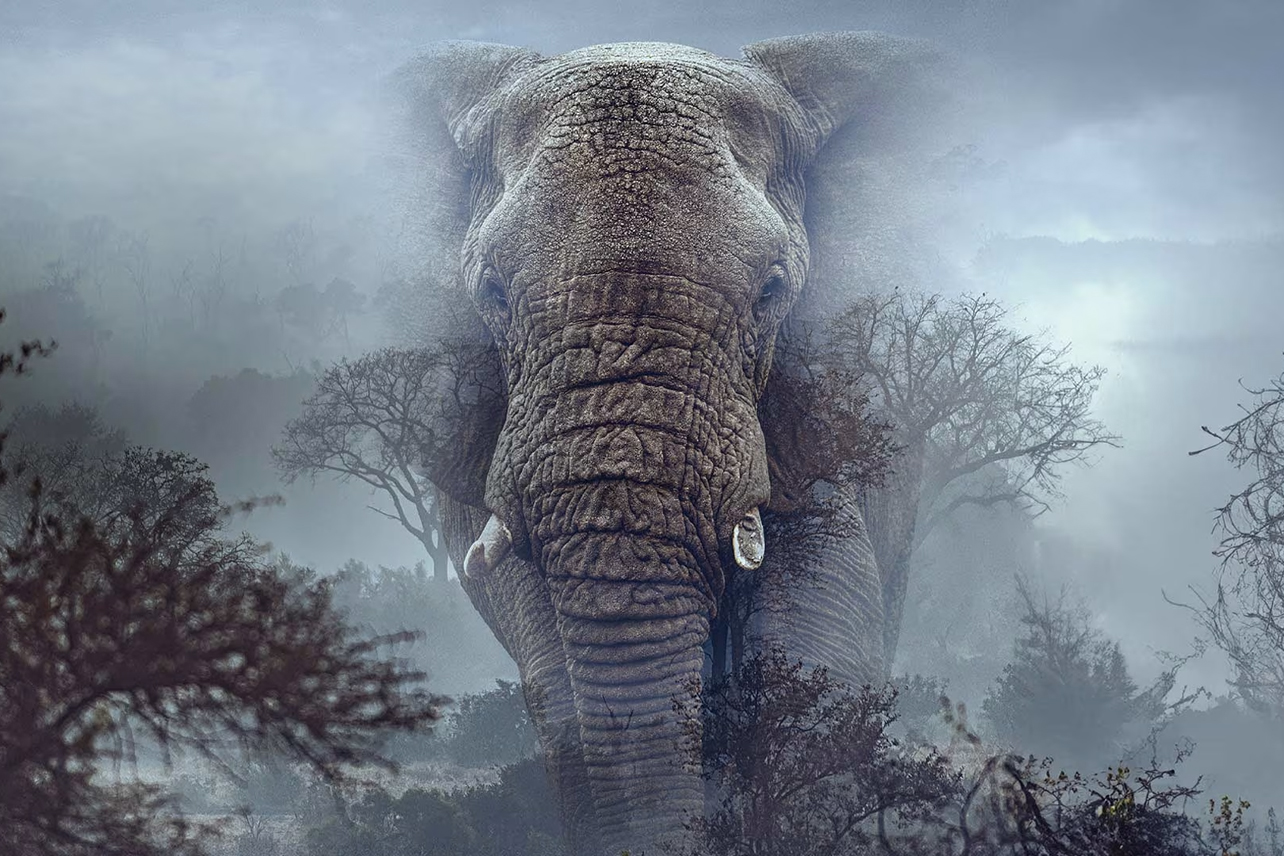
The Gist: Boyes stands in the Smithsonian in Washington, D.C., marveling at a replica of a massive elephant dubbed Henry. In 1955 in Angola, a big-game hunter shot and killed the animal, which measured 13 feet tall and 11 tons, the largest-ever elephant ever recorded; the bones were donated to the museum. Boyes believes the creature’s descendants, a possible goliath subspecies, roam the Angolan highlands, and for years the scientist has yearned to see one, study one, in any capacity. Assuming they actually exist, these “ghost elephants” are, despite their enormity, elusive. Boyes’ goal now is to retrieve a DNA sample from one of these elephants and compare it to the DNA of Henry and other elephants to suss out some data to support his – what is it exactly? A theory? A wish? A dream? A dream. Of course it’s a dream. Werner Herzog films are inevitably always about dreams.
Werner Herzog films are also inevitably about nigh-impossibilities. The region of Angola where Henry was murdered – I can’t help but use that word – is alarmingly remote, atop a sprawling plateau wetland that feeds Africa’s major waterways. Hundreds of previously undiscovered species live there. It’s dubbed “the water tower of Africa,” or, as some put it, “the source of life,” a descriptor so painfully elemental and therefore so painfully Werner Herzogian, I immediately took a knee upon hearing it. Navigating the bush requires assistance from Namibian trackers whose ancestors hail from the oldest human culture on record – a culture that believes elephants shed their skins and become humans. So, a quick inventory: An obsessive man seeking giant elephants that may or may not exist, in “the source of life,” where roamed the first-ever humans. There are precisely zero people on this planet who are surprised Werner Herzog is here to document all this.
As Boyes crews up guides and experts and assembles a convoy of trucks and motorcycles that will take everyone to one of the most remote locales on the planet, Herzog starts asking questions and observing. He’s among the best at both of those things. He quickly dispatches with Captain Ahab comparisons and prods Boyes to talk about the very nature of dreams, and what it might be like to chase an impossible one and actually catch it. What would be his purpose then? Herzog spends a lot of time with a Namibian tracker, Xui, who shows how he harvests specific beetle grubs to make poison for the arrows he uses to hunt antelope; once, Xui was infected with the poison and had to make a series of cuts all up and down his arm to bleed out the toxin so he wouldn’t die (it seems like a miracle he didn’t lose the appendage). The filmmaker observes the people of this land, their ancient customs and beliefs; he gets alarmingly close to a venomous spider with dozens of its offspring teeming on its back; eventually, the arduous journey leads to evidence of a very large elephant in the bush nearby, and closeup shots of elephant dung, the DNA from which might be as valuable as gold for Boyes’ dream.
What Movies Will It Remind You Of? Ghost Elephants is essentially a kinder, gentler Grizzly Man, with a far more hopeful conclusion.
Performance Worth Watching: Setting aside the hypnotic and beautiful intonations of Herzog’s (incredibly famous) narration, Xui emerges as a significantly charismatic figure, a key supporting figure who might deserve a documentary of his own.
Our Take: Herzog’s shrewd wisdom emerges in the architecture of this documentary – he’s all too aware that banking on a big third-act reveal is a low-percentage play that most often leads to disappointment. So he focuses on the journey, not the destination, his observations amounting to his distinct brand of what I like to call “spiritual science”: An hours-long fireside dance that puts its Namibian participants in a trancelike state. Sit-downs with an Angolan king, who desires reassurance that Boyes and his crew will respect the local customs, beliefs and the fauna with which his people feel a primordial connection. A dung beetle rolling off with a piece of Boyes’ DNA treasure. Images of Xui and his cohorts mimicking the actions of elephants, their elbows flapping like the animals’ ears, an arm curling like a trunk. A pithy observation of an old Namibian man who endlessly fiddles with an ancient musical instrument and lives a seemingly carefree life: “I know I shouldn’t romanticize him but, surrounded by chickens – it can’t get better than this!”, Herzog narrates, his gleeful tone straying from his usual existential ruminations.
His usual grim existential ruminations, I might point out – Herzog equating a life with chickens as bliss isn’t just an inside joke for his admirers, but a deviation from his stereotypical norms. Ghost Elephants is not one of Herzog’s portraits of hopeless futility. Not that his filmography is exclusively downbeat; for example, the documentary The Ecstasy of the Woodcarver Steiner, the story of a man who’s so good at ski-jumping, every time he zooms down the track, he risks killing himself by overshooting the landing area, is essentially about the ironies of greatness, about the extremities of human achievement, how the darkest corners of the human soul can also be filled with hope.
Hope, like that of Boyes, who Herzog captures observing a rainbow in gorgeous Angola. The scientist subsequently shares deep thoughts about dreams which, like ghost elephants, are simultaneously real and unreal, while rain begins to patter on his hat, an indicator that the treacherous rainy season is here and it’s time for this journey to end. In that moment, the definition of “success” for this quest seems remarkably fluid, maybe even irrelevant. No other documentary filmmaker would reach such a conclusion.
Our Call: Nobody makes documentaries like Herzog. Nobody. STREAM IT.
John Serba is a freelance film critic from Grand Rapids, Michigan. Werner Herzog hugged him once.