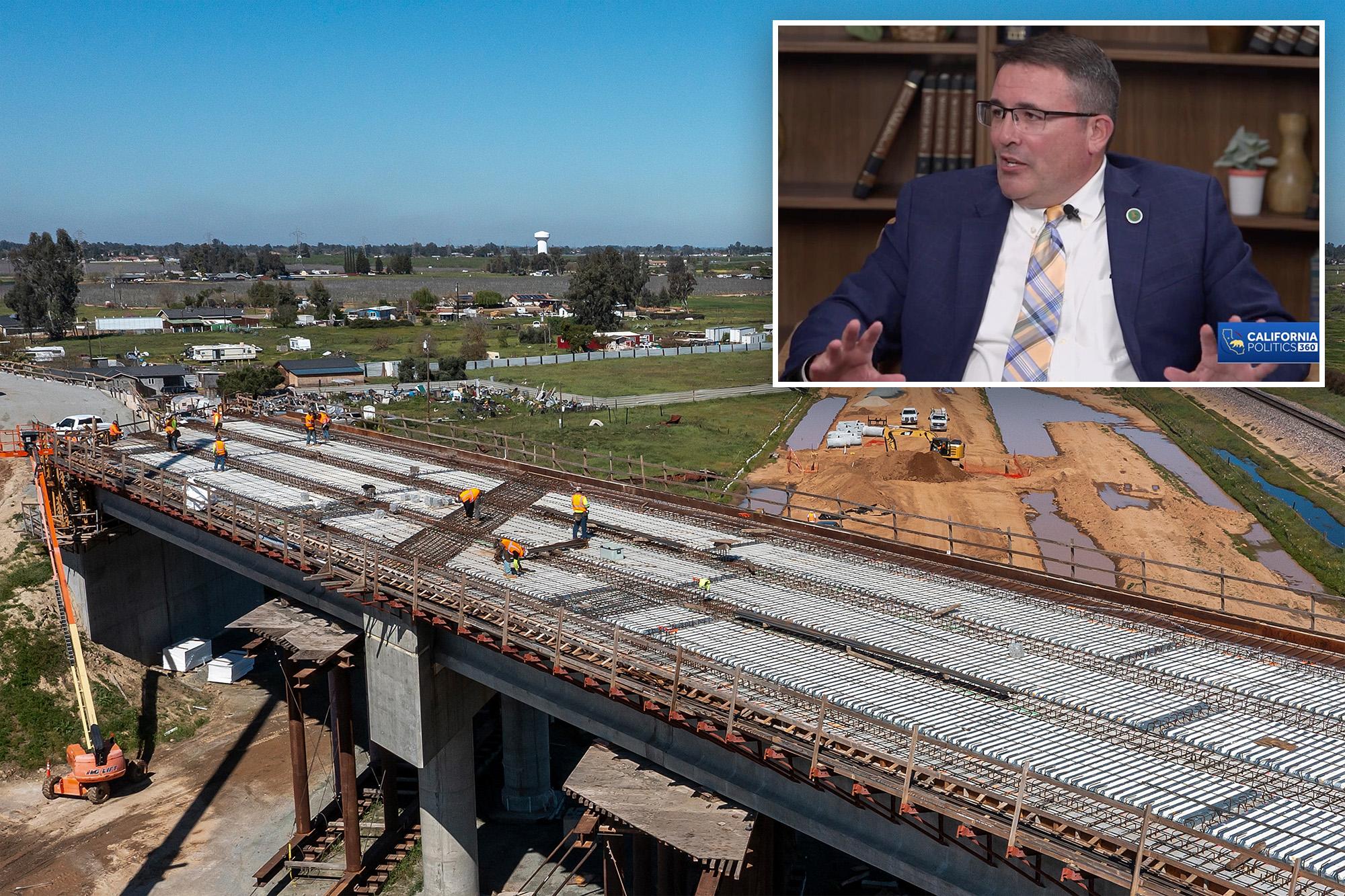
Add The California Post on Google California’s $231 billion high-speed rail dream could hit a literal dead end at a remote Central Valley orchard.
The state’s long-troubled bullet train could be forced to dramatically shrink its first operating segment, potentially leaving both Merced and Bakersfield off the initial route as the project barrels toward a massive cash crunch.
Instead, California may have to pour its remaining money into completing a much smaller stretch of track between Madera and Poplar Avenue in rural Kern County, an isolated endpoint surrounded largely by farmland and orchards, project Inspector General Benjamin Belnap told KCRA’s “California Politics 360.”
The drastic downsizing could become reality if the California High-Speed Rail Authority runs through its available funding as expected by December 2027.
Without another infusion of cash from Sacramento, officials may have little choice but to abandon, at least temporarily, plans to connect the first operating segment all the way from Merced to Bakersfield and focus their dwindling resources on the shorter Central Valley stretch.
The warning represents another potential setback for the decades-in-the-making bullet train, whose original vision was to whisk passengers between Los Angeles and San Francisco.
With enough money no longer available to complete that vision in the near term, the state has focused on getting a 171-mile Merced-to-Bakersfield segment up and running. That portion alone is expected to cost as much as $36 billion.
But even that scaled-back goal could be in jeopardy.
Belnap said he previously raised alarms about the approaching fiscal cliff, but lawmakers ended their legislative session in September without resolving it.
State leaders will now have to move quickly next year to identify additional money in the budget or pursue borrowing if they want to prevent construction plans from being further curtailed, according to Belnap.
“When I first got to the High-Speed Rail Authority, I was charged with looking at their 2023 project update report,” he told KCRA. “One of the things I noticed was that their funding plan was not very specific on when they would need funding.”
The authority also failed this year to secure legislative language that Belnap said would have allowed it to use future proceeds from California’s cap-and-invest program to support financing. Another opportunity to obtain that authority is not expected until July 2027, just months before the projected funding cliff.
The financial headache comes as the massive price tag surrounding the project continues to attract scrutiny.
The Rail Authority currently estimates the broader project could cost roughly $126.3 billion following a reassessment this year. Another estimate has put the potential cost as high as $231 billion.
The latest money worries have also collided with allegations of blown expenses.
A recent Inspector General audit found that consultants working on the project racked up hundreds of thousands of dollars in travel expenses that lacked advance approval or allegedly violated state or contractual rules.
The audit examined roughly $2 million in travel payments to four consulting firms over two fiscal years. Of approximately $1.15 million in expenses reviewed, about 60% allegedly lacked advance approval.
The Inspector General identified roughly $680,000 in expenses without advance approval, including about $592,900 that the office said did not comply with state travel regulations or contract requirements.
Some reimbursements allegedly included premium airline tickets and rideshare trips to gyms, restaurants, a tiki bar, a nightclub and other recreational destinations. The audit also flagged more than $118,000 in travel-related expenses involving people traveling from other countries despite contractual restrictions on international travel.
“These trips clearly appear to be for personal enjoyment rather than for the benefit of the State, and the Authority should have questioned the necessity of those costs rather than paying them outright,” the Inspector General’s report said.
Belnap told KCRA that lax enforcement can encourage repeat behavior.
“It’s learned behavior,” he said. “If you let it through, then they’ll ask for it again.”
Republican lawmakers who have long opposed the rail project seized on the audit.
“Californians are already paying some of the highest costs in the country,” Assembly GOP Leader Alexandra Macedo told the California Post. “They should not be forced to subsidize consultant lifestyles for a rail project that still has not laid a single mile of track.”
The Rail Authority, meanwhile, told The Post it takes the findings seriously and plans to tighten its controls over consultant travel, strengthen documentation requirements and seek repayment of improper expenses that are identified.
“We take these findings seriously,” the authority said, adding that it remained committed to “transparency and continuous improvements.”
Construction on the high-speed rail project began in 2015, with approximately 119 miles currently under active construction.
The project only recently entered what officials have described as its “track-laying phase,” while completion of the Merced-to-Bakersfield segment has been targeted for 2032.
Now, however, the approaching 2027 funding deadline could determine just how much of that route California can actually afford to finish first.