Add The New York Post on Google It was an explosive model.
UK scientists raised alarm bells after drawing up an apocalyptic play-by-play detailing what would happen if the famed Yellowstone supervolcano blew its stack.
“A super-eruption on this scale would be a threat to civilization as we know it,” wrote the authors in a recent piece for The Conversation.
The volcanic formation, which sits underneath the 30-by-45-mile Yellowstone Caldera, is among the most studied on Earth due to its potential for a supereruption when a volcano ejects over 230 cubic miles of magma, rock and ash.
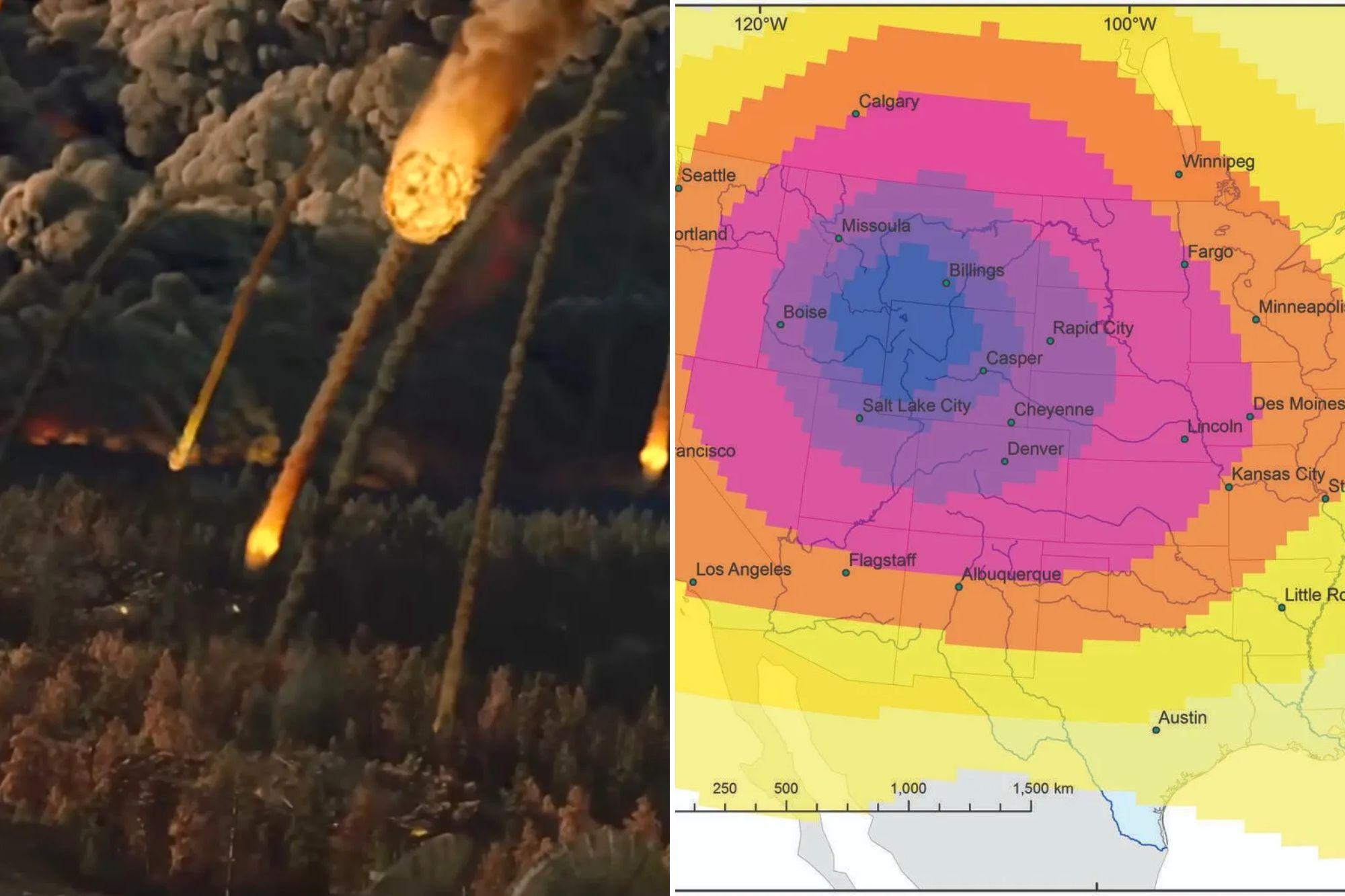
A scene from the 2009 sci-fi disaster movie “2012” depicts the catastrophic eruption of the Yellowstone Caldera. Sony Pictures The Yellowstone supervolcano has produced three such events in the past 2.1 million years with the last one occurring 631,000 years ago. This cataclysmic expulsion snuffed out all life within hundreds of miles of the site, dispersed ash across North America, and caused other effects that were felt worldwide.
And while our ancestors had not yet reached the North American continent — and were therefore not there to experience it — some scientists fear that the next eruption could affect human life.
To determine the destruction level of such an event, the researchers — led by Ilan Kelman, professor in disasters at University College London and Matthew Blackett, reader in physical geography and natural hazards at Coventry — examined how other countries have dealt with other disasters in recent years.
“What follows is a thought experiment into what might happen in the worst case scenario,” they wrote.
One month out, seismologists would notice a surge in earthquakes, prompting scientists to raise the alert from “normal’ to “advisory.”
A USGS ashfall model output for a Yellowstone supereruption is shown in 2014. USGS This turbulence escalates dramatically three weeks out, with the tremors becoming increasingly shallow while geyser activity becomes more and more erratic.
Then, one week later, experts announce an 85-92% probability of a cataclysmic eruption within three weeks, whereupon the volcano alert is raised to “watch.”
They would also designate an evacuation zone extending 62 miles (100km) beyond Yellowstone National Park and impacting roughly 200,000 residents, who would flee to other countries.
On the date of the eruption, magma leaks into Yellowstone’s hydrothermal system, sending “superheated steam, mud and shattered blocks of rock” miles into the air. Several hours later, gas-filled magma would burst through the surface, sending a vast eruption column that rose to 31 miles (50km) into the atmosphere.
Ensuing flows of hot, fast-moving flows of gas, ash and rock would fan out for miles, killing up to 1,000 people immediately, wiping out farmland in multiple states and disrupting power, and water infrastructure.
From three days to one week after the eruption, much of North America is shrouded in shadow, while Billings, Montana, is buried under three feet of ash. Meanwhile, supply chains, sewage, heating systems and mobile phone networks start to break down.
By two weeks, the ashfall obstructs roads, torpedoes drainage systems and results in the closure of airports, railways and farms. States of emergency are declared by the US, Canada, Mexico and most Caribbean and Central American countries.
Between four and six months, respiratory issues put a strain on hospitals while the damage to North American agriculture sends worldwide prices to the stratosphere.
This, combined with a banking crisis, results in a global recession.
Ten years on, the world’s citizens have adopted a more agrarian lifestyle while those eating meat will rely on hunting game. Nonetheless, starvation and migration will be rampant.
The researchers claim that when the dust has settled, “there could be 0.7-1.3 billion premature deaths due to the eruption and its impacts.”
The one silver lining is that in the past, “this unstoppable power of volcanism changed the planet, but did not end humanity – or come close to doing so.”
Thankfully, a Yellowstone eruption isn’t eminent by any means. Based on the prior three eruptions, there has been an average of around 725,000 between events, meaning we technically have 100,000 years to go before the next one.
And, as the USGS experts pointed out, “this is based on the average of just two time intervals between the eruptions, which is meaningless.”
Plus, even if the caldera does go off again, it might not even be large as the most recent volcanic eruption at Yellowstone, “a lava flow that occurred 70,000 years ago.”
Nonetheless, they point out that “volcanoes do not work in predictable ways and their eruptions do not follow predictable schedules.”