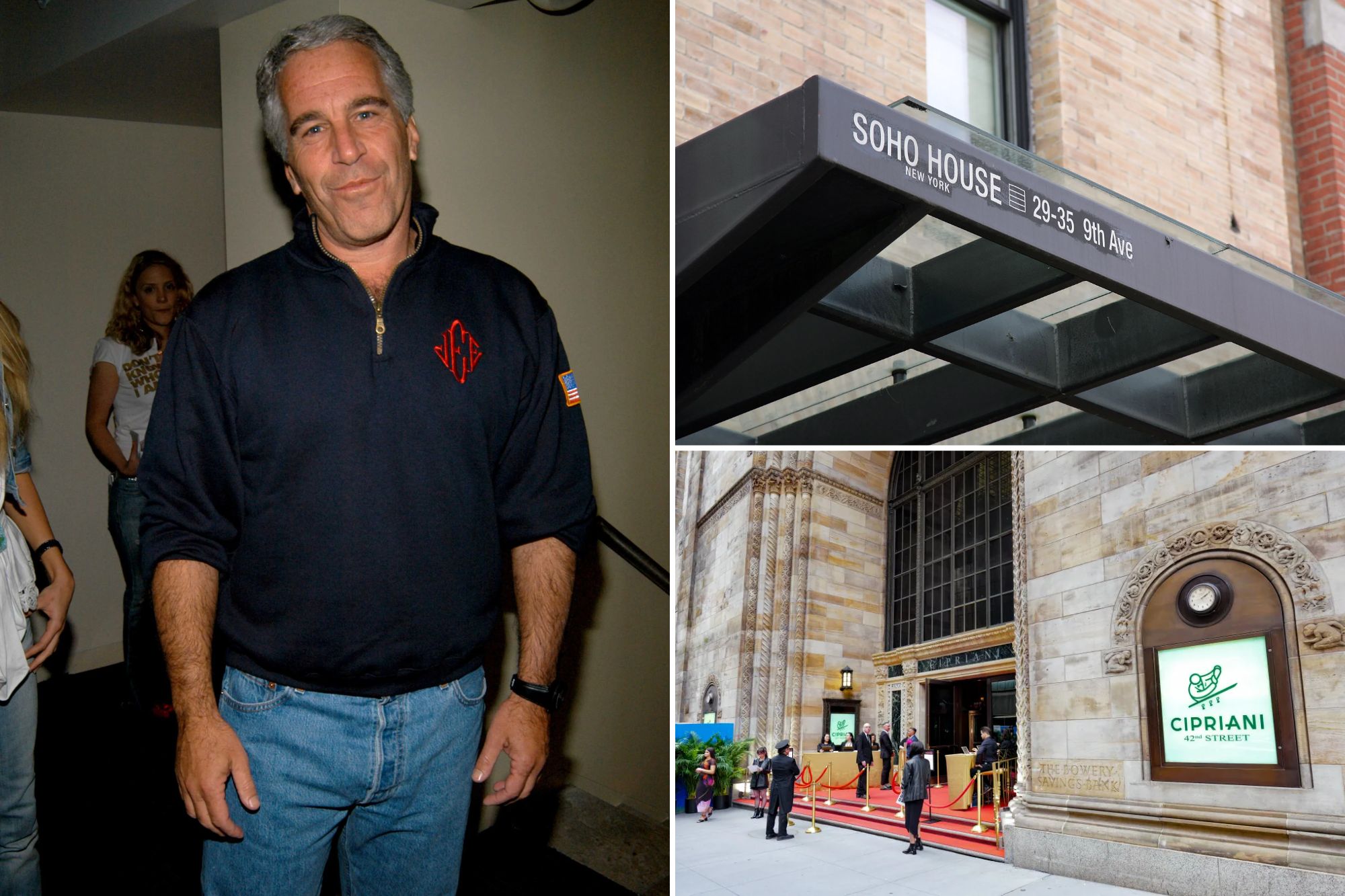
Jeffrey Epstein’s ability to move comfortably within the highest tiers of society extended far beyond his Palm Beach and Manhattan mansions — and into the velvet-rope world of private clubs.
Newly released documents from the Justice Department’s Epstein Library, and reviewed by The Post, show the disgraced financier exchanging emails with figures from the upper echelons of New York’s social scene — including restaurant magnate Giuseppe Cipriani — while seemingly helping people in his orbit gain coveted memberships at Soho House, the celebrity-packed private club that defined elite nightlife in the 2010s.
The documents are part of a massive trove of more than 3.5 million pages released under the Epstein Files Transparency Act. Within them are more than 550 references to Cipriani and roughly 177 references to Soho House, where waitlists during those heady years stretched into the thousands and admission was tightly controlled by membership committees.
Other emails in the newly released files show Epstein interacting with figures connected to Cipriani, the famed hospitality empire known for its restaurants, private clubs and lavish society events. His ties to Cipriani appear to have extended beyond casual social encounters and into potential business dealings.
Several emails from 2010 show Epstein and Cipriani arranging in-person meetings, with Cipriani sharing his phone number and repeatedly urging Epstein to call him over the course of several months.
Meanwhile, many of the messages regarding Soho House involved payment notices for monthly memberships and show Epstein closely tracking applications and celebrating approvals for people in his network.
One April 17, 2018 exchange illustrates the dynamic. An unidentified person forwarded Epstein a message announcing they had been accepted into Soho House New York, writing excitedly: “I got in!!!!”
“yes, i know … and you have a credit card to pay as much as you like for this year. do not be responsible. have fun.”
The exchange suggests Epstein was not only aware of the membership approval but may have helped facilitate it — and was even offering to cover the spending using his “black card.”
The acceptance email itself, sent by Soho House New York’s membership director that same day, confirmed the applicant had been approved following a committee vote and outlined the annual dues of about $1,742 plus a one-time registration fee of roughly $326.
The identities of many of the people involved remain unknown.
Other emails show Epstein’s longtime associate Ghislaine Maxwell appearing in communications tied to payments to Soho House, suggesting she has helped handle the financial logistics connected to the club.
One such message includes banking details for Soho House New York Inc., located at 29–35 Ninth Avenue in Manhattan’s Meatpacking District, confirming funds being wired in connection with the club.
Epstein also relied on intermediaries in his social circle to navigate the club’s membership process.
Among them was New York developer David Mitchell, whose business dealings with Epstein stretched for years. In emails dated Oct. 22, 2014, Mitchell, who was an early investor of Soho House and a member, told Epstein he had contacted a Soho House connection and would attempt to facilitate an introduction.
“I spoke to my contact in London who is no longer with Soho House but he gave me the name of the person to contact in Miami,” Mitchell wrote in the message. “I will reach out to them and see what I can do.”
Other correspondence shows Mitchell forwarding Soho House membership applications directly to Epstein for review.
The messages suggest Epstein may have used coveted club access as a form of social currency — helping people in his orbit gain entry into one of the city’s most exclusive institutions at the time.
Many of the names tied to the applications remain heavily redacted in the records, leaving unanswered questions about who benefited from Epstein’s connections.
In one email exchange dated on April 17, 2018 shows Epstein joking with an unidentified recipient after they secured a coveted Soho House membership that grants access to the club’s locations around the world. In the thread, the person excitedly describes the “Under 27 Every House” membership, prompting Epstein to reply: “perfect – how does it feel to be rich? :)”
At the height of its popularity in the 2010s, the London-based Soho House had become a global status symbol, with outposts in New York and elsewhere, drawing a mix of celebrities, media executives and entrepreneurs.
But Epstein’s emails suggest the private club was only one piece of his social network.
In a June 12, 2010 email, Epstein told an associate — who was saved in his contacts as “Ferg” — he had recently met with Cipriani, writing that “he is a great friend of all of us,” suggesting familiarity within the high-society circle surrounding the famed restaurant and club brand.
Other emails show Epstein corresponding directly with Cipriani about a proposed investment tied to the acquisition of a London club known as “Rafifi,” which involved plans to acquire a long-term lease and invest roughly $1.07 million to refurbish and develop the venue as a branded hospitality project. But it is unclear if Epstein ever invested.
Together, the emails illustrate how Epstein remained deeply embedded in high society years after his 2008 conviction for soliciting prostitution from a minor.
While the documents do not link the club activity to criminal conduct, they offer a glimpse into how Epstein continued cultivating relationships inside exclusive social institutions.
A rep for Cipriani told The Post: “While Mr. Epstein was at some point one of the 1.5 million plus customers that Cipriani serves at various properties on an annual basis, he was never a member of any cub affiliated with Cipriani. Mr. Cipriani was never on his plane, nor on his island and never made any business deals with him. He actually found him quite unlikable.”
Representatives for Soho House did not respond to The Post’s request for comment. Attempts to reach Mitchell were unsuccessful.
But the emails suggest that even as his legal troubles mounted, Epstein still had the connections — and the means — to keep doors open in some of the world’s most exclusive rooms.