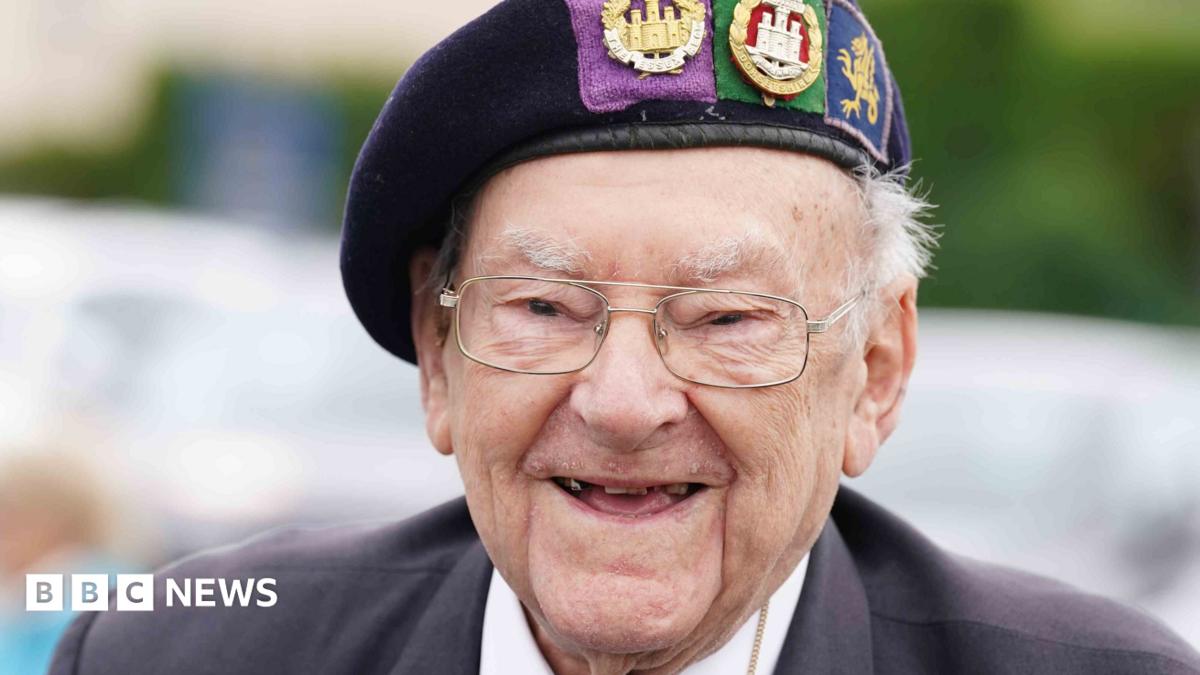
Image source, PA MediaImage caption, Normandy veteran Kenneth Hay was an "extraordinary gentleman", the British Normandy Memorial said
Normandy veteran Kenneth Hay, who survived being captured just weeks after D-Day and spent years educating children about World War Two, has died aged 101.
Hay, from Upminster in east London, served in the 4th Dorset Infantry Regiment. He was captured a month after the allied invasion of northern France and survived a 1,000-mile (1,609km) forced march in eastern Europe until he was liberated by US forces.
His death was announced on Sunday by the British Normandy Memorial, for which he was an ambassador.
The organisation said he was an "extraordinary gentleman whose remarkable life will never be forgotten".
In its statement on social media, the British Normandy Memorial added: "His passion for education was unwavering.
"The countless schoolchildren whose lives he touched with his stories of courage and resilience nicknamed him 'Grandad Ken'.
"We extend our most sincere condolences to Ken's sons Chris and Jeremy, all the Hay family and his very many friends."
Image source, PA MediaImage caption, Hay, pictured in 2025 at the British Normandy Memorial in Ver-sur-Mer, France, served in the 4th Dorset Infantry Regiment
D-Day, on 6 June 1944, saw British, American and Canadian troops storm beaches along the Normandy coastline to begin the liberation of France from Nazi occupation.
Hay had landed at Courseulles-sur-Mer just days after and was captured by the German 12th SS Panzer Division during a night patrol on 7-8 July.
He was taken to Zabrze in Poland, where he was put to work as a prisoner of war in a coal mine.
Speaking of the capture in 2024, Hay recalled his first feelings were of "dread" and "fear".
"We went out on night patrol, was supposed to be doing a blow up of a self-propelled gun in no man's land, but in fact, it was behind their lines," he said.
"So they let us through and then very unfriendly, they sealed it and wouldn't let us back, so we had a battle.
"We had 30 [that] went out on our patrol, 16 including my brother, who was a corporal, got back, five of us got captured and then presumably nine got killed."
As the Russians approached, the prisoners were marched to a new location, approximately 1,000 miles away, during which many of them died.
During the three-month march, Hay said he once "lay down to die" after it became too painful to continue, but two friends turned back for him and lifted him with an "arm around each shoulder".
To play this video you need to enable JavaScript in your browser.This video can not be played
'Most people see names, I see faces' says Normandy veteran Kenneth Hay
Eventually they were liberated by American troops and Hay returned to the UK, via Reims, on 4 May 1945.
Recalling the moment he made it to his mother's house in Barking, he said: "They came running down the road to greet me."
After the war, he was appointed an MBE for services to the community and received the Legion d'Honneur, France's highest order of merit.
Hay regularly visited British schools to share stories of the war and answer questions, saying he believed it was his "duty to pass it on".
Listen to the best of BBC Radio London on Sounds and follow BBC London on Facebook, external, X, external and Instagram, external. Send your story ideas to hello.bbclondon@bbc.co.uk, external
D-Day veterans mark anniversary as nearly 100 British names added to memorial
Dozens of WW2 veterans sign history buff's rifle
Ken Hay: 'Sometimes you wondered, will I ever get home?' Video, 00:02:55Ken Hay: 'Sometimes you wondered, will I ever get home?'