Add The New York Post on Google It took one question during a news conference — ‘When you decided to enter the Hall of Fame as a Met, what stood out to you about the organization?’ — and less than one minute for Carlos Beltrán to hint at his often rocky relationship with the team’s fanbase.
“I would say it was my best years in baseball,” Beltrán began, “even though, at times, it felt difficult and it felt different.
Access the Mets beat like never before Join Post Sports+ for exciting subscriber-only features, including real-time texting with Mike Puma about the inside buzz on the Mets.
“Meaning, my relationship and sometimes how things went down — I don’t know the message that was sent out about me as a person or me as a player. It’s hard to connect with a fanbase when the message out there is always negative.”
The most memorable moment from his Mets career was among his worst, when he could not get a swing off against Adam Wainwright. He was booed at times. He was not “Captain America” David Wright. He fought with the team about a knee surgery. He spent 2005-11 as a Met, only about one-third of his 20-year MLB career.
He spent some of that time as a Yankee, too, which does not further endear him to Mets fans.
And yet, there he was Saturday at Citi Field, slowly walking in from center field to the infield to give a speech to polite, if not overwhelming, cheers, as the franchise celebrated a remarkable and great Met but not quite a beloved one in Queens (even if he was and is in Puerto Rico, which was well-represented).
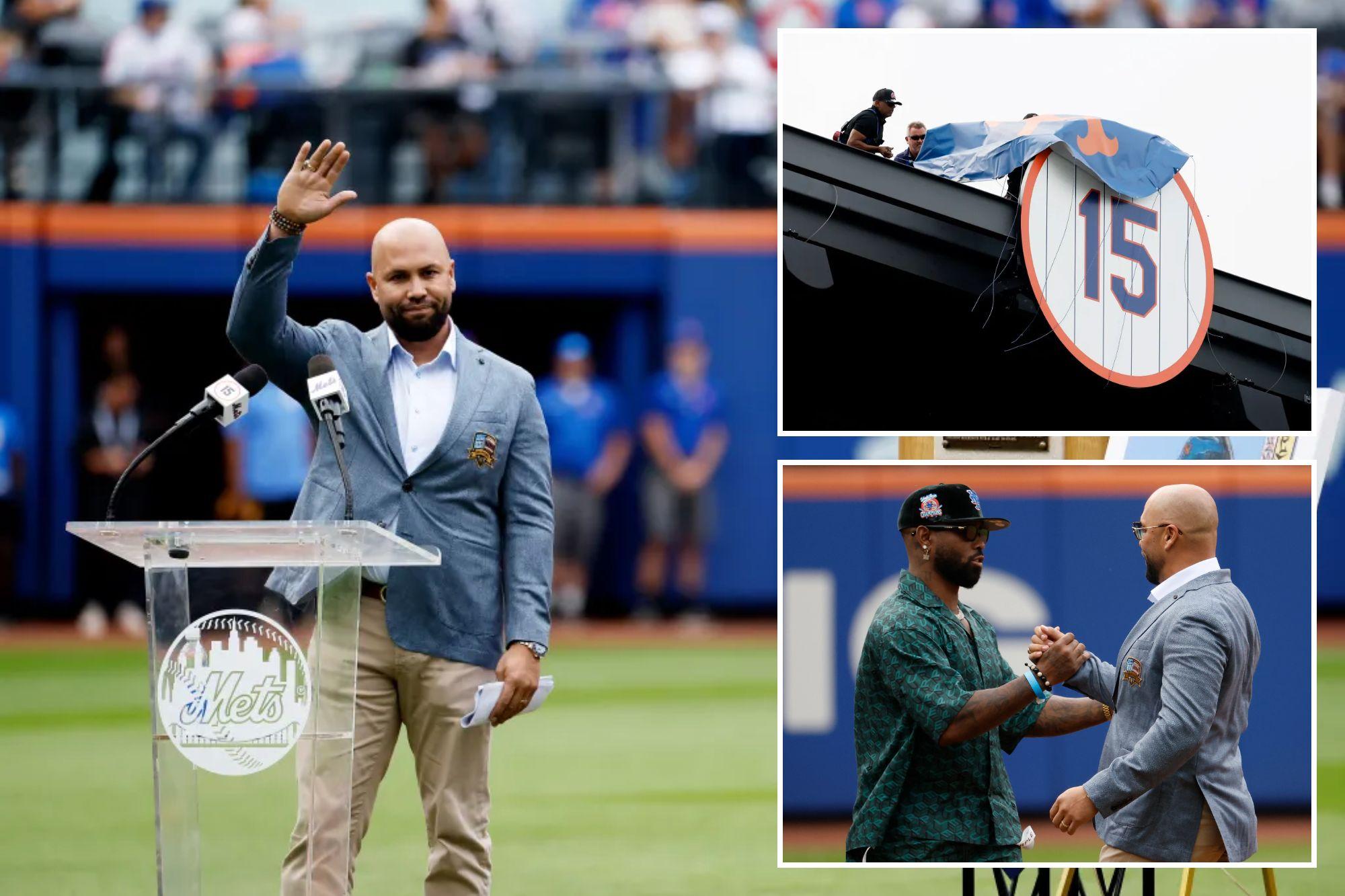
Beltrán now is a forever Met, his No. 15 unveiled and hung in the rafters as the organization also formally inducted him into the team’s Hall of Fame. In doing so, he completed a remarkable journey in which he learned about himself and Mets fans and felt what he called “closure” in being immortalized in a city in which he was not always welcome.
A small-market star with Kansas City from 1998-2004, Beltrán signed a seven-year, $119 million free agent contract with the Mets that some remember better for his rough beginning — a merely OK 2005 — than for some of the best seasons (notably 2006) in franchise history.
“All of a sudden being in New York, there were things that I needed to learn,” said Beltrán, who became the ninth former Mets player with his number retired. “I didn’t have those tools in Kansas City — dealing with the media, dealing with the responsibilities, dealing with expectations, dealing with the ups and downs of baseball in a city like New York.
Among those he thanked was his wife, Jessica, who is a life coach and would tell him that the boos he heard were not personal.
“It feels personal,” Beltrán would respond before a soft chuckle. “They’re pointing at me.”
But he said his skin grew thicker over the years. Becoming a father to three kids who joined him on the field Saturday has helped him better understand the disappointment that Mets fans displayed in him.
“Sometimes, you were hard on me, and that’s OK,” Beltrán said in his speech. “Today as a father, I realize I am hard on my own children, too, not because I love them less but because they are capable of more.
“Back then, I did not understand it. Today, I do.”
Beltrán did not win a World Series with the Mets and is the face of their 2006 regret, striking out to end Game 7 against the Cardinals. But by the numbers, there have been very few Mets who have been better, ranking in the organization’s top 10 in home runs, RBIs, runs scored, on-base percentage and slugging percentage.
He also has returned — actually, a few times — to the organization, currently serving as an adviser to president of baseball operations David Stearns and could have a path toward becoming the team’s next manager if he wants.
He does not have the reputation of the former players whose numbers his No. 15 now lives alongside — Wright, Darryl Strawberry, Dwight Gooden, Willie Mays, Keith Hernandez, Jerry Koosman, Mike Piazza and Tom Seaver — but the relationship has improved and is improving, which might have been best highlighted by Beltrán choosing a Mets cap on his Cooperstown bust.
“I will always be proud to say I was, and I will always be, a New York Met,” Beltran told the crowd.