To play this video you need to enable JavaScript in your browser.This video can not be played
Highlights: Brilliant Brighton batter Arsenal in shock first defeat as champions
Chief football news reporterPublished19 September 2026, 07:30 BSTUpdated 3 hours agoBrighton's 125th anniversary celebrations could not have gone much better.
Decked out in specially-made commemorative kit, Fabian Hurzeler's side produced a performance befitting the occasion.
A home game against Arsenal had the potential to put a dampener on the festivities but instead Brighton marmalised the defending Premier League champions.
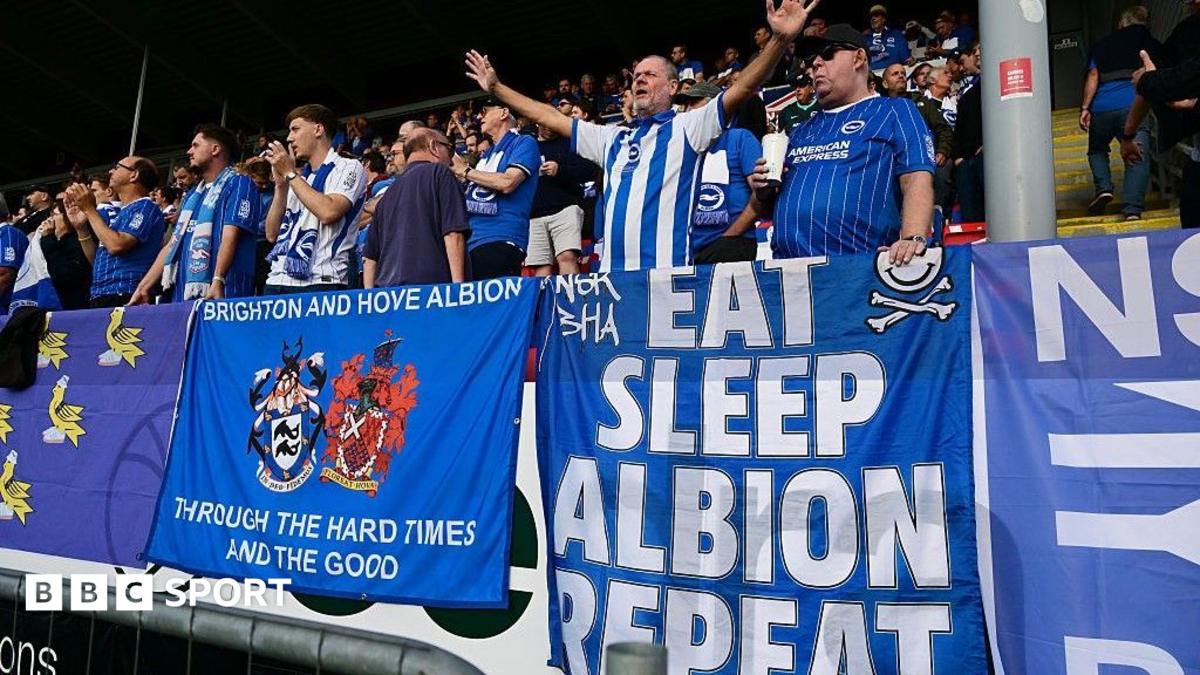
A record crowd of 31,944 were at the Amex Stadium to witness it, roaring their side on to the most comprehensive of 3-0 wins.
Pascal Gross fired them in front, Charalampos Kostoulas drilled in the second on the stroke of half-time and Chema Andres' header made it three after the break.
They had the chances to add to that lead but three was more than enough and the celebrations in the stands had started long before the final whistle.
"It was a special one, not only because we played against maybe the best team in England but because of the performance," Hurzeler told BBC Match of the Day.
"The boys started really intense, they won their personal duels, played good in possession and created chances.
"I'm really proud of my team, hopefully they enjoy it today because these kind of moments are important to enjoy."
From near oblivion to Europe and beating the champions of England on the club's milestone day, this is the Seagulls' remarkable story...
It is Thursday, 9 November, 2023. Brighton manager Roberto de Zerbi is addressing his players in the Amsterdam Arena before their Europa League tie with Ajax.
"There's 3,000 Brighton fans in this stadium tonight," said the Italian. "But there's more than twice that number in the city who have travelled over. Remember that when you go on to that pitch."
A long-standing senior Brighton official was in the dressing room that day. A fan first and foremost, but someone who has spent almost three decades working for the club.
"It made the hairs on the back of my neck stand up," he said.
For some clubs, an encounter with Ajax is commonplace. Not Brighton.
"The royalty of European football," says the official. "From where we've come from, to be in that environment. It was a pinch-me moment."
Brighton won 2-0. It was the high point of the first European campaign in the club's history.
Ask Paul Samrah for his single most memorable moment as a Brighton fan and a very different answer comes back, which goes to the heart of why, as they celebrate their 125th birthday around the visit of Arsenal, the Seagulls are almost unique among English clubs.
August 2007. "After the years of campaigning, the days and nights I spent fighting for regime change and then for the stadium, the moment I heard we'd actually got planning permission, that our objectors had decided not to continue their fruitless efforts to stop the stadium," he explained.
The two stories highlight the before and after reality of Brighton & Hove Albion.
Image source, Brighton and Hove AlbionImage caption, Brighton's final game at the Goldstone Ground in April 1997 was an emotional occasion
Formed in 1901, Brighton were a Southern League club for almost two decades before they were voted into the Football League. They had experienced only seven seasons in Division Two when they were promoted to the top flight for the first time in 1979.
For years, they were known outside Sussex chiefly for "And Smith must score..." - the BBC radio commentary, delivered by the late Peter Jones, at a critical point during the 1983 FA Cup final, late in extra time. It was the moment when Gordon Smith, clear on goal with a chance to earn Brighton their first major trophy, saw his shot saved by Manchester United goalkeeper Gary Bailey. United won the replay.
But in 1995, chairman Bill Archer sold Brighton's Goldstone Ground, their home since 1902, because of escalating debts that there was no obvious way of paying. Fans were not consulted and no alternative stadium was put in place.
Brighton did not leave until 1997, although their final season at the Goldstone was only confirmed by the property company who owned the stadium, after the final game of the 1995-96 campaign, which had to be abandoned as thousands of furious fans spilled on to the pitch to demonstrate against the ownership. Both crossbars were snapped amid the tumult.
After two seasons playing 70 miles away at Gillingham, and with the idea of a new stadium in the Toad's Hole Valley area of Brighton a non-starter, the club returned to the city in 1999 and started playing at Withdean Stadium, most famous for being the home athletics track of Olympic middle distance gold medallist Steve Ovett.
That brings us back to De Zerbi's pre-match team-talk at Ajax.
Brighton had more than 7,000 fans in Amsterdam that night. When they moved into the Withdean, its capacity was only 6,000. The modern Brighton really is a totally different club to the one that existed before.
"After the 1983 FA Cup final, players were sold, there was no investment, the Goldstone was decaying and the crowds were dipping," said Samrah. "There was no communication between board and fans, directors came and went. There was no continuity, no leadership, no direction. We were just rudderless."
There are some notable figures in the Brighton story.
Former Football Association executive director David Davies got involved, Deputy Prime Minister John Prescott overturned a rejected planning application for Brighton's current stadium in Falmer. Former chairman Dick Knight stabilised a club that in 1997 came within 27 minutes of being relegated out of the Football League.
Without that trio, and many more, it is quite possible Brighton would not exist.
They began their second European campaign in the Norwegian city of Tromso last month, knowing the Conference League offers the chance of that elusive first trophy.
They play in a magnificent stadium, a short train journey from the city centre, with its new corporate areas, and, generally, inclusive family atmosphere. Their recruitment model, buying players in and selling them on for vast profits, is envied.
The new Brighton just beat Manchester United at Old Trafford for the fifth time in six visits. Four games into their 10th consecutive Premier League campaign, they sit fifth.
The contemporary Brighton exist the way they do largely because of the vision and investment of Tony Bloom.
Born in Brighton, Bloom is a lifelong fan. His connection to the club is through his grandfather Harry, a former vice-chairman, and uncle Ray, a director.
Bloom, 56, is an entrepreneur. He made his money in finance and gambling, largely through the use of data. He became chairman in 2009, and masterminded the rise from League One and move into the American Express Stadium. Last season, Brighton's average attendance was more than 31,000.
In their 125-year history, Brighton have never had it so good.
"Anyone walking into Brighton today compared to even 15 years ago would not think it was the same football club," sporting director Mike Cave told BBC Sport.
"The club has been on an unbelievable journey. We've got staff members and many fans who have done that journey. For those of us who weren't here 15 years ago, our responsibility is to ensure what's to come - and I think there's lots - is better than what's happened in the recent or long-distance past."
As for Bloom himself, he has reflected on Brighton's 125th birthday in the programme for the Arsenal game.
"Since 1901, this football club has been part of the fabric of our city and the broader county of Sussex," he said.
"It has connected generations of families and communities. Grandparents have brought their children and grandchildren to matches. Lifelong friendships have been forged on terraces, in stands and on away trips.
"Through good times and bad, Brighton & Hove Albion has provided so many of us with some of the most memorable moments of our lives.
"This club is in my blood. Some of my earliest and most cherished memories are wrapped up in the sights and sounds of the Goldstone.
"When I had the privilege of becoming owner and chairman, it was like being entrusted with something precious to safeguard and help develop for the future.
"Many of you reading these words will remember those difficult years. The loss of the Goldstone. The long journeys to Gillingham. The challenges of the Withdean era.
"What got this football club through was the determination of its fans. The bucket collections. The protests. The refusal to accept the Albion should disappear. This anniversary belongs as much to those supporters as anyone. Quite simply, without them, we would not be here today."
Image source, Brighton and Hove AlbionImage caption, Brighton chairman Tony Bloom
Follow Brighton & Hove Albion on BBC Sounds
Listen on SoundsSubscribe and listen for everything you love about the Seagulls