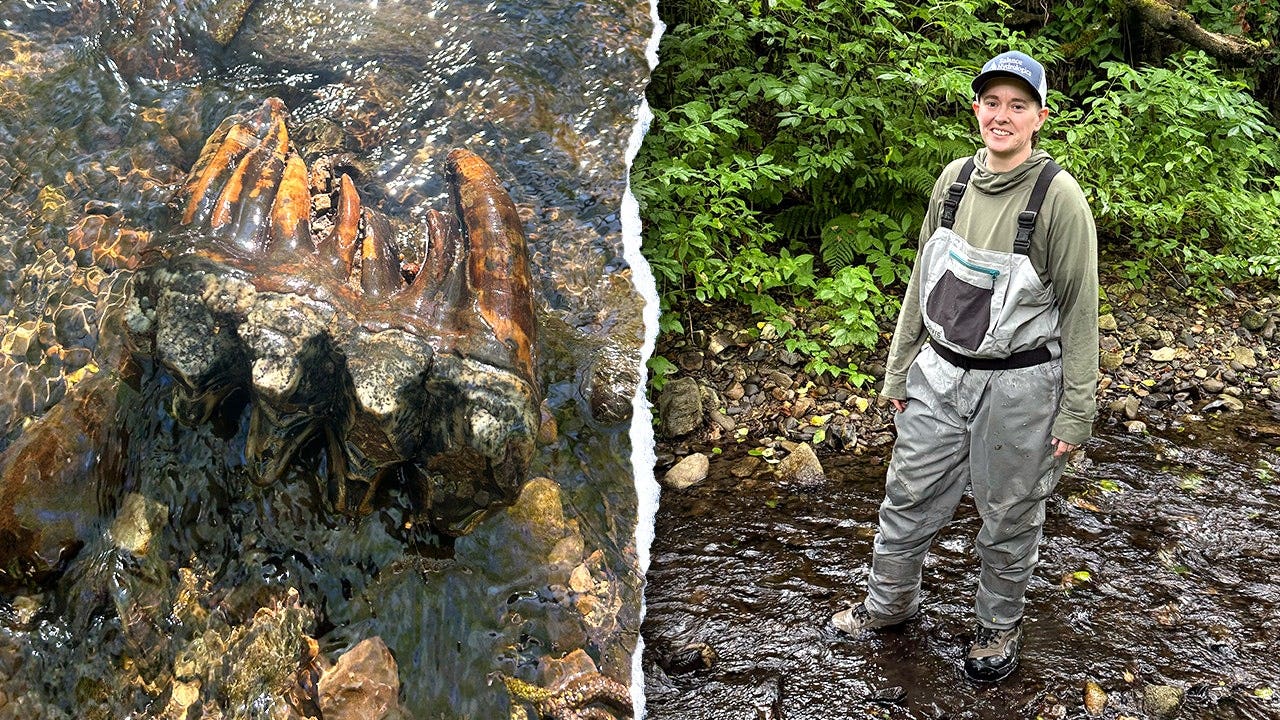
Video Ancient mastodon tooth found in California creek may point to more remains buried Wayne Thompson, CEO of Pacific Paleontology, told Fox News Digital that the exceptionally rare Pacific mastodon tooth discovered in a California creek could be between 50,000 and 100,000 years old.
A scientist surveying a California creek recently stumbled across something unexpected: a tooth from the mouth of an Ice Age giant.
The discovery of the tooth, which belonged to an ancient Pacific mastodon, was announced by the Midpeninsula Regional Open Space District (Midpen) in San Mateo County, California.
Mastodons were massive, elephant-like herbivores that went extinct roughly 11,700 years ago, near the end of the last Ice Age.
SHOCKING PREHISTORIC DISCOVERY ON NJ BEACH '100%' CAME FROM COLOSSAL ANCIENT PREDATOR
The tooth was found in a Midpen preserve creek by Brigid Lynch, a Balance Hydrologics geomorphologist who was surveying the area as part of an effort to improve the habitat of the threatened California red-legged frog.
"As a geologist, I've gone out and seen stuff in the field, but definitely nothing as exciting as this," Lynch said in a release.
Geomorphologist Brigid Lynch, pictured at right, discovered the mastodon tooth while surveying an area for habitat improvements for the threatened California red-legged frog. (Balance Hydrologics)
Pictures of the molar show its strange shape, which Lynch initially thought was an oddly shaped rock.
The tooth is in "immaculate condition," Wayne Thompson, CEO of Pacific Paleontology, told Fox News Digital in an interview.
T REX FOOTPRINTS UNEARTHED IN FIRST-EVER DISCOVERY 66 MILLION YEARS AFTER CREATURE WALKED THE EARTH
Thompson, whose job it was to examine the fossil and assess the site where it was discovered, said the tooth likely dates back between 50,000 and 100,000 years, based on where it was found.
"It doesn't happen often. … [It's] quite uncommon."
"There is a lot of misinformation going around about the age of the tooth," he said. "Most of the reports out [there] are saying it's 10,000 years old, but it's not 10,000 years.
"From the location where the specimen was found, we can pretty confidently say that it’s much, much older than 11,700 years — probably on the order between 50 and 100,000 years," he added.
ANCIENT OCEAN MYSTERY DEEPENS AS LONG-MISIDENTIFIED FOSSIL IS FINALLY REVEALED BY RESEARCHERS
Thompson said the condition of the tooth also offers clues about what happened to it after the mastodon died, noting that it "hadn't moved very much in the stream where the creature died."
"Mastodon teeth are — the roots are extremely fragile — and this one had the majority of the roots of the molar still preserved with it intact, and so, it wasn't tumbled around in the stream," he said.
The ancient molar was found in a Midpeninsula Regional Open Space District preserve in San Mateo County, California. (Balance Hydrologics)
The paleontologist believes the rest of the animal may still be at the site.
CLICK HERE TO SIGN UP FOR OUR LIFESTYLE NEWSLETTER
"It probably recently came out of the skull and the skull, along with the rest of the bones, are still buried out there," he said.
The unusually well-preserved mastodon tooth may have recently separated from a skull that remains buried at the discovery site. (Midpeninsula Regional Open Space District)
It is "extremely rare" to find a mastodon molar in such well-preserved condition, Thompson said.
"It doesn't happen often. ... [It's] quite uncommon," he said.
CLICK HERE FOR MORE LIFESTYLE NEWS
Looking ahead, researchers from Stanford University's Doerr School of Sustainability plan to carbon date the molar to determine its exact age.
Researchers will also create a 3-D scan of the tooth, which will be used to produce a replica.
TEST YOURSELF WITH OUR LATEST LIFESTYLE QUIZ
Thompson said mastodons favored creek and river valleys, browsing on leaves rather than grazing on grasses as mammoths did.
Pacific Paleontology CEO Wayne Thompson, shown in overalls and beard, described the mastodon tooth as being in "immaculate condition" after he examined the rare fossil. (Midpeninsula Regional Open Space District)
Alder trees, he said, were among their preferred food sources — and they still line the creek where the tooth was found.
CLICK HERE TO DOWNLOAD THE FOX NEWS APP
"Even today, when we went out to the site to inspect where the biological monitor was surveying, there were still hundreds of alders along the stream," Thompson said.
Andrea Margolis is a lifestyle reporter for Fox News Digital and Fox Business. Readers can follow her on X at @andreamargs or send story tips to andrea.margolis@fox.com.