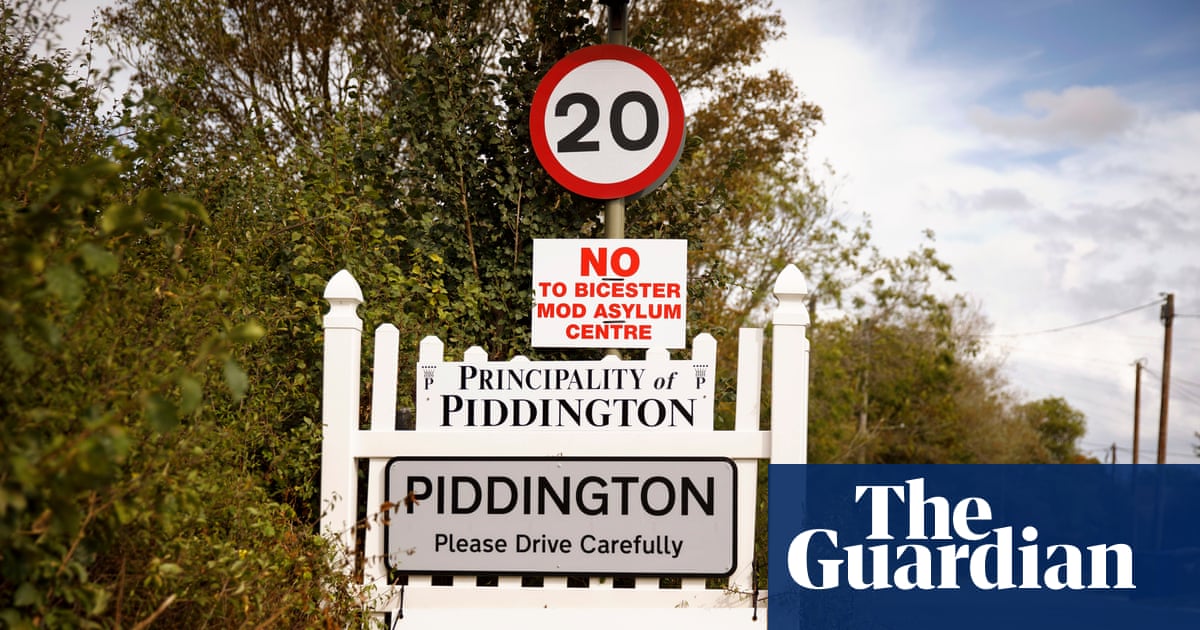
In a symbolic referendum, villagers in Piddington voted 285 to 26 to become an independent state over plans to house more than 1,000 asylum seekers nearby. Photograph: Alicia Canter/The GuardianView image in fullscreenIn a symbolic referendum, villagers in Piddington voted 285 to 26 to become an independent state over plans to house more than 1,000 asylum seekers nearby. Photograph: Alicia Canter/The GuardianUnease in ‘newly independent’ Piddington as world media and Danny Tommo descend As villagers take stock following symbolic vote, some fear far-right weaponisation of asylum dispute and influx of ‘masked people like in Dover’
The first significant event in the newly independent principality of Piddington was a decision to select the newt as the national animal, reflecting optimism that the amphibian’s endangered status might help block plans to open a centre for 1,250 asylum seekers on neighbouring land.
The choice was announced on Thursday morning, the day after Piddington announced that villagers had voted overwhelmingly to leave the UK. Parish councillors were also thinking about asking local children to design a flag and considering whether the new principality’s national sport should be cricket or football.
The second noteworthy event was the arrival of Daniel Thomas, who prefers to be called Danny Tommo, the leader of the new balaclava-wearing anti-migrant movement Patriot Platform, with an offer to rally his masked supporters, if the site is opened, “to protect women and children” locally.
By the end of the week, some residents of this pretty Oxfordshire village were still struggling to interpret Tuesday’s symbolic ballot of 358 villagers, and the announcement on Wednesday that Piddington had voted to “secede from the UK and pursue self-determination” by a margin of 285 to 26, in protest at plans to convert a former military base near the village into housing for asylum seekers.
View image in fullscreenAfter expressing unease over the vote on Newsnight, Rachel Marsh, a Piddington resident for 20 years, said she’d received ‘violent threats online from a lot of very toxic keyboard warriors. I’ve never encountered anything like this before.’ Photograph: Alicia Canter/The GuardianFor many, the vote was a demonstration of plucky British eccentricity in the face of adversity, with Ealing comedy Passport to Pimlico vibes. The day after the independence vote there was still a summer fete atmosphere: Battle for Britain bunting was hanging over the doorway to the village hall, “I Am Spartacus” placards stood by the roadside alongside new signs telling drivers that they were entering the Principality of Piddington, “The Village That Roars”. Journalists from Japan, Norway and Ireland arrived, puzzled by the lack of public transport and functional wifi; they scrutinised the community noticeboard in search of clues to explain the village mindset (“Tortoise Found”, “Harvest Coffee Morning”, “Pilates for All Abilities”).
For others, the week’s events have more troubling outcomes. Chef Rachel Marsh, who used to run a livery yard in the village where she has lived for 20 years, was meeting police officers on Friday to discuss her safety. She received death threats and her family was targeted with racist abuse online after she expressed unease in a Newsnight interview that fear was being used as means to “rally and activate people” locally.
The determined jollity of the village independence movement left a sour taste, she said, in the light of the backlash she had received both from local residents and online activists.
“Given that their aim is to protect women and children it is quite ironic that they are using aggression like this towards me for speaking up against racism,” she said. Originally from New Zealand, Marsh has lived in the UK for 40 years; her husband’s parents were Windrush generation arrivals from Jamaica. Messages posted online this week suggested that she and her husband should leave Britain. “We’ve had violent threats online from a lot of very toxic keyboard warriors. I’ve never encountered anything like this before.”
View image in fullscreenA sign near the MOD base in Piddington where the government plans to house more than 1,000 asylum seekers. Villagers’ reasons for opposing these plans range from concerns over environmental risks and treatment of asylum seekers to hostility towards immigrants. Photograph: Alicia Canter/The GuardianMarsh, like everyone else in Piddington, opposes the government’s asylum housing plan, announced in June. Residents were particularly dismayed at the government’s decision to submit a fast-tracked ‘Urgent Crown Development’ application, designed for projects deemed to be of national importance, allowing ministers to bypass local authority planning processes, as they race to meet a commitment to shut down asylum hotels entirely “in this parliament”.
But village harmony has fractured in places, over disagreements over how best to oppose the decision. Some locals back a Wrong Plan, Wrong Site campaign, primarily focused on the legalities, cost and environmental risks of the proposed housing. Other activists have highlighted the perceived risk to local women of the site. One local, asking not to be named, said the rhetoric in the village had become markedly “more hostile to asylum seekers” over the summer. “The tenor has changed,” he said.
The leader of the parish council, Tim McNally, who led the independence movement, said he was happy that the village had “sent a message to the political jugular”, adding that he was now talking to other village leaders elsewhere in Britain, sharing a blueprint with advice on how to object to unpopular decisions imposed by central government.
In interviews earlier this week he said he would consider renaming the village Trumpington if the Donald Trump agreed to adopt the principality as the 51st US state. Since June he has been filming video appeals for support, speaking direct to the camera as he walks around the village on his @piddingtonroars X account. The campaign has attracted Elon Musk’s attention, prompting the SpaceX CEO to tweet to his 241.6 million followers: “Soon, this will happen to your town”, above a description of the plans for housing for asylum seekers in Oxfordshire. McNally responded: “Thank you, Elon, for helping our little village roar around the world.”
View image in fullscreenLocal parish councillor Joe Marshall, who said that a meeting was being held with the far-right group Patriot Platform ‘so we can open a dialogue’. Photograph: Alicia Canter/The GuardianOn Thursday, parish councillor Joe Marshall was cheerful about the ballot result, if still wrestling with the practicalities of independence. The village would continue to view King Charles as their monarch, he said. Councillors were wondering if “someone’s son’s under-11 cricket team” might agree to represent the principality. “Ultimately we’re not going to be culturally any different from Britain,” he said.
He saw nothing problematic about the swift visit from a nationalist activist leader, stressing that all politicians, environmental campaigners and political figures were welcome to visit. “We’ve not written to these people to invite them but with the high profile of what we’re doing right now, these people will want to come. Our responsibility as a parish is to ensure the safety and the security of the village,” he said, adding that a private meeting with Patriot Platform was being held “so we can open dialogue”.
“I assume that their intent is to offer protection, which right now we don’t need because there is no one on this site,” he said. “We’d rather engage with people, walk them around the village, have a cup of tea and a chat, rather than say: ‘We don’t want you here’.” Villagers were disappointed, he said, that there had not been any similar visits from Home Office ministers or government officials. “They haven’t sent a representative even to have a private conversation with the parish council.”
Thomas arrived without an entourage of men in balaclavas on Thursday afternoon. On Friday morning he posted a video of himself outside the gates to the Site A military base, standing outside the village hall, on the village green and interviewing two villagers.
View image in fullscreenRobin Smith, who lives near to Piddington, says the asylum seekers who would be housed at the MOD site ‘are humans. This camp is not the right place for them.’ Photograph: Alicia Canter/The GuardianRobin Smith, who runs an IT consultancy in Bicester, was sorry to have missed him on the whistlestop tour. “I would have liked to have met him and to have heard him explain his manifesto. The people who are coming over are humans. This camp is not the right place for them.” Andrew Smith, a Network Rail employee from Bicester, was less upbeat: “We don’t want to see masked people like there were in Dover – that’s not really the view of the local people; we are concerned to do the right thing. These people have got to go somewhere, but it has to be properly resourced with the proper facilities.”
The Liberal Democrat leader of Oxfordshire County Council, Tim Bearder, said it “was disgraceful the way the far right are weaponising” the dispute. But he was encouraged by a Wednesday evening planning committee meeting, where district council officials were critical of the government’s proposed plans for the new site. “It was considered in 2005 and rejected. There is no electricity, no water, and no footpath. There have been two fatalities on the nearby road. It’s not in the best interests of local residents or the asylum seekers,” he said.
Calum Miller, Lib Dem MP for Bicester and Woodstock, said the interference of external groups was not welcomed by the majority of people in the local area. “The events of this week have shown the power of local opposition to this proposal,” he said. “Local councillors, local people, and a local legal challenge are taking the government to task for this proposal.”
Rachel Marsh was one of the 26 people who opposed the independence vote. “This is just a publicity stunt. It’s complete theatre,” she said. She was uneasy at the arrival of Patriot Platform’s leader in the village. “My feelings about the appropriateness and suitability of Site A are exactly the same as the rest of village – I object, like everyone else – but you don’t need to base objection on a fear-based rhetoric.”