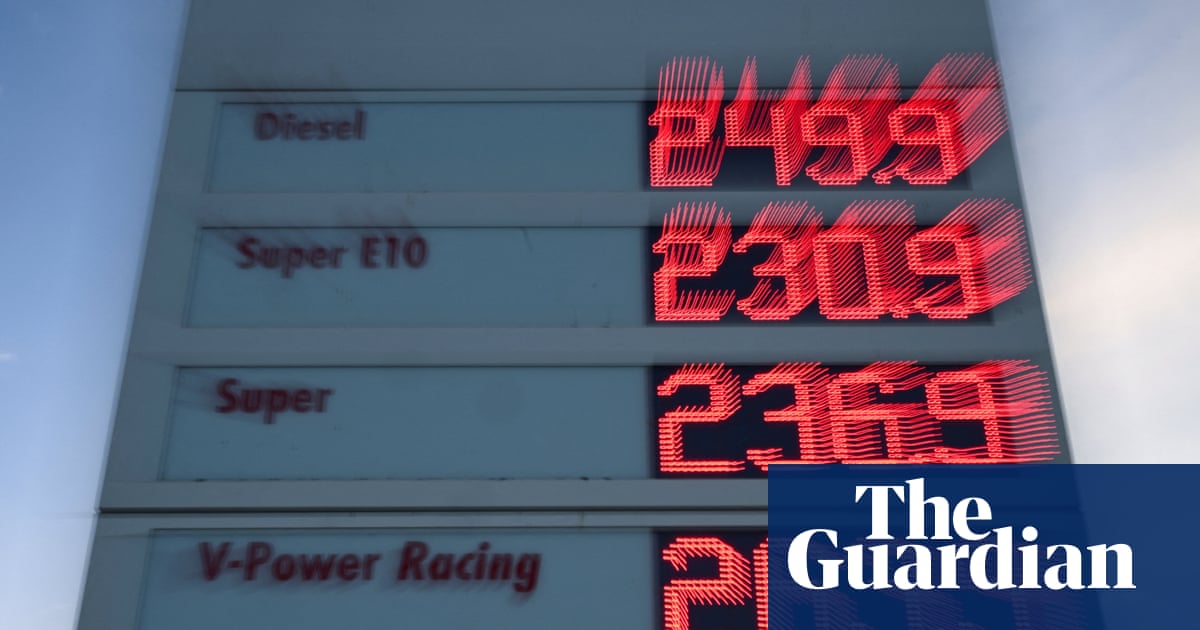
A display board shows prices at a fuel station in Leezen, Germany. Across the EU, petrol prices are 24% up on a year ago, while diesel is up 38%. Photograph: Annegret Hilse/ReutersView image in fullscreenA display board shows prices at a fuel station in Leezen, Germany. Across the EU, petrol prices are 24% up on a year ago, while diesel is up 38%. Photograph: Annegret Hilse/ReutersRecord fuel prices across EU prompt calls for bloc-wide windfall tax on firmsGerman minister says companies are ‘exploiting situation’ in Middle East, as sky-high prices become major domestic issue for leaders
European governments have discussed imposing a bloc-wide windfall tax on energy companies, as near-record fuel and gas prices pile pressure on leaders desperate to contain mounting public discontent and the challenge of the far right.
With elections due next year in eight EU countries including France, Italy, Spain and Poland, leaders are scrambling to head off the potential fallout from what analysts have warned could be one of the continent’s biggest energy shocks in decades.
Germany’s finance minister, Lars Klingbeil, called on the European Commission at a meeting of EU finance ministers in Dublin on Friday to propose possible ways to tax what he described as the excessive profits of oil companies.
“Several member states have been calling for models for a long time,” Klingbeil said, demanding proposals by next month. “People can see how oil companies are exploiting the situation, overcharging and significantly increasing their profits.”
Oil futures have climbed back above $100 a barrel, about 50% higher than before the Iran war, as escalating attacks across the Middle East threaten more supply routes. Derivatives markets suggest traders do not expect a near-term drop in prices.
Pump prices have already reached all-time highs across Europe. In Germany, diesel prices surged to a record average of €2.45 a litre on Wednesday, while petrol hit a fresh high of €2.31 a litre, according to Europe’s largest motoring association, ADAC.
Prices are even higher in the Netherlands, where petrol eclipsed last week’s record high to reach €2.73 a litre on Wednesday, with diesel at an average €2.78 a litre. Prices have risen higher still for petrol in Denmark and for diesel in Finland.
Across the EU, petrol prices are 24% higher than a year earlier, while diesel is up 38% and jet fuel costs more than 100% more. Benchmark gas is trading at €81 a megawatt hour, up 150% on a year earlier, with analysts suggesting it could hit €100.
The EU’s economic commissioner, Valdis Dombrovskis, has said the commission has no plans “at this stage” for an EU-wide taxing mechanism, but stressed it was “ready to engage in discussion” and member states were free to impose their own taxes.
Sky-high fuel prices are already a major domestic political issue in France and Italy, both of which next year face crunch elections in which voters’ concerns are likely to be dominated by the soaring cost of living, driven largely by high energy prices.
In Italy, Giorgia Meloni’s ruling rightwing coalition, trailing rivals in the polls, said this week it would scrap road tax for 14.5m cars and motorbikes from next year at a cost of over €2bn, on top of a cut to diesel duty that has already cost €2.8bn.
“We have chosen to redirect a portion of the resources used to address rising fuel prices into a simple, structural measure designed especially for those who use cars and motorcycles every day to work, take their children, or get around,” Meloni said.
France’s president, Emmanuel Macron, told ministers he wanted the government’s “full mobilisation” on fuel supply and prices, including efforts to secure supplies internationally by working toward the “peaceful reopening” of the strait of Hormuz.
In the latest of a wave of protests, French fishers blocked access to two ports and a fuel depot in southern France on Thursday over soaring diesel prices that this week rose to €2.37 a litre, just below their record of €2.38.
The fisheries minister, Catherine Chabaud, said the fishers had agreed after six hours of talks to lift the blockades after a promise that those with cashflow issues would be granted zero-interest loans and support measures would to be tied to fuel price changes.
The prime minister, Sébastien Lecornu, this week extended emergency fuel subsidies until the end of the year for the agriculture, fishing and construction sectors. But the government is reluctant to step in to cut fuel prices for all.
“Blanket measures that affect everyone – including those who don’t need them – are a false economy,” the country’s finance minister, Roland Lescure, told journalists earlier in the week. “Why? Because ultimately, we’ll have to fund them.”
In August, Spain doubled its diesel tax discount to €0.20 a litre from 1 September after diesel prices jumped by 15.7% in July, while in Germany, the embattled chancellor, Friedrich Merz, has promised action “soon” to ease the impact of record fuel prices.
Berlin cut fuel taxes for two months in May, but that lapsed just as renewed clashes in the Middle East began further pushed up oil prices. Merz’s centre-right CDU was this month heavily defeated in state elections in Saxony-Anhalt by the far-right AfD.
Two more state elections this weekend are likely to bring further gains for the far-right party, which has campaigned on a platform of a return to the cheap Russian gas imports Europe largely abandoned after Russia’s invasion of Ukraine in 2022.