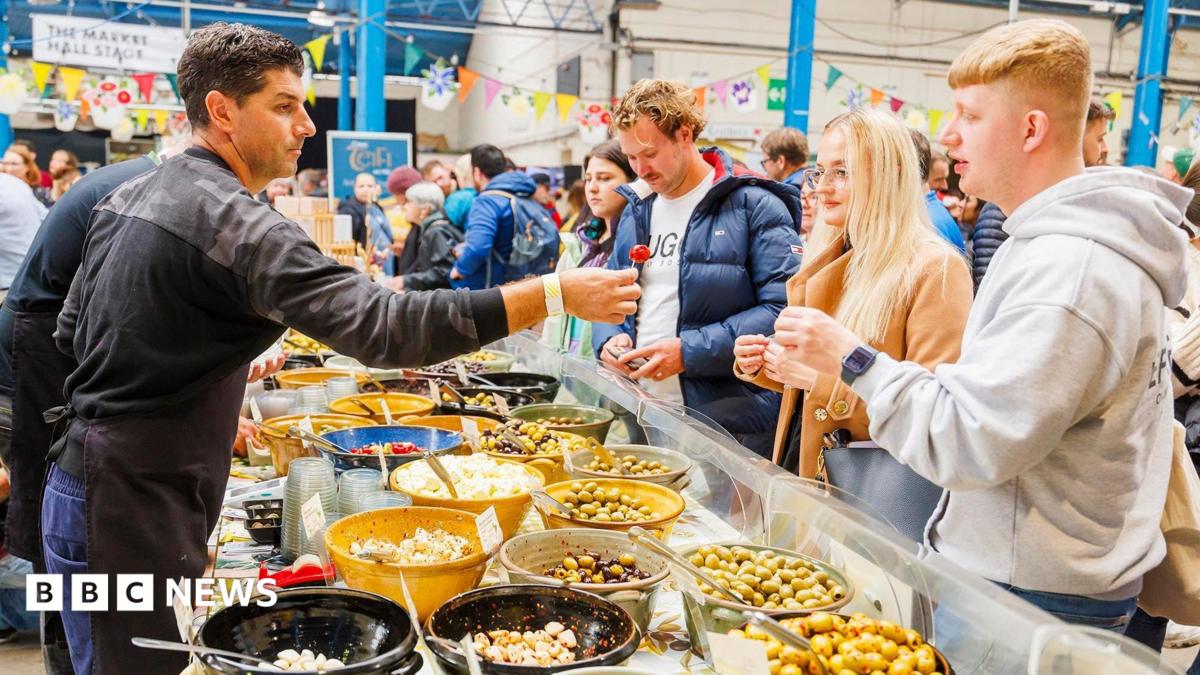
Image source, Tim WoodierImage caption, Food festivals like Abergavenny are vital points in the calendar for many catering businesses
British food festivals are being used to target small food and craft businesses in a scam made possible by artificial intelligence (AI).
A BBC Wales investigation found dozens of traders received professional-looking emails purporting to be from festivals with any requests for money only coming after multiple emails are exchanged.
One trader whose "heart sank" when she discovered she had lost money, said that despite spotting scams regularly, the multiple emails she exchanged were "so realistic" that she fell for one.
Abergavenny Food Festival said the accessibility of AI meant scammers could reach more people with scams that look "far more believable".
Image source, Harriet ThomasImage caption, Harriet attends food and craft festivals and runs workshops across south Wales
Harriet Thomas had applied for a stand at the Abergavenny Food Festival on previous years, and was "really excited" when an email came offering her the opportunity to book a place for her knitting workshops.
She said that as she spent so much time on a computer running her business, she was used to seeing scams, but this time "nothing sparked a red flag".
Unlike other scam emails, the one in question "looked completely genuine" including the email address it had been sent from.
"[I] filled in a jot form, which is something we use all the time and again, all the fonts, everything, [and] the branding was completely legitimate," she said.
She said she had been reassured by subsequent email exchanges which showed the sender had detailed knowledge of the Abergavenny festival site and facilities on offer, until she finally paid for a pitch.
It was only after she published a Facebook post to say she would be at the festival, that she saw a social media post from the real one warning about the scam emails.
"My heart just sank. I was so embarrassed," she said.
Despite publicising her experience to warn other traders and reporting the scam, she said she did not know how they could be stopped.
"It's getting more and more competitive to try and get a stall at these events. So people are more likely to fill a form in quickly thinking, I really, really want to make sure I secure my space," she said.
Image source, Tim WoodierImage caption, For one weekend in September, the food festival takes over the market town of Abergavenny
Scam emails seen by BBC Wales that used the branding, details and even the names of staff from food festivals right across the country, including Narberth, York, Broadmead, Ludlow, Mold, the Forest of Dean, Newport and St Fagans.
Andy Fryers who coordinates Abergavenny Food Festival said the number and credibility of the scams it had seen had made things "much more difficult" for them this year.
There was no conclusive proof the scam was powered by AI, but experts have said it would not have been possible five years ago.
"I think it's the evolution of AI and the easy accessibility of it now," Fryers said.
"Anyone can get on to Claude or ChatGPT, or whichever one you want to go with, and within a few minutes get it to search out all traders in a certain area, get contact details, search our website, get contact details, make up a couple of Gmail accounts.
"It's very straightforward and quite cheap and you can blanket approach these things."
The most recent figures from Report Fraud - the reporting service for cyber crime and fraud across England, Wales and Northern Ireland - echo that, with an increase of 395% in reports which were linked to AI during 2025-26 compared to the previous year.
Image caption, Food festivals such as Abergavenny are a labour of love for people like Andy
With many festivals ran by volunteers and attended by small, local traders, Fryers said seeing the emails that used his name had initially been a shock.
"You can feel like this person is targeting you, and when we first started getting these it felt a little bit like someone trying to do over the festival," he said.
"But actually you realise when you start seeing other festivals being targeted by the same thing, you realise actually it's not. This is a computer-generated thing.
"Obviously someone's putting it in but... it isn't personal, it's just someone trying to scam you, it's just someone trying to make a quick buck."
Another local company paid £400 to the scammers and bought stock to sell at the festival before they realised they had been scammed.
The festival managed to find space for them at a discounted price, but organisers said they worried that if others turn up on the day having been caught out, it may not be possible to help them also.
Image source, UK Finance/ Giles MasonImage caption, Giles Mason tries to educate the public on how to avoid being scammed
Giles Mason, who runs the Take 5 to Stop Fraud campaign at UK Finance which represents the banking and finance industry, said scam emails used to be "riddled with spelling mistakes, poor grammar".
"The use of AI means that that has been wiped out, and also using sort of official looking imagery, graphics, to make it look as convincing as possible as well," he said.
He said that targeting sole traders or volunteer-run operations was an attempt to bypass the security systems of big companies like banks who have had to "invest heavily in stopping scams and building very secure systems to protect their customers".
Two-thirds of these types of scams now start through contact online.
But with £1.3 billion stolen through fraud and scams, last year, he said that if you receive an email, call or text, "particularly if it's out of the blue, just take that moment to stop and think".
He said: "If it's a genuine organisation, they won't mind you taking that moment to stop.
"Go to the company's official website and contact the organisation through the details on there so you know you're dealing with them direct and not with the scammer."
Learner drivers turn to YouTube and TikTok to cut costs - but instructors warn of risks
Repeat offender fined for searching for gold in protected river
Ex-BBC presenter questions role of Royal Family in new documentary