3-MIN READ3-MINAdvertising partnerPublished: 10:00am, 18 Sep 2026[The content of this article has been produced by our advertising partner.]
Hong Kong is preparing for many more electric vehicles on its roads. The city’s First Five-Year Plan, announced alongside the Policy Address, calls for the steady electrification of vehicles and safe, efficient charging networks, with around 10,000 fast chargers expected by 2035 to support about 500,000 EVs.
That longer-term target follows an updated EV roadmap released in February, which calls for fast chargers to become the backbone of Hong Kong’s public charging network. An interim target of at least 4,000 fast chargers has been set for 2030, supporting about 200,000 EVs.
Industry is responding with different initiatives, from expanding charging networks to introducing technology designed to get motorists back on the road more quickly.
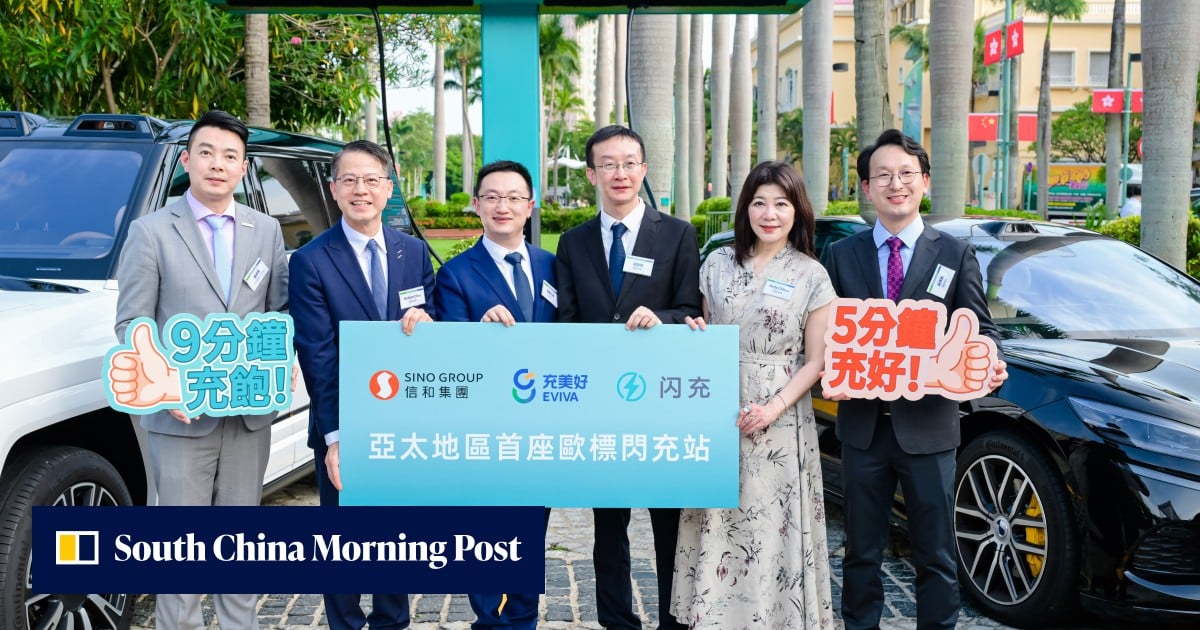
At Gold Coast Piazza in Tuen Mun, a new ultra-fast charging station can compress charging times to as little as five minutes for compatible EVs. The system can charge a compatible EV battery from 10 to 70 per cent in five minutes, or from 10 to 97 per cent in nine minutes.
The pilot project is a collaboration between Sino Group, BYD, CR EVIVA and iCar, with each contributing to its development and operation.
The technology is also being made available to EVs from other manufacturers. Vehicles equipped with the compatible European-standard CCS2 charging interface can use the station, with charging performance depending on the capabilities of each vehicle.
“Sino Group has, in fact, continued to expand EV charging facilities across its managed properties over the years, with more than 2,200 charging points currently available across its portfolio,” said Bella Chhoa, Chief Commercial Officer of Sino Group.
Charging away from home
Speed, however, is only one consideration in meeting Hong Kong’s charging needs.
Research published by HKU Business School found that private cars in Hong Kong travel about 30km a day on average, meaning a full charge in most mainstream private EVs can cover more than a week of usual commuting.
Away from home, faster charging provides another option for motorists who want to replenish their batteries and continue their journeys with minimal delay. For commercial vehicles such as taxis and light goods vehicles, spending less time charging also means getting back to work sooner.
CR EVIVA brings experience from operating one of Hong Kong’s largest charging networks. According to the company, its network covers more than 1,700 contracted charging spaces, including around 400 DC fast and ultra-fast charging spaces. It introduced 500kW fully liquid-cooled charging technology in 2024 and is now working with partners on the latest ultra-fast charging technology at Gold Coast.
Delivering ultra-fast charging presents a technical challenge since higher charging power requires more electricity to be available at a charging site.
This is addressed at the EVIVA ultra-fast charging station at Gold Coast through energy storage. Fully liquid-cooled charging equipment is used in conjunction with an energy-storage battery system, allowing electricity to be stored and released at high power when a vehicle plugs in.
Safety and compatibility have also been considered. The station uses the European CCS2 charging standard and has undergone the necessary approval procedures in Hong Kong.
The road ahead
EV technology is advancing in parallel with charging infrastructure. BYD’s Flash Charging technology is designed to work with vehicles equipped to support higher charging speeds, including models using its second-generation Blade Battery technology.
Ouyang Xiaocheng, BYD Hong Kong Sales Director, said the Gold Coast station represented an important development for the company’s Flash Charging technology as it expands its use outside the mainland market.
At the launch, BYD and iCar Group also announced the establishment of Hedi Flash Charging Technology, a joint venture intended to support the development and operation of charging infrastructure in Hong Kong.
“We will continue working with local partners to provide drivers with more efficient and safer ultra-fast charging,” he said.
“We believe our collaboration with EVIVA, BYD and iCar will give drivers a more efficient and convenient charging option and support greater EV adoption,” said Chhoa.