play Live Sign upShow navigation menuplay Live Click here to searchsearchSign upNews|Israel attacks LebanonMacron and Aoun discuss efforts to back Lebanon’s army, end Israeli attacksThe French presidency said the aim of the Paris talks was to review a Lebanese armed forces deployment plan.
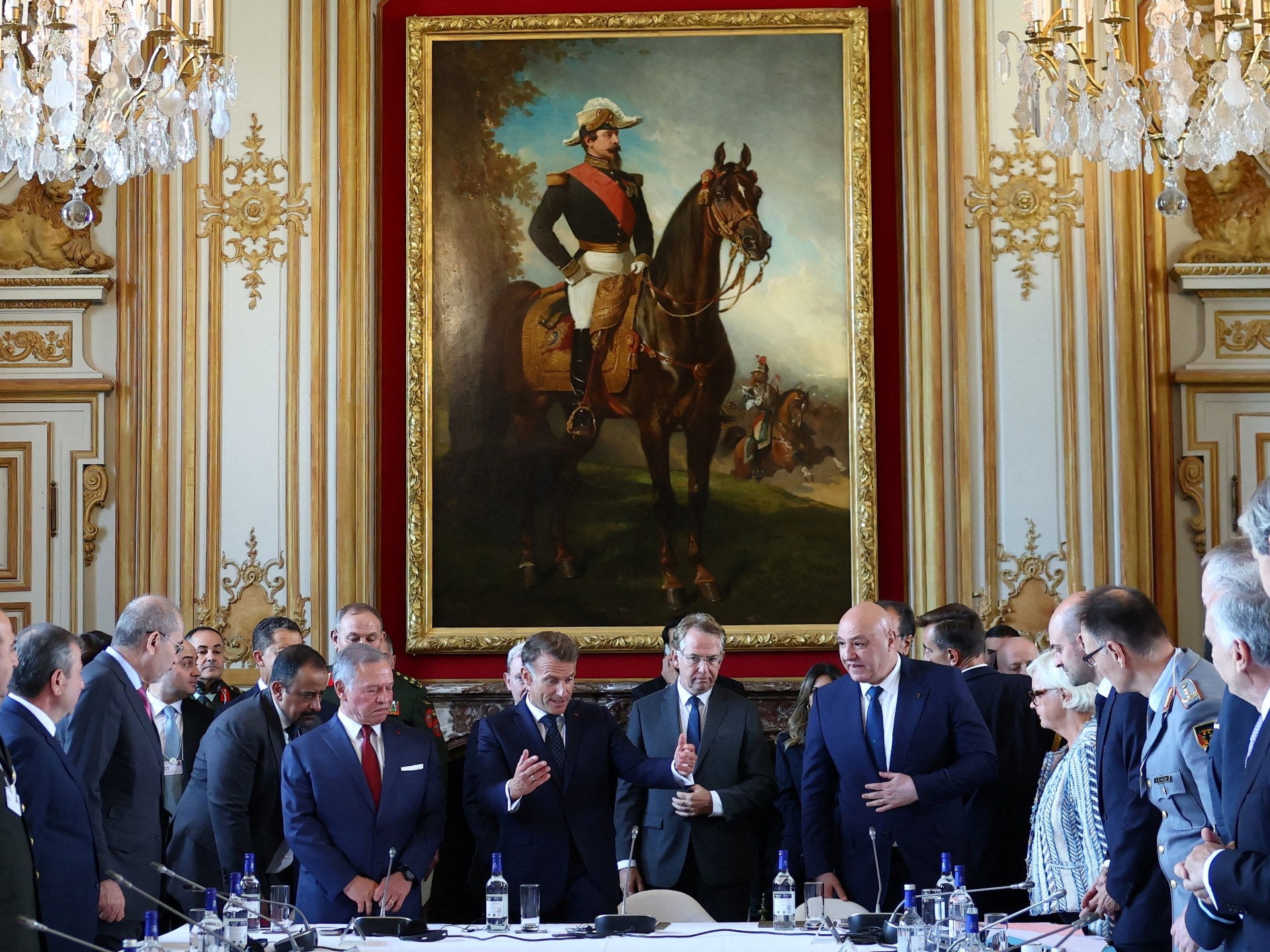
xwhatsapp-strokecopylinkgoogleAdd Al Jazeera on GoogleinfoFrench President Emmanuel Macron, centre, Jordan's King Abdullah II, centre left, and Lebanese President Joseph Aoun, centre right, open the 'Aqaba Process' meeting in support of the Lebanese Armed Forces at the Hotel des Invalides in Paris [Gonzalo Fuentes/Pool Photo via AP]By Al Jazeera Staff, AFP and AnadoluPublished On 17 Sep 202617 Sep 2026The leaders of France, Lebanon and Jordan convened in Paris to drum up international support for the Lebanese army.
Macron welcomed Lebanese President Joseph Aoun and King Abdullah II of Jordan to Paris for the talks on Thursday.
The meetings come after a US-mediated framework deal was agreed between Israel and Lebanon in June. But the agreement did not force Israel to withdraw from the large area of southern Lebanon it occupies, and Israel has continued its attacks on the country.
The agenda also included the creation of a new force to succeed a longstanding United Nations peacekeeping mission in southern Lebanon.
The officials were later joined by chiefs of defence staff from Lebanon, Jordan, France, the United Kingdom and Italy, as well as top US and Saudi officials, a French military source told the AFP news agency.
Macron said that the talks aimed to “strengthen Lebanon’s sovereignty and enable it to fully ensure its security”.
“A sovereign and stable Lebanon is a decisive step toward peace and stability for the entire region,” Macron wrote in a statement on X.
“We support the Lebanese Armed Forces, which are indispensable for asserting the authority of the Lebanese state across its entire territory,” he added.
The French presidency said the aim of the Paris talks was to review a Lebanese armed forces deployment plan based on a “clear, credible and realistic” framework.
Paris said it wanted this as a prerequisite for what it hopes will be “robust” international support, whether in the form of financial assistance, equipment or training.
Earlier in the day, Aoun and Macron also discussed “efforts to put an end to Israeli attacks in light of the Lebanese-American-Israeli negotiations and the ‘framework agreement’”, according to the Lebanese presidency.
Aoun also said the Lebanese army is the “main pillar for protecting Lebanon’s sovereignty”, stressing that strengthening state authority is a Lebanese choice rather than an externally imposed demand.
The Lebanese president expressed his “profound relief” at the progress of the talks, his office said in a statement on X, adding that he also expressed hope that the needs of the Lebanese army would be met by its allies.
Aoun reiterated his affirmation that only the state should have arms and praised the Lebanese army’s role in working towards the country’s stability.
The poorly equipped Lebanese forces have struggled to carry out their mission to disarm Hezbollah in the south.
Aoun has repeatedly stated his determination to disarm Hezbollah, but “without a confrontation”.
The talks also come as the mandate of the United Nations Interim Force in Lebanon (UNIFIL) ends this year after almost half a century of operations dating back to the Israeli invasion of 1978.
Last year, the UN Security Council, under US pressure, decided to end UNIFIL’s mandate on December 31, 2026.
France and Italy have said they want to set up a multinational coalition to succeed UNIFIL. The force has just fewer than 7,500 peacekeepers from 46 countries.
Aoun told the AFP this week that Lebanon wanted a new force, European or otherwise, to prevent a security vacuum after the UN peacekeepers leave south Lebanon.
Israel and the United States attacked Iran in February, setting off a war that has spread across the Middle East, including in Lebanon, with Israeli forces fighting Hezbollah.
Israel invaded southern Lebanon, and its forces continue to occupy what is a stretch of Lebanese territory about 10 kilometres (six miles) deep along the border.
In June, Israel and Lebanon signed a US-sponsored framework agreement that involves the disarmament of Hezbollah, a gradual withdrawal of Israeli forces from Lebanon’s south and the deployment of the Lebanese army to the region.
Fears of a renewed Israeli military campaign, however, are growing in Lebanon after escalating attacks, despite the “ceasefire” agreed to in June.