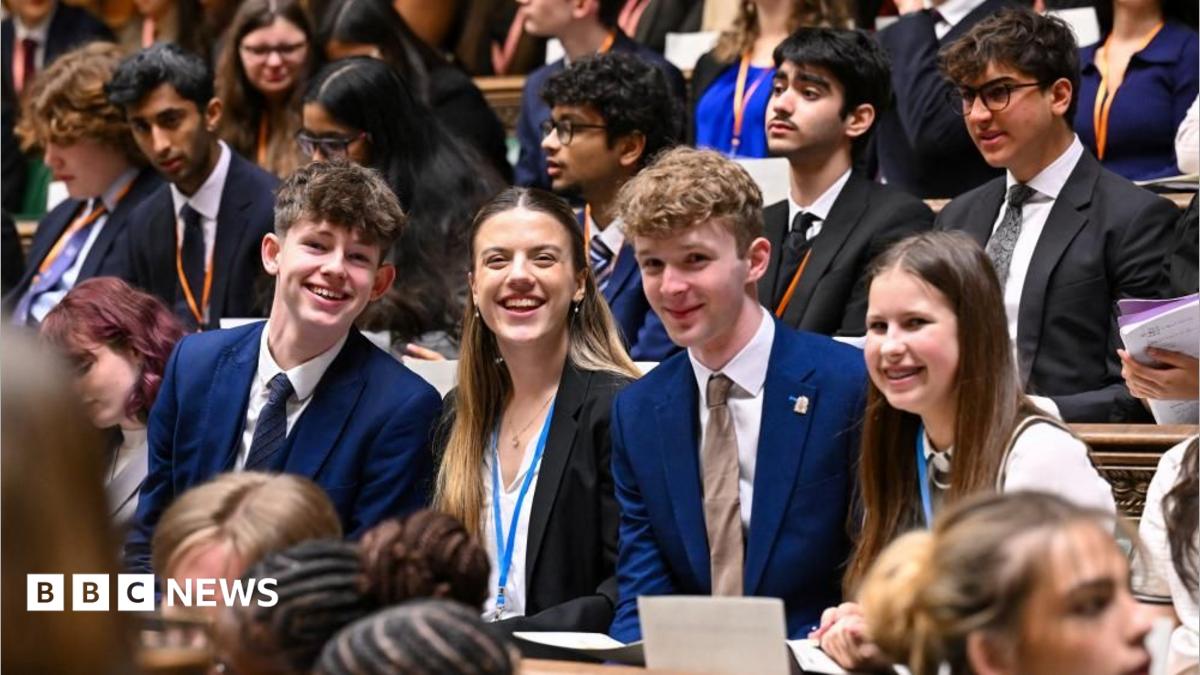
Image source, House of Commons/ReutersImage caption, Members of Youth Parliament pictured in the House of Commons chamber in February 2025
The UK Youth Parliament is at risk of being axed within months, BBC News has learned, as the government is not committing to funding it any longer.
The parliament was launched in 2000 to boost interest in politics among young people and has more than 300 elected members aged between 11 and 18.
Once a year, the young politicians are allowed to hold debates in the House of Commons chamber, on a day when MPs are not sitting.
Some MPs and young people say axing it would be a blow for youth democracy, while others say it is not providing value for money.
The Department of Culture, Media and Sport (DCMS), which funds the parliament each year with taxpayer cash, is not committing to giving any more grants to it.
A spokesperson for the DCMS praised the youth parliament's "important legacy... giving elected young people a national platform to represent their peers, engage with decision-makers and develop confidence, leadership and skills for life and work".
It received £453,000 in taxpayer funding in the last year alone with about £2.4m public money spent on it among other youth initiatives between 2017 and 2024.
While no final decision has been made on funding beyond March 2027, a government source said: "The government has not committed to continuing the programme in its current form."
UK Youth Parliament insiders told the BBC that without government funding, it is likely to close.
It follows a government review, external published in October last year, which concluded that while the parliament was delivering on its intended goals, only a quarter of young people know about it - and some schools felt "excluded from the process."
The government says it is working with young people and youth organisations to design a new scheme that increases their involvement in democracy and decision-making, with further announcements to be made this autumn.
Any new scheme will have a "particular focus on under-represented groups", a government source said.
Bobby Forbes, the recently departed chair of the UK Youth Parliament's Youth Select Committee, which works with officials in Westminster, said it gives teenagers "a direct way to scrutinise government and hold decision-makers to account".
Image caption, Bobby Forbes, 18, was a member of the UK Youth Parliament until recently
The 18-year-old said scrapping it "would be a huge mistake and detrimental to youth voice across the UK," and it should be allowed to evolve within its current format.
But Jack Rankin, the Conservative MP for Windsor, said last year it "should not receive taxpayers' money and should not sit in the Chamber of the House of Commons".
He has said it should be funded by voluntary donations rather than public money. It is understood the funding is spent on the UK Youth Parliament's annual conference, held in Brighton last year, plus travel, communication and support staff.
The youth parliament is run by the National Youth Agency, but was previously under the British Youth Council which closed amid financial challenges in 2024.
Members are elected every one to two years by voters aged 11 to 18 who live, work or go to school in local authorities. Similar schemes are held for the devolved Scottish, Welsh and Northern Irish parliaments.
Some politicians started their careers in the UK Youth Parliament, including Labour minister Keir Mather who was became the younges MP in 2023 - known as the "baby of the House" - when elected aged 25.
Peter Swallow, the Labour MP for Bracknell in Berkshire who ran for UK Youth Parliament aged 14, told the BBC the organisation has campaigned successfully on issues such as votes for 16-year-olds.
A Bill to lower the voting age from 18 to 16 for all UK elections is currently making its way through Parliament.
It would be "short-sighted to cut off funding to a scheme" given these developments, Swallow said.
"As we face a world where trust in politics is low and young people in particular are doubting the value of democratic institutions, I cannot imagine a more important time for young people to be invited into the heart of our democracy through programmes like UK Youth Parliament."
Bill to lower voting age to 16 introduced in Parliament