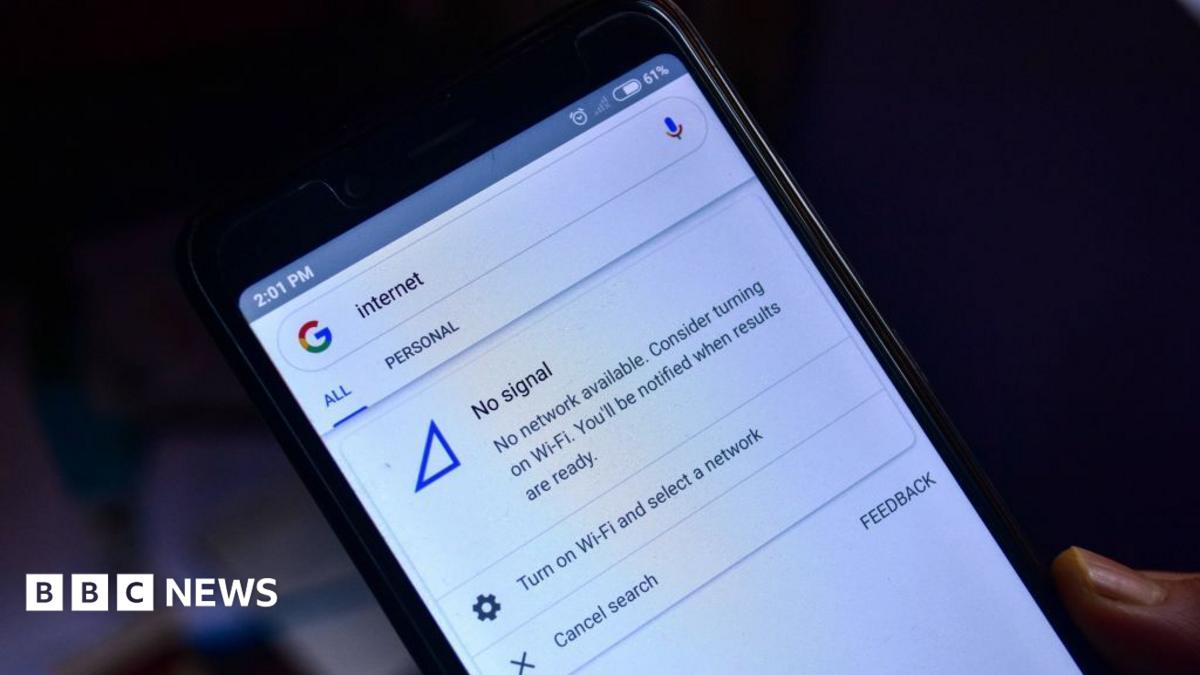
Mobile users across London say their mobile service is becoming increasingly unreliable, with reports of slow data speeds, failed connections and calls not getting through.
Mobile UK, the trade association representing the UK's major mobile networks, said London's mobile phone connectivity "continues to lag frustratingly behind other international hubs".
Data commissioned by the BBC England Data Unit found some of the worst areas were Liverpool Street and Covent Garden, where service proved to be extremely slow and unreliable during rush hour but worked normally during quieter periods.
So what impact does this lack of connectivity have on Londoners and their ability to earn a living, and what are the reasons behind it?
Virgin Media O2 recently called for urgent reform after being "forced" to switch off dozens of mobile sites across London because of new building developments.
Once a development receives planning consent, mobile operators are issued a notice-to-quit and must remove their antennas.
They are given an 18-month period to find a new site - although they say finding new antenna sites can take an average of two years. Temporary sites need to be found to maintain signal coverage.
Robert Joyce, director of mobile access engineering at Virgin Media O2, said: "If we can't find a replacement site before we remove that equipment then we can have a coverage hole in that location."
Image source, Google MapsImage caption, A survey taken near Covent Garden found that almost every mobile data test across four UK networks had failed
Operators say that thousands of people can be affected when a site is lost and cannot be replaced.
Mobile UK, which represents EE, O2, Three and Vodafone, said: "Delivering world-class coverage is an uphill battle in a high-density city where development constantly reshapes the skyline."
Network capacity is the total amount of data a network can handle at any given time.
Mobile users can have four or five signal bars but still experience slow uploads, undelivered messages and failed calls when a network is congested.
Philip Maguire, the founder and CEO of network measurement service Inakalum, said: "When the areas are busy, very often the networks don't have enough capacity to deal with all the data demands from users, and that's a capacity issue not a signal problem."
He added that most people would have "no chance" finding a reliable connection in the evening after leaving work despite the signal working in the early morning.
Image source, CureCleansImage caption, Adikalie Sumah, who runs a shoe-cleaning business, says the poor coverage is affecting his work
Philip surveyed three streets on behalf of the England Data Unit, all within a few minutes' walk of Covent Garden, on a weekday evening. He found that more than one in four data tests across EE, O2, Three and Vodafone failed outright.
Even when the networks worked, the data speed was found to be unreliable or slow - stuck under 15 Mbps (megabits per second). This meant that many people in the heart of the West End would struggle with basic tasks, such as loading maps or making video calls.
However, tests on the same streets at less busy times found that all four networks performed well, highlighting an issue of congestion rather than coverage.
Adikalie Sumah, from Southwark, runs the shoe-cleaning business CureCleans and recently relocated to an office near London Bridge.
The move was designed to create easier access for customers and delivery drivers to drop off and collect their shoes, but he says the mobile signal is so bad he struggles to take calls in the office.
He uses EE, but the rest of the team use a range of network providers including O2 and Three.
Adikalie said: "When we're trying to contact customers to pick up and drop off their shoes, it's a bit of a struggle trying to get through to them."
They make and receive a lot of phone calls while taking orders and organising deliveries, and the poor service makes their work difficult.
At the moment, Adikalie manages this problem by taking phone calls outside the office and leaving all the doors and windows open to improve the signal, but says this means they sometimes get complaints from the neighbours.
He added that with winter approaching and because of the noise complaints, taking calls outside the office would no longer be an option. He said he had contacted his landlord about the issue but was told nothing could be done to improve it.
Adikalie mainly subcontracts to young people across Southwark, helping them to gain work experience, and while he hopes to keep offering these opportunities, he worries poor mobile service could hold the company back.
Image source, CureCleansImage caption, Joshua Folorunsho struggles to find a mobile signal in central London
Joshua Folorunsho, 22, from Peckham, is a full-time content creator and an employee at CureCleans.
He is known as JTA across his social media platforms and creates content for the company.
"Obviously this is my livelihood so without it I'm not able to eat and put clothes on my back, so it's very important to me," he said.
Joshua, who has been using the services of Three since he was 15, said: "Sometimes when I call people it doesn't even ring, but I have service."
He said he struggled to find a reliable mobile signal when travelling across central London unless he's "lucky".
Joshua said he contacted a Three store in his local area but was told there was nothing they could do - and they said they also had poor mobile service.
Victoria Olaofe, 24, from Bermondsey, works as a sales representative near St Paul's, and she says that her poor mobile service means she misses out on pay.
"There have been occasions where my manager has tried to contact me, but I simply haven't received the calls or messages until much later. It's even affected things like clocking in on my phone."
Victoria gets paid by the hour and needs to clock into work using her phone, but her mobile data becomes unusable once she's in central London. This means she cannot clock in until hours later.
She said there did not seem to be any solution, so she just loses pay.
"I've also tried troubleshooting the issue. My mum even contacted Three after experiencing poor coverage in her area, and although my experience isn't identical to hers, it made me realise there may be a wider issue."
In response to a social media callout, Victoria said: "I realised I'm clearly not the only person experiencing this.
"It was reassuring to see that others are reporting similar issues, although it's concerning that so many people seem to be affected."
Experts say capacity shortfalls during busy times, housing developments and planning regulations are partly to blame, with rules varying across London's 33 councils - creating more challenges for network providers.
A spokesperson for London Councils, which represents all the local authorities in the capital, said: "The London Growth Plan and London Infrastructure Framework we developed jointly with the mayor highlight the importance of digital infrastructure and mobile connectivity.
"There is a range of factors behind the current connectivity problems, but boroughs take this issue seriously and are working with network providers and other partners to help resolve them."
Mobile UK said that mobile operators had invested "billions of pounds to upgrade their networks across London" and were committed to working with the government and local councils to improve mobile phone service.
The organisation also said it recognised that the Draft London Plan, external acknowledged the challenge housing developments posed to mobile operators in London, but it wants urgent policy reform on planning and a "unified framework that treats digital infrastructure as a priority".
A government spokesperson said: "Fast, reliable digital infrastructure is fundamental to a growing economy, keeping people connected wherever they live, work or commute. That's why we are working with industry to deliver our ambition for higher-quality standalone 5G coverage across all populated areas of the UK by 2030.
"We recognise that demand on mobile networks is growing, particularly in busy urban areas, and are reviewing planning rules and working through our Mobile Market Review to support investment, improve network performance and make it quicker and easier to build the infrastructure consumers and businesses need."
Listen to the best of BBC Radio London on Sounds and follow BBC London on Facebook, external, X, external and Instagram, external. Send your story ideas to hello.bbclondon@bbc.co.uk, external
Find out if your area is an internet 'not-spot'