Video FIBA Secretary General Andreas Zagklis on why 'men's' label has not been added to flagship World Cup event FIBA Secretary General Andreas Zagklis addressed why the organization has not labeled its primary World Cup the 'men's' World Cup, referencing 'concerns' over the differences between men and women.
FIBA Secretary General Andreas Zagklis addressed the organization’s decision not to formally label its flagship global tournament the "Men’s Basketball World Cup," connecting the naming debate to broader questions about eligibility in men’s and women’s competitions.
"The naming is of course a matter that the Central Board has discussed," Zagklis told reporters Sunday during a press conference ahead of the 2026 FIBA Women’s Basketball World Cup. "The Central Board has for the moment maintained the current naming. We do not see that the aspect of men’s and women’s is something that devalues or values the other World Cup in such a way."
FIBA officially calls its women’s tournament the "FIBA Women’s Basketball World Cup." Its other senior five-on-five tournament remains the "FIBA Basketball World Cup," without "men’s" in the title. Zagklis added that the organization is also considering "broader concerns" over the separation of the men's and women's categories, and referenced studies over "who can compete" in each respective competition.
FIBA SECRETARY GENERAL ANDREAS ZAGKLIS SPEAKS OUT ON CAITLIN CLARK'S IMPACT ON GROWTH OF WORLD CUP
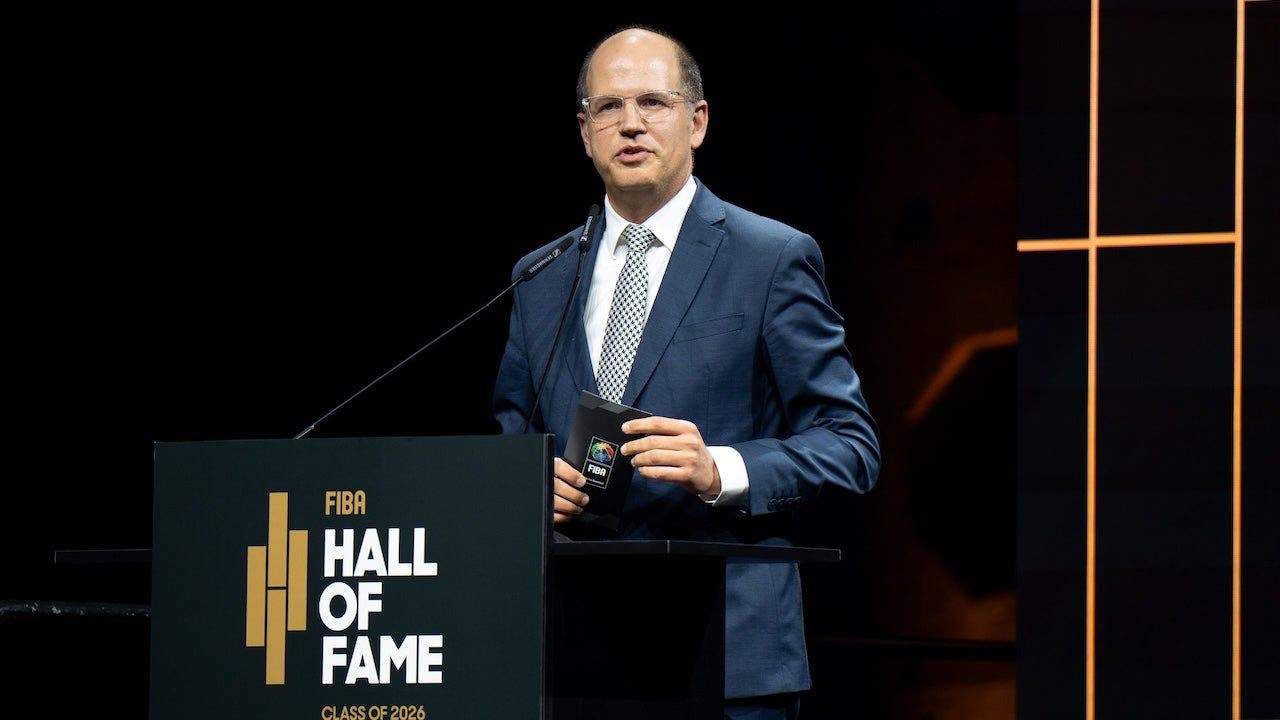
Andreas Zagklis, secretary general of FIBA, attends the FIBA Hall of Fame 2026 Enshrinement Ceremony in Berlin, Germany, on April 21, 2026. The event includes the International Basketball Federation Class of 2026 awards and induction ceremony at Kraftwerk Berlin. (NurPhoto via Getty Images)
"We also need to be cognizant of the broader concerns about men and women, and the concerns as well as the studies we are making for our competition and who can compete in the women’s World Cup and who can compete in the other World Cup, which is not necessarily just the men’s World Cup," he said.
Zagklis did not explicitly mention transgender athletes in his answer. However, FIBA has publicly confirmed that it is reviewing transgender eligibility and has established an interim approach while that process continues.
Following the International Olympic Committee’s adoption of a policy protecting the female category, the FIBA Central Board confirmed in April that FIBA will follow the IOC standard for the Olympic and Youth Olympic Games. The federation said it is waiting for further guidance on the practical, legal and operational aspects of implementation.
FIBA-run competitions, including its World Cups, remain subject to a separate review. In December 2024, the Central Board extended its process for adopting a formal transgender eligibility policy by two years.
FIBA said it is collecting basketball-specific data and evidence related to transgender participation. A Gender Eligibility Committee composed of medical and legal experts is scheduled to give the Central Board its recommendations at the beginning of 2027.
Until then, FIBA said it will not entertain transgender eligibility requests. The organization therefore has not announced a permanent policy for its own competitions, but transgender applicants cannot receive eligibility approval while the review remains underway.
Zagklis' answers come amid ongoing controversy in the WNBA, which operates under a different set of rules.
The WNBA’s collective bargaining agreement says only women may play in the league. However, it does not publicly define that term or provide specific eligibility standards for transgender or intersex players.
Debate intensified after Indiana Fever guard Sophie Cunningham supported excluding transgender women and girls from female sports. Her comments prompted demonstrations supporting and opposing transgender participation outside WNBA games.
WNBA COMMISSIONER CATHY ENGELBERT SENDS TRANS INCLUSION MEMO AFTER ENES FREEDOM, ROYCE WHITE ANNOUNCEMENTS
THE CRAIG CARTON SHOW–UNFILTERED, UNAPOLOGETIC AND UNMISSABLE. DOWNLOAD HIS DAILY PODCAST NOW!
Former NBA players Enes Kanter Freedom and Royce White later declared themselves eligible for a future WNBA draft after publicly identifying themselves as women. Their announcements were widely viewed as attempts to challenge the wording of the league’s eligibility rule.
A WNBA task force discussed the subject in August but did not adopt a new standard. The league said no immediate eligibility matter affected the WNBA and condemned "bad-faith" efforts to demean or marginalize others.
Supporters of sex-based eligibility rules argue that clear boundaries protect fairness and opportunities in women’s sports. Supporters of transgender inclusion argue that blanket restrictions can discriminate against a small and frequently targeted population.
Unlike the WNBA, FIBA has announced a formal review, created an expert committee and established a timeline for recommendations. But it has not disclosed the evidence collected so far or indicated what policy it may ultimately adopt.
CLICK HERE TO DOWNLOAD THE FOX NEWS APP
Zagklis’ remarks did not announce a new rule. They showed that FIBA’s decision to leave "men’s" out of its World Cup name exists alongside a continuing discussion about how the organization will define eligibility for both competitions.
When asked about the nature and purpose of the studies Zagklis was referring to and whether FIBA would anticipate biological males competing in the next FIBA Women's World Cup, FIBA pointed OutKick to the Central Board meeting back in April before the tournament began.
Jackson Thompson is a sports reporter for Fox News Digital covering critical political and cultural issues in sports, with an investigative lens. Jackson's reporting has been cited in federal government actions related to the enforcement of Title IX, and in legacy media outlets including The New York Times, The Los Angeles Times, The Philadelphia Inquirer, The Associated Press and ESPN.com.