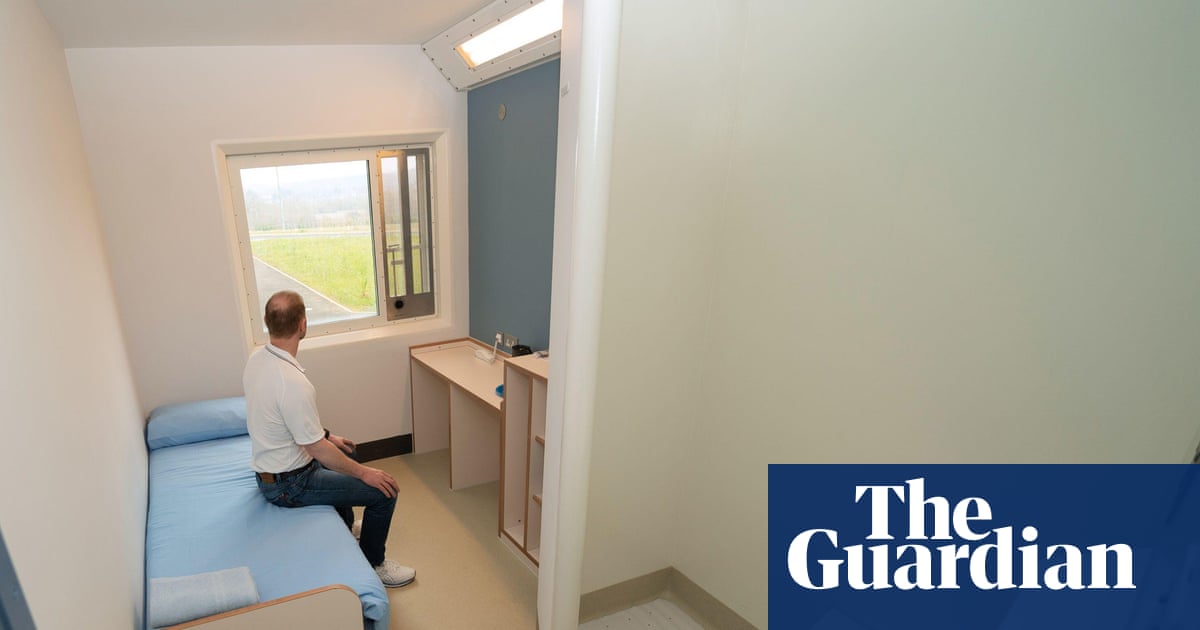
An example of an existing category C prison cell. Photograph: PA Images/AlamyView image in fullscreenAn example of an existing category C prison cell. Photograph: PA Images/AlamyPrisoners to ‘double up’ in one-person prefab cells, leaked documents showExclusive: Ten category C prisons in England and Wales asked to add second beds, in breach of safe occupancy limits
The Prison Service has drawn up plans to “double up” hundreds of prisoners in temporary prefabricated cells built for one person, at the request of the Ministry of Justice, leaked documents show.
Amid an ongoing overcrowding crisis in England and Wales, governors of 10 category C prisons have been asked to sign off the installation of second beds in “rapid deployment cells [RDCs]”.
The units, some of which measure 2.9 metres by 3.4 metres and include a bed, toilet and shower, were placed in the grounds of more than 15 prisons as a temporary solution to past overcrowding problems.
Estimated to have a 15-year lifespan, the steel-framed “pods” can be stacked to be two storeys and are usually occupied by low-risk prisoners, some of whom have been allowed to move into them as a reward for good behaviour.
According to leaked emails, the planned doubling-up suggested by Ministry of Justice officials would increase the overall capacity of the prison estate by 476.
Responding to the leaked documents, governors and prison officers said the numbers being proposed by Whitehall could breach health and safety laws and make jails unsafe for prisoners, staff and the public.
The plans were disclosed in an email sent on 27 August by a senior Prison Service executive to governors.
“As you are aware, maximising available prison capacity is of high ministerial interest, and HMPPS [His Majesty’s Prison and Probation Service] have been asked to explore the viability of crowding Rapid Deployment Cell accommodation,” the executive wrote.
“The physical viability of installing a second bed in these units has been worked through at pace, and the assessment … is that ground floor units only are suitable to install a second bed.
“Given continued high population growth, and less supply coming online than anticipated, it is important that all potential capacity is identified quickly, and as such the panels need to take place over the next few days.”
The email was sent three days before Andy Burnham announced a substantial narrowing of prisoners’ eligibility for the government’s early release scheme, blocking hundreds of violent criminals from being freed.
Read moreAccording to a second leaked document, the doubling up plans would include beds being added to temporary cells in the following prisons: Wayland, in Norfolk (43 beds); Littlehey, in Cambridgeshire (60); Erlestoke, in Wiltshire (66); and Rochester, in Kent (60).
Other prisons asked to find extra capacity in temporary cells include The Verne, in Dorset; Wymott, in Lancashire; Channings Wood, in Devon; Whatton, in Nottingham, which is a prison for people convicted of sexual offences; The Mount, in Hertfordshire; and Huntercombe, in Oxfordshire.
The second document also shows that the doubling up proposals would breach “operational capacity”, putting the number of prisoners above safe occupancy levels.
Mark Fairhurst, the national chair of the Prison Officers Association, said capacity breaches could prompt industrial action by his members. “By law our members cannot strike, but I know they would walk out on health and safety grounds if asked to oversee prisons which cannot cope with the numbers being proposed,” he said.
“Creating more space increases the pressure on an already overcrowded prison estate and risks the stability of prisons. If the government are convinced that early release schemes are sufficient, you have to ask why they are now insisting prisons source every available bit of spare capacity.”
Tom Wheatley, the president of the Prison Governors Association, said a full risk assessment would have to be carried out on each prison to ensure the public and staff remained safe if doubling up occurred.
“RDCs are amongst the least secure accommodation in the prison estate and prisoners located in them will have to be risk assessed. If you don’t do this, the prison won’t be sufficiently safe or secure,” he said.
“Increasing the operational capacity of a prison isn’t as simple as putting bunk beds in cells. There needs to be staff available to supervise the additional prisoners and there needs to be additional regime activities.”
Andrea Coomber, the chief executive of the Howard League for Penal Reform, said the proposal was an act of desperation.
“Rapid deployment cells were themselves meant to be a short-term response but, ironically, they have come to be seen as being among the more positive parts of the prison estate, with fewer issues related to violence, debt and drug misuse. The risk now is that all this will be undermined as more and more people get crammed in,” she said.
There are 87,111 people in prison in England and Wales. Under the Ministry of Justice’s own definition of safety and decency, the prison estate should not hold more than 81,616 people.
Reacting to the leaked documents, a ministry spokesperson said the department was investing up to £4.7bn creating 14,000 new prison places.
“As the public would expect, we’re pulling every lever available to ensure there is always space to lock up dangerous offenders,” the spokesperson said.
“Cells are only doubled up where it is safe to do so, and no final decision has been taken on these units.”