Add The New York Post on Google Talk about divine inspiration.
A former Lower East Side synagogue that later became a creative haven for generations of New York artists has hit the market for $10.95 million.
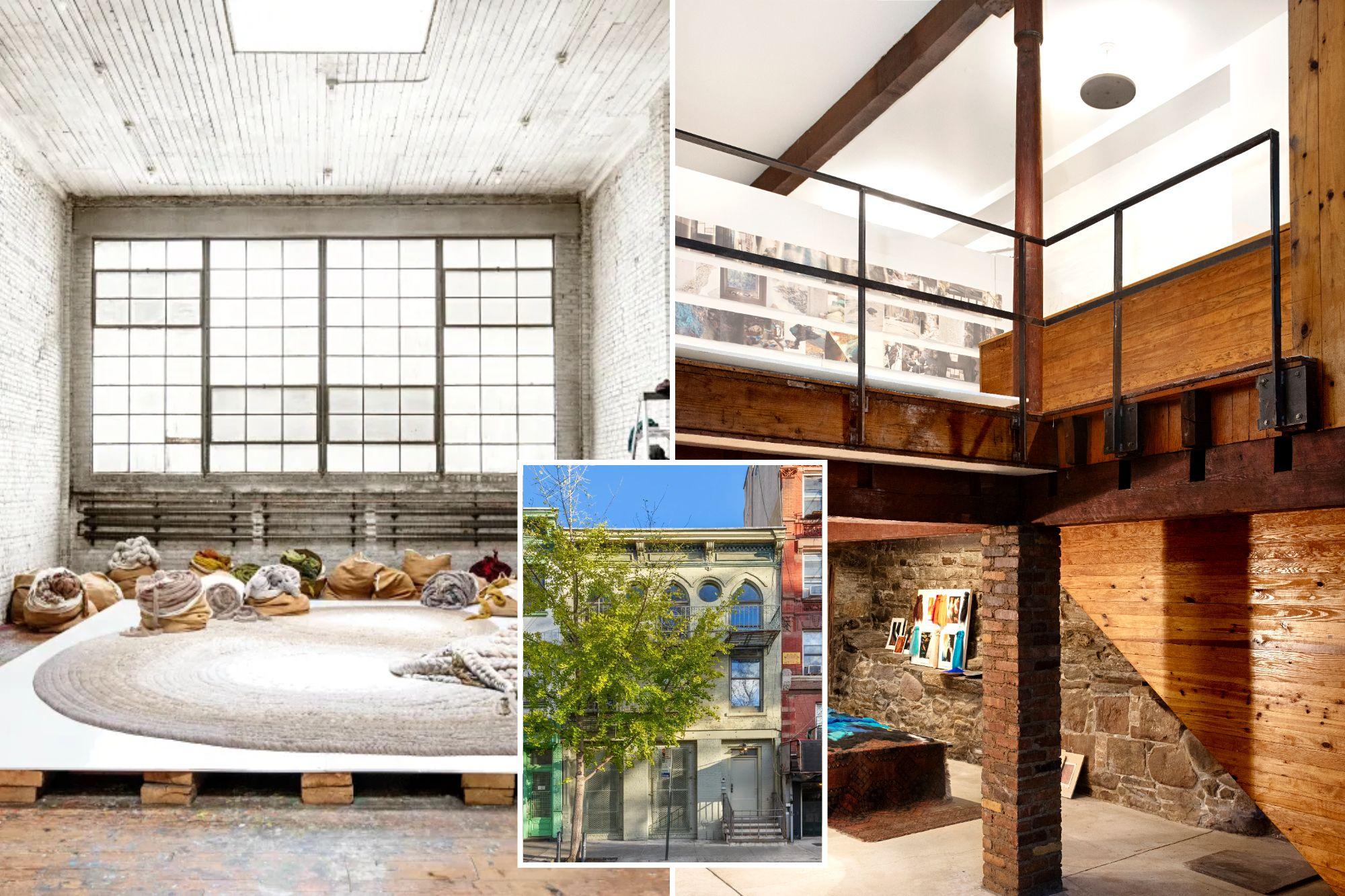
The roughly 6,800-square-foot building at 80 Forsyth St. has served as the studio of fiber artist Dana Barnes since 2013 — but its artistic pedigree stretches back decades, with traces of its religious and creative past still embedded throughout the three-story property.
Before Barnes moved in, the building was the longtime home and studio of Abstract Expressionist artists Milton Resnick and Pat Passlof, who took over the space in the 1960s.
And before the artists came, there were worshippers.
The 25-foot-wide brick building was originally erected as a synagogue in the 19th century for an early Eastern European Jewish congregation in the neighborhood, according to the sellers.
Remnants of that chapter remain throughout the property — including a former mikvah, or a Jewish ritual bath, on the lower level, along with pointed arch window forms dating to its synagogue days.
The building’s evolution from a house of worship into an artist enclave began during a transformative period for the Lower East Side, when artists were increasingly moving into the neighborhood’s former industrial, commercial and religious spaces.
Resnick, a Russian-born painter who became associated with the Abstract Expressionist movement in New York, and Passlof, an American painter who studied with Willem de Kooning, made 80 Forsyth their home and workspace.
The pair transformed portions of the old synagogue to suit their work while retaining much of the original structure.
Some of those changes are still there more than half a century later.
Hand-built pine walls installed by the two remain, as does an upper gallery mezzanine dating to the 1960s. Original casement windows, cast-iron columns, skylights, and wood and concrete floors also survive.
In places, the floors are still splattered with paint from the artists who worked there before Barnes — evidence of the building’s creative history that the current owners deliberately chose not to remove.
Barnes, a former fashion designer known for large-scale fiber sculptures and wall hangings, and her husband, private investor Dale Westhoff, purchased the property for $6.4 million in 2013.
Rather than scrubbing away its past during their ownership, the couple preserved much of what previous generations left behind.
Barnes has since used virtually the entire building as her studio, filling the expansive rooms with coiled, knotted and woven textile works that range from sprawling floor pieces to towering sculptural installations.
Ceilings rise to more than 18 feet in portions of the property, while large windows and skylights bring natural light into the studio spaces.
The building also comes with two vintage kitchens, 2.5f bathrooms, laundry and storage areas, and two woodburning fireplaces.
A bedroom-office area occupies the top floor, while the upper levels look out over Sara D. Roosevelt Park, the nearly eight-block green space stretching along the eastern side of Forsyth Street.
There are also about 225 square feet of fenced outdoor space at the rear of the property.
Despite its unconventional history, the building isn’t frozen in time — and its next owner could take it in an entirely new direction.
The sale includes approximately 10,000 square feet of additional air rights, according to the listing, potentially giving a buyer substantially more room to work with than what currently stands on the site.
The building and its block are also not landmarked, according to the listing, opening up possibilities for alterations or future development, subject to city approvals and zoning requirements.
That means a buyer could preserve the unusual live-work setup that has defined the property for decades — or explore something altogether different.
The property is being marketed for uses ranging from another private residence and artist’s studio to a gallery, foundation or other creative space.
Its combination of scale and history makes it particularly unusual in a Lower East Side that has changed dramatically since Resnick and Passlof first began working there in the 1960s.
Today, the surrounding blocks are packed with new residential developments, galleries, restaurants and nightlife, while 80 Forsyth still bears the physical fingerprints of several very different eras of downtown New York.
For Barnes, the building became the latest chapter in that lineage.
Her works have been shown in galleries and exhibitions in the US and abroad, and the artist increasingly divides her practice between New York and Amsterdam.
That shift is now prompting Barnes and Westhoff to part with the Forsyth Street property after more than a decade of ownership.
Jonathan Hettinger, Mark Amadei and Megan Hait of Sotheby’s International Realty hold the listing.