The conviction in The Hague of former President Hashim Thaci and three former Kosovo Liberation Army leaders has caused consternation in Kosovo — both among political leaders and on the streets. DW reports from Pristina.
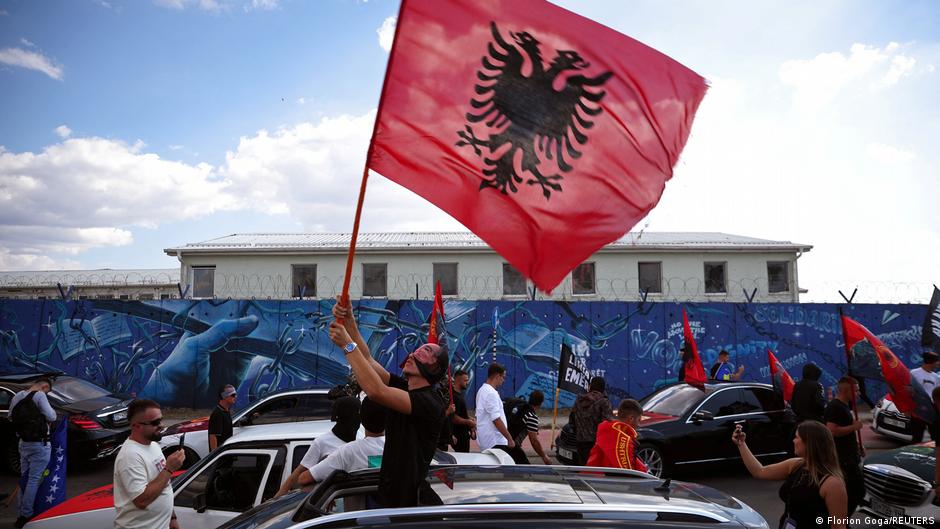
https://p.dw.com/p/5MiEGA protester waves an Albanian flag outside the headquarters of the European Union Rule of Law Mission in Kosovo (EULEX) after former President Hashim Thaci was found guilty of war crimes by the Kosovo war crimes tribunal in The HagueImage: Florion Goga/REUTERSAdvertisementThe announcement of the verdict was greeted with shock and profound disappointment in Pristina.
Thousands of citizens had gathered in the main square of Kosovo's capital, many waving flags of the Kosovo Liberation Army (KLA), to follow the announcement live on large screens. Similar gatherings took place across the country in Kosovo's main cities.
When it became clear that the Kosovo war crimes tribunal in The Hague had found former President Hashim Thaci, and former Kosovo Liberation Army (KLA) leaders Kadri Veseli, Jakup Krasniqi and Rexhep Selimi guilty of war crimes, the crowd fell silent.
The initial silence was then followed by calls for justice and chants of support for the four men.
Groups of citizens began trying to demolish sections of the perimeter wall surrounding EULEX, the EU Rule of Law Mission in Kosovo, which was deployed in Kosovo after the country's declaration of independence from neighboring Serbia in 2008 and continues to operate to this day.
Large numbers of Kosovo police officers and special units intervened to prevent further damage and incidents.
But it wasn't just the people on the streets who were disappointed; the country's political leaders were quick to respond to the news from The Hague.
Kosovo Foreign Minister Glauk Konjufca, who was present in the courtroom in The Hague when the verdict was announced, said that "the conviction of the former KLA leaders is a terrible judgment for Kosovo, for our liberation war," describing it as "a major blow to the state and to the domestic narrative."
"Kosovo experienced the war itself. We know what the KLA war was about and we know that there was no criminal mechanism to harm any population. It is a sad, unjust and undeserved decision," he said.
Kosovo Prime Minister Albin Kurti labelled the verdict an "unacceptable injustice."
"The conviction and such a severe sentence for four former leaders of the Kosovo Liberation Army is an unacceptable injustice, a great and harmful punishment," he said on Wednesday.
The Democratic Party of Kosovo (PDK), a party founded immediately after the war by Hashim Thaci and several other former KLA leaders, described the guilty verdict as an "unjust and unacceptable judgment," stressing that "the battle for justice continues until the very end."
"In The Hague, the right of our people, who fought for freedom, survival and liberation from the Serbian state regime that killed, expelled and terrorized Kosovo Albanians, was dealt a severe blow. For us, this judgment represents a major injustice because it is based on allegations and material that we consider fabricated and which, over the years, have been promoted by the Serbian state apparatus and propaganda in an effort to criminalize the just war of the Kosovo Liberation Army," the PDK said in a statement.
The response from Kosovo's acting president, Albulena Haxhiu, was similar. She described the convictions of the four men as "a severe blow to their families, deeply shocking news for the Republic of Kosovo and a grave moment for the Albanian nation wherever it lives."
"On a day like this, the weight of this decision cannot be separated from the history from which we have emerged," Haxhiu wrote in her statement. "Kosovo experienced first-hand the violence of a state apparatus that killed civilians, committed massacres, expelled hundreds of thousands of Albanians from their homes and left behind thousands of people killed or missing. This experience is an indelible part of the memory of Kosovo and the Albanian nation."
More than three years after the start of the trial and nearly six years after the four men were charged with war crimes and crimes against humanity committed during the 1998–99 Kosovo War, the panel of judges at the Kosovo Specialist Chambers in The Hague handed down guilty verdicts against former KLA leaders Hashim Thaci, Kadri Veseli, Jakup Krasniqi and Rexhep Selimi.
While the three-judge panel dismissed the charges of crimes against humanity, the four men were convicted of war crimes against civilians and political opponents who did not support the KLA during the war.
Hashim Thaci, who was indicted while serving as president of Kosovo, was sentenced to 25 years in prison. Jakup Krasniqi, who served as a KLA spokesman and later as speaker of Kosovo's parliament on several occasions, was also sentenced to 25 years in prison. Kadri Veseli, who headed the KLA intelligence service during the war, was sentenced to 18 years in prison, and Rexhep Selimi, who served as chief inspector of the KLA military police, was sentenced to 13 years in prison.
Defense lawyers for the men said they would appeal the verdict.
The Kosovo Specialist Chambers, which was set up by the Kosovo Assembly (parliament) in 2015, is staffed by international judges and based in The Hague. It deals exclusively with cases relating to allegations of crimes committed by members of the KLA during the Kosovo War.
Before returning to join Kosovo's struggle for independence in 1998, Hashim Thaci had been a student in Switzerland.
As a political leader of the former KLA, he received support from Western leaders, who invited him to participate in the 1999 peace talks in Rambouillet, France. At the time, Thaci was seen in Kosovo as a leader who could guide the country toward independence.
Around 13,000 civilians — most of them Kosovo Albanians — were killed and around one million people were displaced during the war, which saw Kosovo, at the time a Serbian province, fighting for independence from Serbia.
Following NATO's intervention against Serbian forces and their withdrawal from Kosovo, Thaci founded his own political party and came to power, first as Kosovo's prime minister and later as president.
In 2008, Kosovo declared independence from Serbia, a move rejected and still not recognized by authorities in Belgrade, Moscow and Beijing. Kosovo's statehood is, however, recognized by over 100 countries.
Relations between Kosovo and Serbia remain tense, despite more than 15 years of negotiations between the two countries, mediated by the European Union and supported by the United States.
Thaci, who like the other three men, denied the charges against him, resigned as president of Kosovo in 2020 to face the charges and defend himself in The Hague.