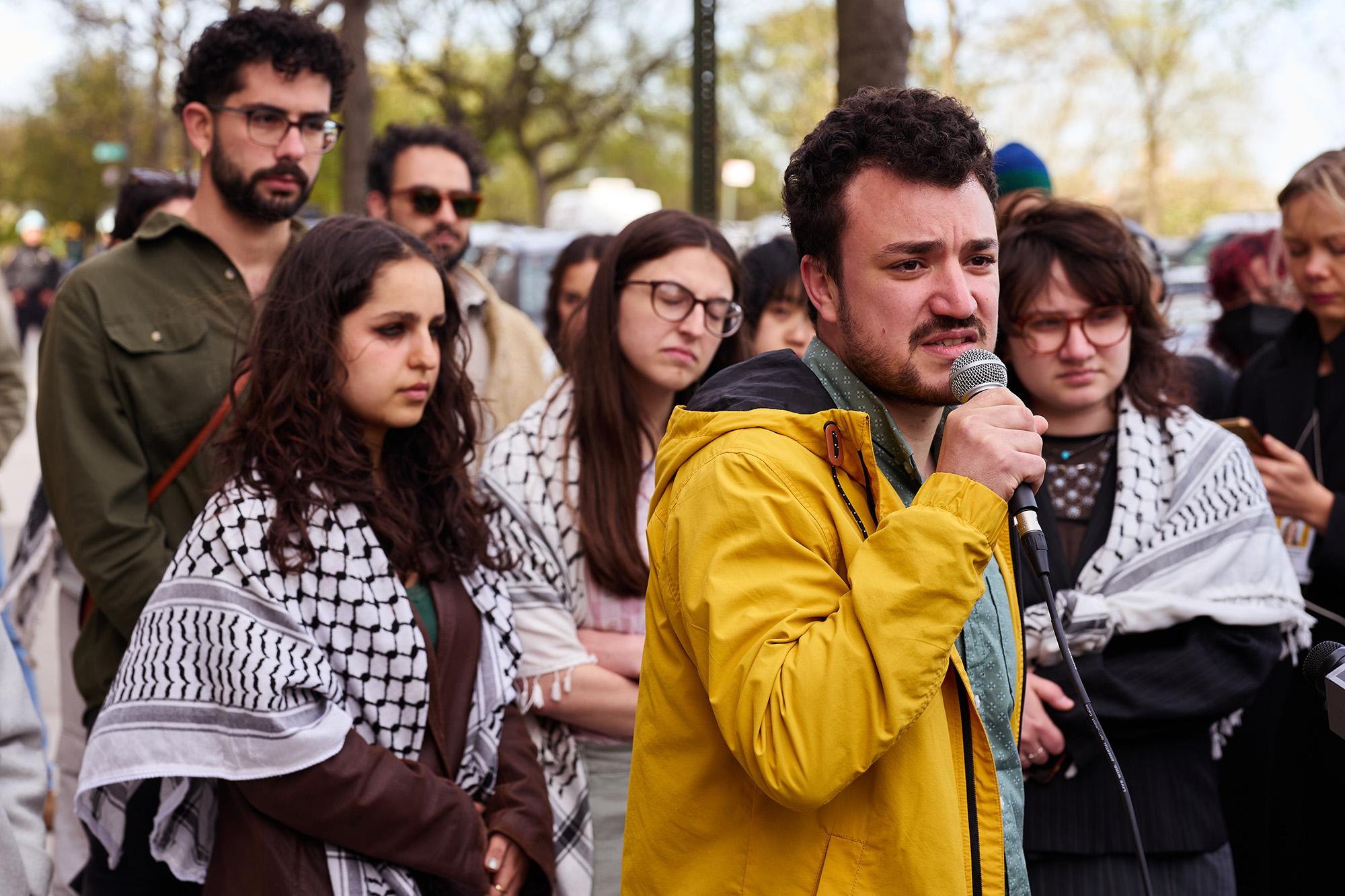
Mahmoud Khalil at a news conference with Jewish Barnard and Columbia students who were detained during a New York Police Department sweep of the "Gaza Solidarity Encampment" on Tuesday, April 23, 2024. James Keivom See more of our coverage in your search results.
Add The New York Post on Google Mahmoud Khalil, the Algerian citizen who has spent the better part of his four years in the United States participating in unlawful demonstrations at Columbia University, is suing everyone he can.
Facing imminent deportation for his role in Columbia University Apartheid Divest — the group that claims to be working toward the downfall of Western civilization — Khalil is showing some real nerve.
On Monday, he filed a lawsuit against Columbia and the dean of his master’s degree program, claiming they failed to protect him and his fellow window-smashers from discrimination and harassment.
It’s not the first time Khalil has sought protection under the laws of the constitutional system he advocates overthrowing.
In March 2025, Khalil sued Columbia and several federal lawmakers to stop the university from turning over students’ disciplinary records to Congress.
Had Congress seen that Columbia failed to expel anti-Israel fanatics who destroyed school property, trespassed, and falsely imprisoned custodial staff, the government might have concluded that universities weren’t taking discrimination against Israelis and Jews seriously.
Khalil and his comrades may dream of a world without a First Amendment, but they were happy to invoke it to protect themselves.
In July 2026, he sued multiple government officials, think tanks and other nonprofits, arguing they conspired to have him deported.
Apparently he believes that private organizations making political arguments are not protected by the First Amendment, while destroying property and disobeying police are sacred civil rights.
To summarize: Anyone looking to hold Khalil and his fellow professional agitators accountable for documented lawbreaking is violating civil rights law — and anyone trying to protect the students those agitators wanted to intimidate is violating the First Amendment.
It’s exactly the level of sophistication you’d expect from someone who understands the American system only to the extent necessary to keep trying to destroy it.
There’s something comical about Khalil’s lawsuit spree, but it’s also deadly serious.
They know that a free country has weaknesses totalitarian states do not have.
Our freedom of speech allows misinformation to proliferate.
Living in a free country means putting up with that nonsense — to an extent.
It does not mean we have to allow our enemies to undermine us on our home turf.
Khalil is not a citizen and would make a very bad one if he became one; he should be sent home before that happens.
He is free to criticize the Great Satan of America and the Little Satan of Israel from Algeria or Syria.
Likewise, freedom doesn’t mean that we must take seriously those who use our laws cynically.
Khalil poses as a champion for free speech and civil rights.
He wants Americans to think he is following in the tradition of civil disobedience, and that the government is victimizing him because he has unpopular views.
Khalil and his fellow plaintiffs are thugs who led a campaign of intimidation, repeatedly broke campus rules and the law, and are simply trying to get away with it.
He’s not just using our laws against us; he’s trying to use our fundamental decency, and our culture of love for patriotic dissenters, against us.
Let’s not forget that CUAD — the umbrella organization which 94 Columbia student groups joined — maintains a website that honors vile anti-American individuals and terrorist groups.
These are not patriotic Americans seeking to change our politics.
They are enemies of everything that makes our civilization great, and they’re not messing around.
They think our Constitution is a suicide pact, and they want the United States to commit suicide.
Dismiss his claims, deport Khalil, and stop letting our enemies use the glories of freedom to undermine the land of the free.
Tal Fortgang is a legal policy fellow at the Manhattan Institute.