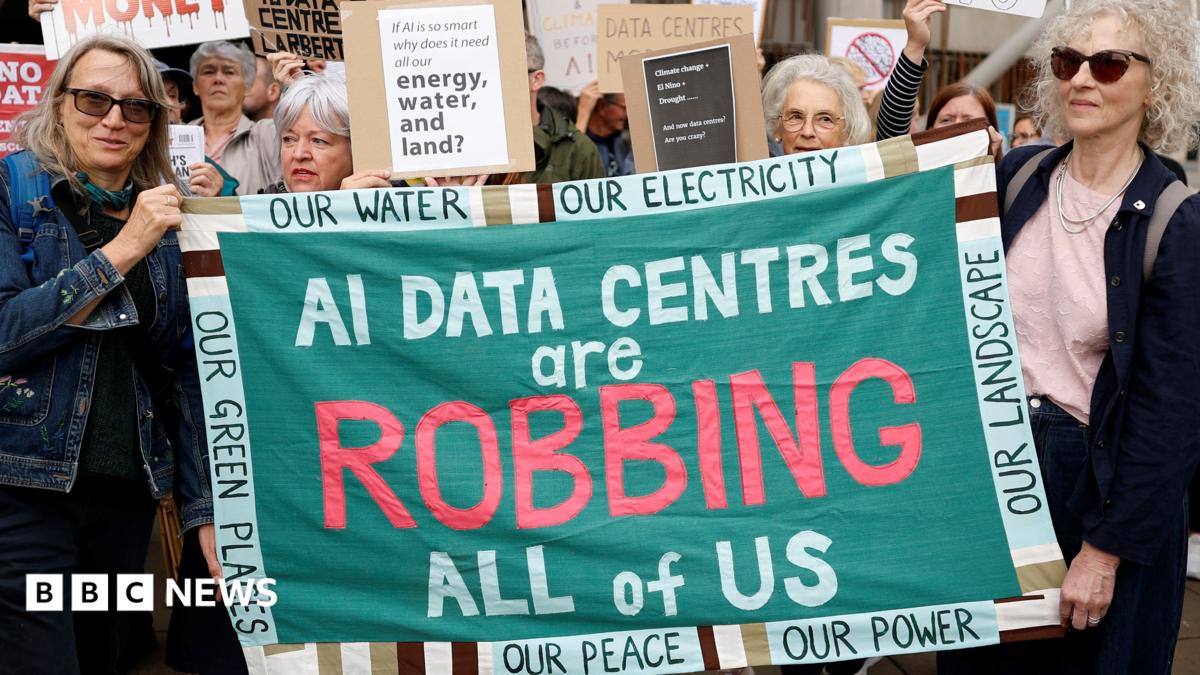
Image source, Getty ImagesImage caption, Activists protested against data centres in their local area outside the Scottish Parliament earlier this month
Scotland environment, energy and rural affairs correspondentPublished15 September 2026Updated 18 minutes agoScotland has a new boom industry, at least if planning applications are taken at face value.
The term "hyperscale data centre", rarely heard a few years ago, is now dividing opinion across the country as a rush of applications are made to build them.
A debate at Holyrood later, led by the Scottish Greens, will call for planning applications to be put on hold until promised new national guidelines are in force, with an emphasis on energy demand and the environment.
Ahead of the debate, ministers announced that all new applications for AI data centres will have to undergo an environmental impact assessment.
The growth of AI is happening at lightning pace, so what are the advantages and disadvantages of Scotland being at the forefront?
Image source, DataVitaImage caption, There are about a dozen plans for data centres in Scotland's central belt alone - including this design for a site in North Lanarkshire by the company DataVita
The single biggest reason why developers are interested in Scotland is because it allows them to say that their energy-hungry facility is being powered by green electricity.
Scotland has an abundance of wind and much of the energy from it is currently wasted because the transmission infrastructure isn't large enough to carry it from where it is generated to the consumers.
Installing more, bigger pylons to ship the electricity to England, where the bulk of the UK's population is, or bring the largest consumers of that electricity closer to the generators.
Building more data centres could push up electricity prices, Holyrood committee warned
Shortly before the debate in parliament, the government ordered that environmental impact assessments be submitted during planning applications for all new data centres with a power capacity exceeding 50 megawatts.
It said that proposed developments under that threshold would still have to be considered under established environmental regulations on a case-by-case basis.
The update follow an order last month requiring planning authorities to notify ministers of all new data centre applications within a week of validation.
Public Finance Minister Hannah Mary Goodlad said that the requirement for environmental impact assessments would "create a level playing field for developers" while helping to protect the environment.
But the Greens described the move as "the bare minimum of what is needed", arguing a moratorium was required until a national strategy and guidance was in place for councils.
For people living in communities where potential sites have been identified, fears remain about the faceless, warehouse-like buildings housing the servers can cover a massive footprint.
Image caption, Jamie Prentice is worried about the potential impact of data centres
At Blackdog in Aberdeenshire, local resident Jamie Prentice spoke to me about the development planned for there which would stretch across several fields.
His house looks out to the Aberdeen Bay wind farm and the sea beyond.
But he says that if it's built there he'll effectively be living on an industrial estate.
Local people have begun to mobilise their opposition to it through social media, but Jamie clearly feels it will ruin the area.
He asks me whether I think the Blackdog project will ever happen and I have genuinely no idea.
It is likely the site has been chosen because of its proximity to the offshore wind farm which could give the developer some "green" kudos.
Scotland may have plenty of renewable power generation but experts have warned that does not necessarily mean data centres would run exclusively on renewable power.
During periods of low wind or when clouds are blocking the sun, it may mean having to fire up fossil fuel power stations to provide the energy required to keep the servers blinking.
Dr Callum MacIver warned MSPs this week that the additional demand could make climate change targets difficult to achieve because of the additional reliance on gas.
A mechanism that requires data centre developers to match their projects, with new green generation capacity being commissioned, would be a neat way of mitigating the risks but that requires government or regulatory intervention.
Political leaders across the globe have so far seemed reluctant to intervene, despite warnings.
There are concerns about the unintended consequences of building data centres which have been pushing up bills in Ireland and some parts of the US.
Last year, Irish data centres consumed 23% of the country's electricity and the demand for energy has pushed up the price for consumers.
The electricity system operator here says it is delinking the price of electricity from the high wholesale cost of gas, which should prevent a similar outcome.
But analysts are not yet convinced that is going to be fully effective.
There has been much anger in recent years about how much water some of the larger data centres consume in trying to keep the equipment cool.
Relatively speaking, Scotland has no shortage of water although recent summer heatwaves have resulted in the east of the country experiencing drought-like conditions.
Technology, though, has improved rapidly in this area and more modern facilities use a closed loop of water, similar to that in domestic central heating systems.
One of the reasons Scotland is favoured by developers is the relatively cool climate which means it generally requires less energy to bring down the temperature of that water.
Currently the water consumed by existing data centres is relatively low.
Colin Lindsay, a manager at a commercial subsidiary of Scottish Water, recently claimed the 97 cubic metres used daily is less than the amount consumed by Scotland's libraries., external
However, the concern is about future growth and location specific impacts.
Lindsay argues careful planning will be needed to avoid pressures on the drinking water supply.
The Scottish government has said it wants to "harness the economic opportunities" which come from data centres as an emerging sector.
The relative cheapness of land in Scotland makes it an attractive location for data centre developers.
Supporters claim they can bring with them thousands of jobs but most of those are in the construction phase.
Once operational, they can run with just a handful of people on site.
While they might be energy hungry, there are ways in which electricity system operators can manage that hunger so that supply and demand are matched.
Scotcast: The Revolt Against Data Centres
Listen on SoundsLarger operators - the likes of Google and Chat GPT - will be building their data centres all over the world and say they are able to shift the work they do from the servers in Scotland to others in Silicon Valley, or beyond, when needed.
That means they don't have to operate flat out at all times and so grid operators will be afforded flexibility when they need it.
That doesn't mean balancing the demands of data centres will be easy but experts say it is no different to the additional electricity needed to charge electric vehicles or power domestic heat pumps.
Recent warnings about the potential dangers of AI show that there are significant unknowns with such a rapid growth of a new industry.
The AI revolution is happening and there are clearly pros and cons to Scotland being at the heart of it.
A backlash over data centres is another threat to the AI juggernaut
AI staff 'genuinely frightened' for humanity's future, ex-Anthropic researcher tells BBC
OpenAI boss says world 'right to be afraid' but should trust AI firms