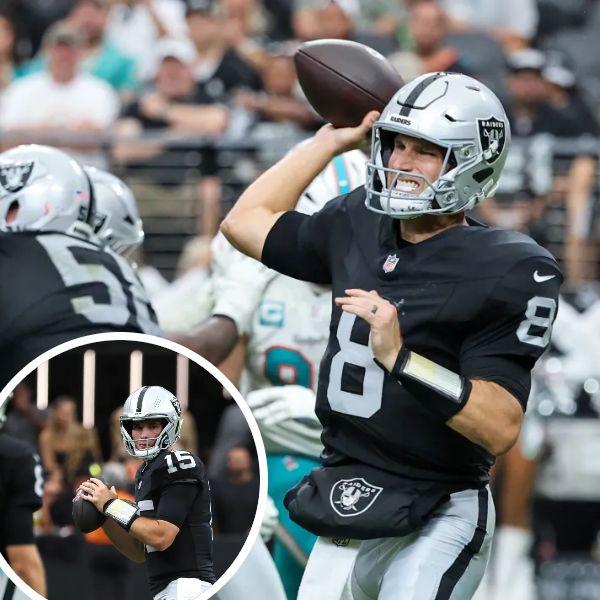
Add The California Post on Google The Raiders can win games with Kirk Cousins doing exactly what he did on Sunday.
And how much of Klint Kubiak’s offense remains available if their quarterback cannot consistently threaten defenses beyond the underneath passing game?
That is the question tucked inside an otherwise encouraging season opener, and it could eventually determine how quickly Fernando Mendoza moves from the sideline to the huddle.
Maybe even sooner than anyone originally envisioned.
Cousins delivered three touchdown passes against the Dolphins, offering a reminder that experience, anticipation and an understanding of where the football should go still count for something.
On throws traveling 10 or more yards downfield, Cousins completed one of seven passes for 21 yards and two interceptions.
One completion. Two passes caught by the other team.
That doesn’t erase everything he did well. But it does raise a question the Raiders cannot afford to dismiss simply because they won.
How much of the field can Cousins still force a defense to respect?
Asked Monday whether the Raiders need a more effective downfield passing game, Klint Kubiak needed just one word.
The need is clear. Whether Cousins can meet it is another matter.
And if he cannot, how long before the Raiders turn to Mendoza, who is 16 years younger and has a considerably stronger arm?
Cousins was tremendous in the shorter passing game, completing 20 of 22 throws for 139 yards and all three touchdowns. Those are winning numbers, and there is nothing inherently wrong with taking an efficient route to the end zone.
Kubiak can build around that. His offense can manufacture space, create favorable matchups and put the football in the hands of players capable of turning modest throws into meaningful gains.
Ashton Jeanty can do damage that way. So can Michael Mayer. Eventually, Brock Bowers will rejoin that conversation.
But there is a difference between choosing to attack underneath and having little choice because everything beyond it becomes an adventure.
Opposing defensive coordinators get paid to recognize the difference.
If they determine Cousins cannot consistently beat them farther downfield, they can squeeze the space in which the Raiders operate. Safeties can creep closer. Linebackers can attack shorter routes more aggressively. Those easy completions can become contested catches with a defender arriving almost immediately.
The consequences would extend beyond the passing game.
A defense that feels comfortable crowding the line of scrimmage without paying for it over the top can make his afternoon considerably more difficult. The same short throws that helped the Raiders function Sunday become harder to sustain when defenders have fewer reasons to retreat.
The Raiders do not need Cousins launching 50-yard passes every series.
They need enough credible answers beyond the underneath routes to keep opponents honest.
“Chunk it deep,” is how Kubiak put it.
That includes intermediate throws delivered before a safety closes or a cornerback recovers. Arm strength is about more than distance. It is also about getting the football through a window before that window disappears.
At 38, Cousins does not appear to have the same margin for error he once did.
Seven attempts cannot tell the entire story. Protection, separation, timing and decisions all deserve examination before every unsuccessful throw gets pinned on diminished velocity.
Removing a player of his caliber changes an offense, and Cousins deserves consideration for what was missing. Bowers can create separation, attract coverage and turn a routine completion into something much bigger.
It might also make the larger concern more obvious.
What happens if those opportunities are there and the quarterback struggles to deliver the ball?
Getting Bowers back would give the Raiders another answer. It would not automatically answer the question about Cousins.
Bowers’ value extends well beyond catching short passes and fighting through tackles. He can threaten the seams, work behind linebackers and punish defenses farther downfield.
The case for starting Cousins was understandable. Let the veteran establish the offense. Give the rookie time to learn. Avoid making every part of a new operation dependent on a young quarterback figuring things out simultaneously.
But it cannot become a commitment that survives regardless of what happens on the field.
Mendoza is the big Christmas present sitting under the tree. Everybody walks past it every day, takes another look and gets a little excited imagining what might be inside.
The Raiders have good reason to be thoughtful about when they unwrap it.
But the possibility changes how all of this feels. As concerning as Cousins’ limitations might be, the Raiders could already have someone in the building capable of taking this offense beyond what the veteran can offer.
Mendoza still has to prove that. A stronger arm and a lofty draft position do not guarantee a better offense.
But for a franchise and a fan base that have spent the better part of three decades watching quarterback problems turn into another offseason search, there is something refreshing about having a potential answer waiting down the hall.
And something exciting about the possibility that turning to him could mean raising their expectations.
If Cousins’ limitations begin dictating too much of the playbook, the calculation changes. Especially if Mendoza demonstrates in practice that he can handle the assignment while giving Kubiak access to throws the offense needs.
The standard cannot be that Mendoza must eliminate every rookie concern before the Raiders consider him, while Cousins gets unlimited tolerance for limitations that restrict everyone around him.
At some point, the rookie’s development and the offense’s immediate needs could point toward the same decision.
Sunday did not establish that the Raiders have reached that point.
It did establish something worth watching as the schedule unfolds and opponents study how to defend them.
Cousins showed how effective he can be when the game stays underneath.
How effectively he can operate beyond it could determine how long this remains his job.