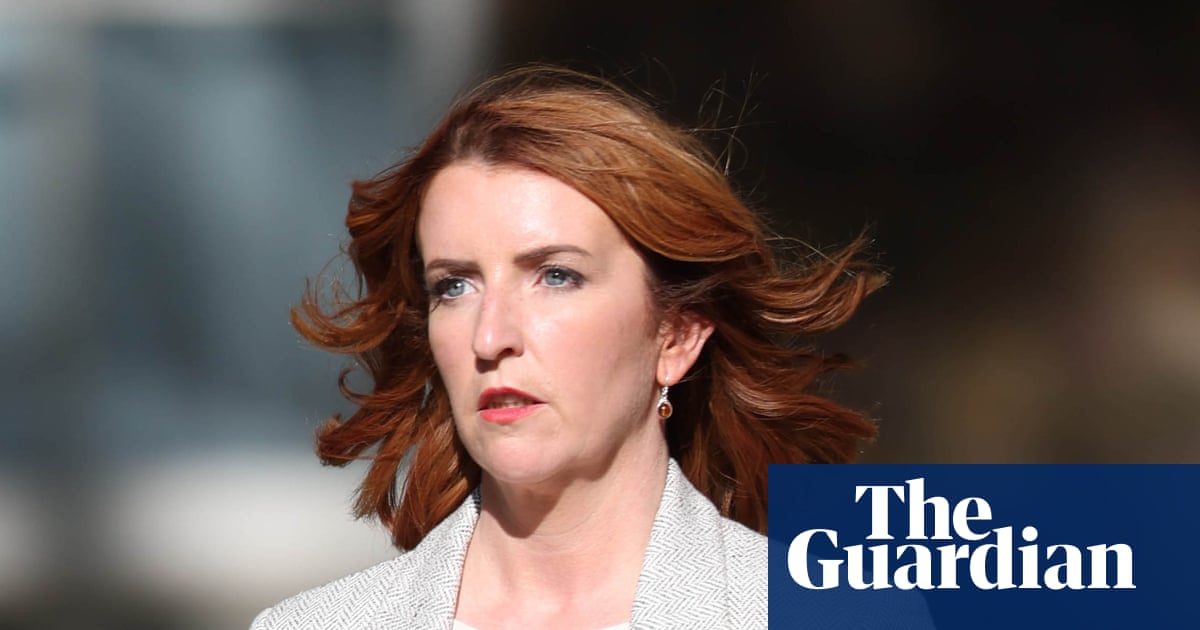
Louise Haigh will address the TUC conference on Tuesday. Photograph: Ryan Jenkinson/Getty ImagesView image in fullscreenLouise Haigh will address the TUC conference on Tuesday. Photograph: Ryan Jenkinson/Getty ImagesUK must heed warnings from AI experts, minister saysLouise Haigh will set out benefits of AI to TUC conference while vowing government will take safety seriously
Ministers must “heed the warnings” from industry leaders about the threat posed by AI as it looks to capitalise on the technology, the first secretary, Louise Haigh, will say on Tuesday.
Labour MPs and peers have called for the government to further cooperate with international partners to build regulation for the technology, after three Anthropic researchers warned that artificial intelligence could kill off humanity within the decade.
Over the weekend, Anthropic urged its competitors and governments to coordinate a global slowdown in AI development. It was backed by many of its rivals including OpenAI, Google DeepMind and X’s Elon Musk.
Haigh will say at a speech at TUC Congress on Tuesday that there are huge potential benefits for health and public services from the use of AI, but that the government would look seriously at the public safety and national security threats with international partners.
On Monday night, one of the founders of Anthropic, Jack Clark, suggested that an artificial intelligence “kill switch” held by a third party may need to be mandatory for companies, saying it was something society “might want to eventually pass rules around”.
One of Anthropic’s biggest rivals and the operator of ChatGPT, OpenAI, has also urged the government to capitalise on renewed fears over AI safety and impose legislation reining in the technology.
“We support stronger UK rules for the handful of companies, including OpenAI, developing the most powerful AI systems,” said OpenAI’s head of policy in Europe, Tom Duff Gordon.
However, the tech company said legislation should be narrowly focused on the most advanced AI labs and not startups working on less powerful systems.
Haigh, whose speech will also lay out priorities for public control of transport, water and energy, will tell trade unions: “AI has enormous potential to transform our public services, make our businesses stronger and deliver new scientific breakthroughs.”
But she will say that the government must “heed the warnings of those who are at the forefront of developing this technology” and “be ready to work with international partners” to prioritise public safety and national security.
MPs and peers on the parliamentary committee for human rights on Monday called for a new regulatory framework for AI in the UK, including an independent oversight body and legislation to protect the public.
View image in fullscreenAnthropic’s chief executive, Dario Amodei, calls on the AI industry to coordinate a slowdown. Photograph: Bhawika Chhabra/ReutersIt said AI posed a number of threats, from public face-scanning to explicit deepfakes and flagging disciplinary action for workers without reasonable cause.
Alex Sobel, the Labour chair of the human rights committee, said the world was unprepared for dealing with the “potentially dire” consequences of a rapidly developing technology.
“Nowhere in the world, including the UK, has a current legislative and regulatory approach to AI that is fit for purpose,” he said.
A government spokesperson said the UK took the risks from advanced AI “extremely seriously” and recognised the need to keep pace with the evolving technology, including working closely with AI companies and other countries.
“We should not assume that the existing framework will always be sufficient as AI capabilities develop. Any future measures will be evidence-based and focused on the risks we need to address,” said the spokesperson.
Last Friday, more than 70 MPs and peers urged Andy Burnham to back a ban on the creation of artificial superintelligence (ASI) and lead an international movement to stop its development. The letter came at the end of a week of chilling warnings about the technology, in which experts estimated a 10% chance ASI would wipe out humans.
Among the signatories were former government ministers, along with the former head of the civil service Robin Butler, senior Labour MPs including John McDonnell, and leading Conservative, Liberal Democrat and Scottish National party MPs.
They urged the prime minister to throw the government’s weight behind a bill, tabled in the Commons on Tuesday, that would prohibit ASI.
Sobel, the Labour MP behind the bill, said they wanted Burnham to foster “a clear framework where superintelligent AI cannot be created”.