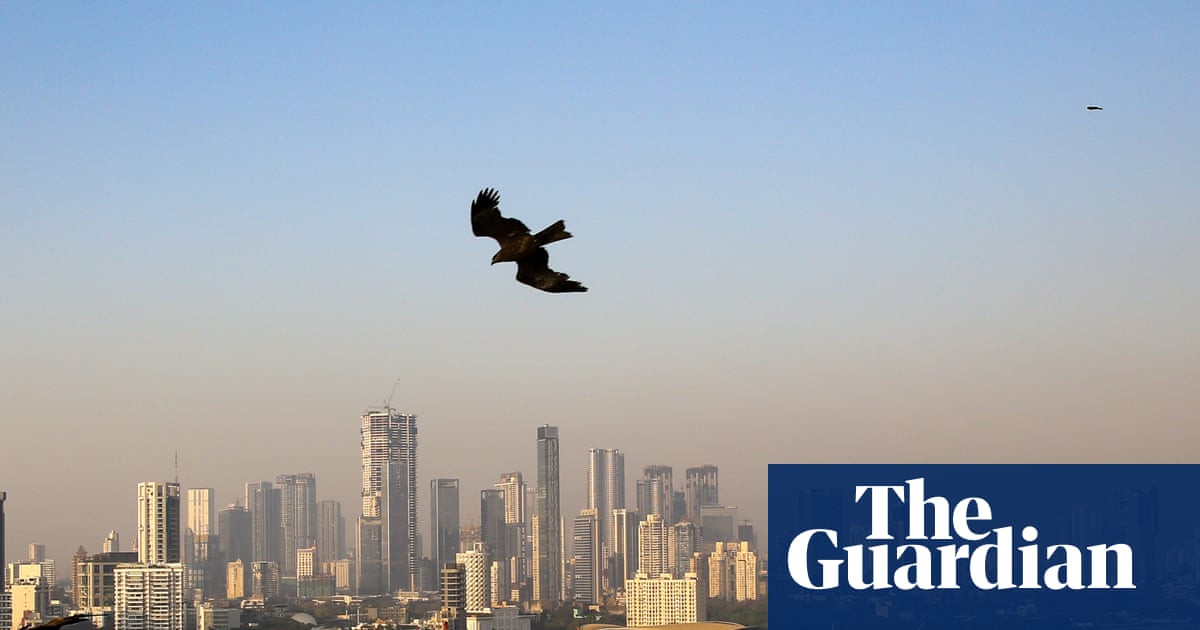
A view of Mumbai. Photograph: Divyakant Solanki/EPAView image in fullscreenA view of Mumbai. Photograph: Divyakant Solanki/EPAWhat would it take to make India’s cities better – and safer?After a five-storey building collapsed in Delhi, focus is on how urban areas can adapt to growing populations. Plus, Ahmedabad’s ace newspaper delivery driver goes viral
Recently, I may have saved a woman’s life on the road. Somehow, this was something I had expected to happen.
On that day, I saw a truck leave a construction site with a tangled wire trailing behind. I frantically looked to see what the wire was attached to and spotted the scaffolding a few meters ahead. I shrieked and grabbed the hand of the woman walking in front of me just as the metal pipes came crashing down. We hugged for a brief second, and then walked our separate ways.
Mumbai (pictured top) is a city that is being made every day, and so much of the Bandra-Khar area that I inhabit is never not under construction. Since I moved here from Seoul earlier this year, I have learned to be hypervigilant every time I walk the streets.
I was reminded of that moment last week as news broke about the collapse of a five-storey building in Delhi, which killed seven people. Authorities had flagged safety concerns in the neighbourhood months earlier, the Hindustan Times reported, after 23 people died in a fire at another building.
As the world’s most populous country, India can feel like a place where life can be startlingly cheap, and people die every day in tragedies that could have been prevented. According to analysis of government data by the Times of India, between 2020 and 2004 nearly 33,000 deaths occurred due to building collapses, fires or people falling into pits and maintenance holes.
The collapse in Delhi has prompted questions, once again, about the state of urban infrastructure in India’s biggest cities. At a time when the country is undertaking a rapid infrastructure boom – new airports, high-speed expressways, luxury residential towers– daily life in cities like Delhi, Mumbai or Bengaluru appears to be deteriorating.
Indian cities are not walkable, they rank among the worst for air quality, construction is poorly regulated, seasonal flooding is common and waste management remains under pressure. These challenges are only going to increase; the World Bank expects India’s urban population to double, going up to 951 million, by 2050. More than half of the urban infrastructure the country will need by then has yet to be built, it said.
View image in fullscreenThe problem with India’s roads begins with on-street parking, believe some experts. Photograph: DB Pictures/AlamySo, what would it take to make our cities better and safer? The experts I spoke to broadly agreed that Indian cities don’t lack rules as much as the political will and institutional machinery to enforce them.
For infrastructure veteran Vinayak Chatterjee, one solution lies in giving urban local bodies more power. He points to a constitutional amendment from 1992 that was meant to strengthen municipalities and give them greater responsibility over urban planning. “But it remains largely unimplemented – in spirit and will. It is a serious matter that affects the very fabric of our urban existence,” said Chatterjee, founder of the Infravision Foundation.
Rahul Goel, an expert on transportation safety and a professor at the Indian Institute of Technology, Delhi, believes the problem with India’s roads begins with on-street parking. “People are using public space for personal use. Everything becomes better when you remove on-street parking,” he said, arguing that freeing up roads would make pedestrians and cyclists safer, reduce traffic jams and make walking easier.
In other cities in the global south, from Bangkok to Manila to Cape Town, one cannot just park their car on the road to run errands, Goel said. He described it as a governance failure, saying there is a need to create more parking spaces and perhaps have civil defense personnel or municipal workers enforce fines.
“Our streets are self-run,” Goel said. “That’s why they are in complete disarray.” He pointed to the Delhi Metro as an example of a space where people follow rules and things are orderly. “When rules are enforced, people follow them.”
View image in fullscreenPeople vacate buildings marked for demolition in Satya Niketan after the collapse of a five-storey building. Photograph: Vishal Kapoor/Zuma Press Wire/ShutterstockThe same gap between rules and enforcement is evident at construction sites.
India has detailed guidelines for construction approvals, including how traffic must be managed, what signage must be put up, and creating paths for pedestrians. But compliance remains a significant problem, says Geetam Tiwari, emeritus professor at Indian Institute of Technology, Delhi. In an audit of construction sites on highways, including bridges, Tiwari and her colleagues found widespread violations. Contractors had a financial incentive to complete projects quickly with payments being tied to the pace of construction, she said, adding that penalties for violations were low enough that it was cheaper to simply pay the fine than make fixes.
For unsafe buildings and unauthorised renovations, Tiwari said, the solution also requires bringing stakeholders together: resident associations, landlords, lessees and local authorities to conduct audits, raise awareness and penalise contractors who violate safety requirements. Actions, she said, that should not wait for the next tragedy.
In the aftermath of the Delhi case, the high court has directed authorities to inspect student accommodations for safety. Building owners have been arrested and several municipal officials in charge of the area have been suspended.
A similar governance deficit shows up when it comes to air pollution, another long-time challenge for Indian cities. Ronak Sutaria, founder and CEO of Respirer Living Sciences, has been working on one aspect of this issue: by developing affordable air-quality monitors for construction sites. Respirer’s air-quality monitors are now installed in 5,000 locations across 10 cities in India, helping authorities identify pollution hotspots. (Some cities, including Mumbai, require construction sites to monitor pollution levels.)
“A number of sites are getting alerts [from authorities] and are taking dust-suppression measures, for instance, to bring down [pollution] levels. So, the entire loop is sort of working,” Sutaria said.
Indian cities continue to grow, but the question is whether governance can keep pace. On that afternoon in Bandra, I recall thinking how lucky the woman and I were not to be grievously injured. But we shouldn’t have to rely on luck to survive.
View image in fullscreenXi Jinping, far right, with Russia’s Vladimir Putin and India’s Narendra Modi at this year’s Brics summit. Photograph: Alexander Kazakov/Sputnik/Kremlin Pool/EPANew Delhi declaration | The Brics summit held in New Delhi over the weekend adopted a declaration with Iran and the United Arab Emirates agreeing to a late-stage compromise on the language about the war in the Middle East. Chinese president, Xi Jinping, who visited India for the first time in almost seven years, announced that China would helm the group’s presidency for the next year.
Political donations | An investigation by the BBC’s Shubhangi Misra claimed that six unrecognised political parties registered in Gujarat received donations of £132m (Rs 1,700 crore) in 2023-24, higher than the income of national parties excluding the BJP. Despite fielding few candidates and evidence of little political activity, the high amounts expose glaring gaps in oversight of political finances.
Women’s health support | Two south Indian states, Karnataka and Tamil Nadu, have recently announced policies aimed at supporting women through perimenopause and menopause. Karnataka plans to introduce a women’s health programme that will integrate menopause into the public health system. Tamil Nadu will assess the physical and mental health needs of perimenopausal women.
Calling all emerging writers | Applications are open for South Asia Speaks, a wonderful platform for emerging writers from the region offering free, year-long mentorship and resources to develop a book-length project. The deadline is 30 September – find out more and apply here.
A recommendation from someone with great taste
View image in fullscreenPoet Parag Pawan’s book.This week, write and professor Amitava Kumar (@amitavawriter), whose latest book, The Social Life of Trains, explores how railways helped shape India’s national identity, suggests the work of a poet he discovered on Instagram:
“Can I begin with a confession? I have been a professor of literature for more than three decades, but I don’t often understand poems. How lovely it is, then, to discover a poet whose lines are as clear and beautiful as the dawn! Recently, I came across the poems of a young Hindi poet named Parag Pawan. They spoke to me and, more importantly, they spoke to our moment. I immediately sat down to translate them into English.
A series of his poems could be translated as Poems for the Unemployed. One of the poems, sharp and precise, begins with the funny, acerbic lines: ‘On the topic of our unemployment / the prime minister gives speeches / but he doesn’t give us jobs. / He works for eighteen hours / while we believe that asking anyone to work / for more than eight hours / is exploitation.’”
View image in fullscreenUmar Khalid, who has spent six years in an Indian jail without trial.2,192
That’s the number of days Umar Khalid has spent in jail since his arrest on 13 September 2020 – without trial. Last week, the student activist wrote a searing account describing the daily drudgery of life in prison, published in The Quint. Earlier this year, in his first interview since being jailed, Khalid told the Guardian’s Hannah Ellis-Peterson: “Humanity is a privilege that is not granted to people like me.”
View image in fullscreenWorld’s fastest paper delivery service? Ayan Shaikh at work in Ahmedabad. Photograph: InstagramAs more people read news online, watching Ayan Shaikh (@paperboy_ayan) delivering newspapers with serious swag gave me great joy and some hope. The 22-year-old from Ahmedabad posts videos of it on Instagram, and it’s a feat to watch. Watch his papers swerve, reach gravity-defying heights and land with pinpoint accuracy and tell me his deliveries don’t rival Jasprit Bumrah.
Delivering papers was Shaikh’s first job after he dropped out of school. He spent four years mastering the techniques that would allow him to make faster deliveries to earn more money. The first video, filmed by his friend, had 20m views and a recent one has crossed 128m, more views than many Bollywood stars might command. He starts his day at 4:30am, making 300 deliveries in two hours, before he begins a second shift as a gig worker for quick commerce apps.
“I think people love [the videos] because I do it passionately … from my heart,” he said. “If you do things dedicatedly, anything is possible. It won’t work out once, twice, thrice, but it might on the fourth attempt.”
Do you have any thoughts or responses to this week’s newsletter? Is there anything you’d like us to cover in the future? Share your feedback by replying to this, or emailing us at thisisindia@theguardian.com and we may include your response in a future issue.