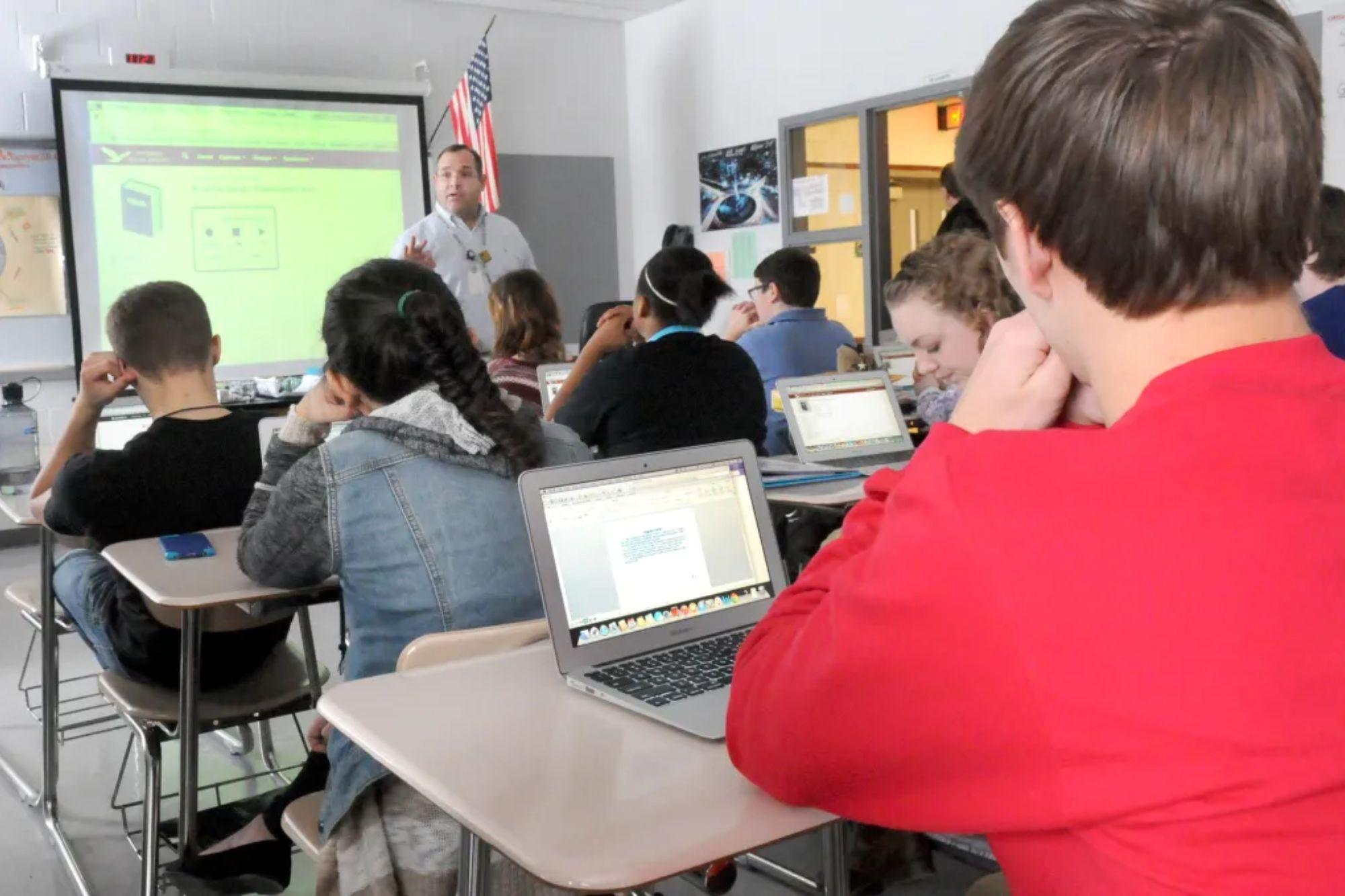
Add The New York Post on Google A veteran researcher of children’s play and wellbeing makes a bold claim in his new book: It’s not too much screen time but rather a bad school system that’s making young people so depressed and anxious.
“School by its very nature is a stress-inducing environment,” author Peter Gray told The Post. “You are being given the message that somehow poor performance predicts a poor future for your life. This is an anxiety-provoking situation. How could it not be?”
Gray, a research professor in psychology and neuroscience at Boston College, argues in his new book “Restoring Childhood: How to Set Kids Free in the Age of Anxiety” (Thesis, out Tuesday), that an increasingly high-pressure school environment is the real culprit for the decline in teen mental health.
And, while I don’t agree with him that concern over the inordinate amount of time kids are spending online is a “moral panic,” I do think he’s right that my generation has been failed by our school system. We’ve been taught that test results and college placement are more important than practical knowledge and social skills.
As a young person who grew up with an iPhone in my pocket, I can personally testify to the fact that it sucked up most of my free time and left my generation worse off.
Still, Gray has opened my mind up to the possibility that school is also a key factor at play.
If social media is to blame for youth depression and anxiety today, he writes, why were teen suicide rates in the ’90s nearly as bad as in the post-social media era? And why do youth self-harm rates spike during the school year, not during the summer when kids are spending the most time online?
That seems to suggest that school could be an exacerbating factor. “Every single study that I have been able to find in which a demographically balanced sample of school-age kids are asked the question, ‘What is the leading source of your anxiety or depression or stress?’ … school comes out on top,” Gray explained to me.
Gray points to research stretching back into the ’90s which suggests kids in high-pressure, performance-oriented schools are overwhelmingly more likely to experience mental health problems, regardless of socioeconomic status. One 2020 study of students at such schools suggested clinically significant anxiety and depression ran six to seven times the national average (data was from before the pandemic).
He argues that the Core Curriculum, rolled out around 2009, has transformed virtually every American school into a “high-pressure” environment, where students’ scores on standardized tests became everything and teachers are encouraged to teach to a test rather than to teach life skills.
At the same time, Gray says, “Society began to believe that it’s very important for children to go to college, and so schooling shifted from being kind of preparation for life to preparation for college. That shift meant that schooling became sort of this academic training ground for doing the things that would supposedly get you into college.”
I certainly agree. Being a young person today means thinking about college before you’ve even hit puberty and attaching your intrinsic worth to standardized testing that pits you on a percentile scale against your peers.
All this pressure — not to mention the heaps of homework that come with it — is, from my experience, is at odds with a happy childhood. I went to a boarding school where performance was everything, and I can confidently say I’ve never seen so many unhappy people in one place, in spite of all their privilege.
Gray has convinced me that schooling is part of why my generation is so depressed and anxious. We were taught college is everything and encouraged to have an entire resumé by the time we were teens.
In place of real-life experience and unstructured exploratory learning, we were given a one-size-fits-all vision of success. The results have been dismal. In fact, young college graduates today are having a record-breaking terrible time on the job market, while their peers who didn’t graduate are doing better than ever.
That’s a formula for depression, anxiety, and resentment at the world for setting you up with all the wrong skills. And it’s probably contributing to the popularity of DSA-style candidates among Gen Zers who feel screwed over by the system.
Gray is right to call out modern education for making my peers miserable. Perhaps they could consider that the “system” they were failed by wasn’t capitalism, but rather our school system.