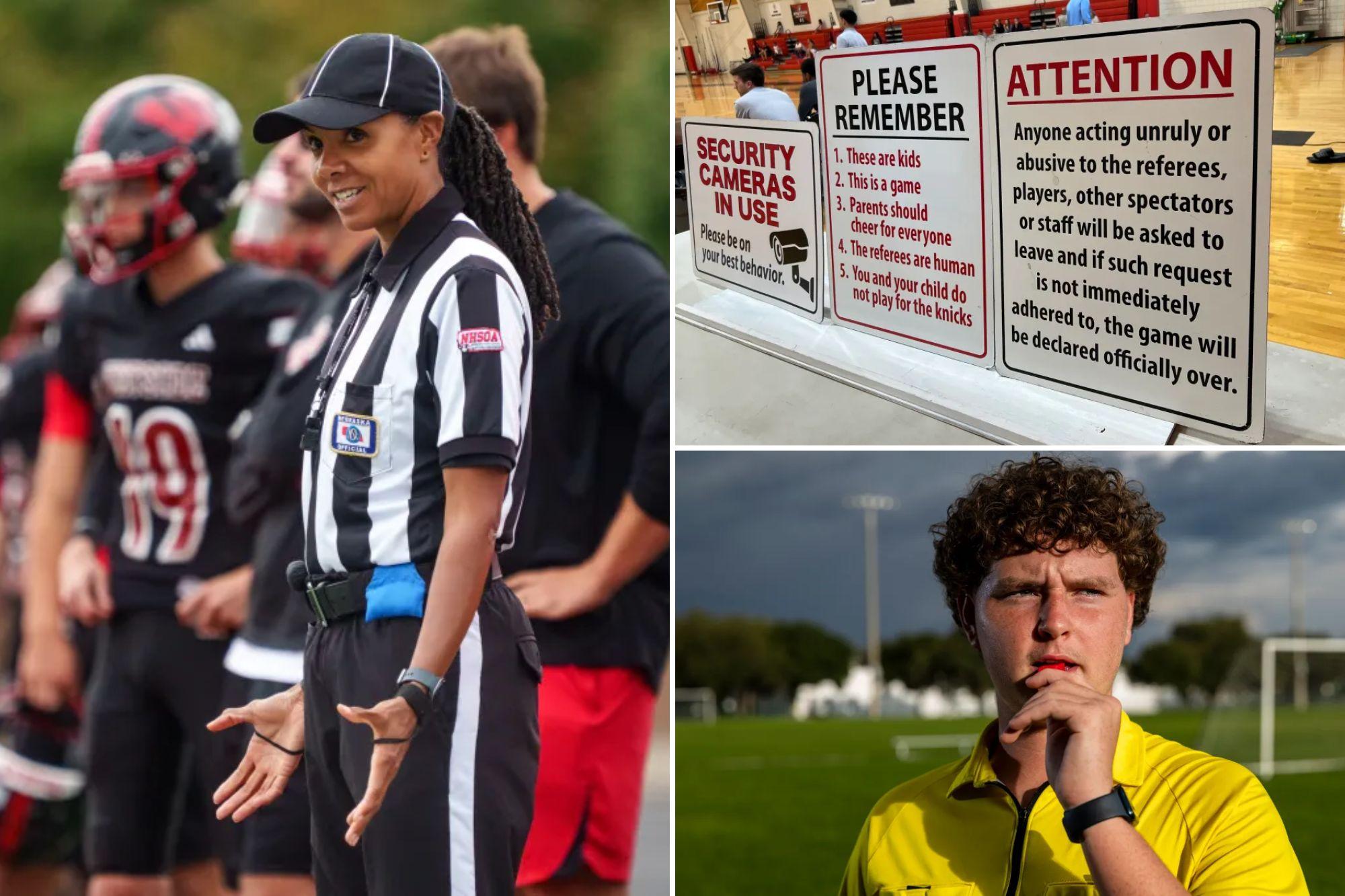
Add The New York Post on Google When Reshea Bristol pulled up to a youth basketball gym in Chandler, Arizona, to referee a game between first- and second-graders, she knew something was wrong as police cars swarmed the entrance.
But before the Tiny Tikes could take the court, the former WNBA player, who spent more than a decade playing professionally overseas, was told that an aggressive parent had come out of the stands and slapped the coach.
While the incident wasn’t directed at her, the veteran athlete soon learned that the rules of fandom had changed — and her job as an official might not be so black-and-white.
“You can’t just go out and ref the game,” Bristol told The Post. “You have to ref the game. You have to ref the parents. You have to ref the coaches and the players. It’s a full-on job.”
And increasingly, it’s a job officials nationwide are deciding they don’t want.
Youth sports have been hemorrhaging referees for years, and officials told The Post that one major reason is unhinged parents standing on the sidelines.
What was once innocent heckling has graduated into unhinged screaming, threats, and occasional violence, making a part-time gig increasingly hard to sell — and even harder to keep people doing it.
Data from the National Association of Sports Officials show that almost 69% of officials believe sportsmanship is getting worse, while about 40% cite parents as a major contributor.
In Florida soccer alone, nearly 200 referee abuse or assault cases were reported in the past year, about half involving spectators.
“I was totally oblivious to what the atmosphere was going to be like,” Bristol said of the unruly parents, many of whom she believes are fixated on their child “going pro.”
Those familiar with the sidelines generally agree that bad behavior is more common in sports like soccer or flag football than in volleyball. Even more so in youth sports, where parents may still dream of their kids going places because of their athletic abilities.
“The louder parents are at the younger age of any sport,” Bristol told The Post. “I don’t know if it’s them trying to relive their life through the kids or what,” she added. “For me to experience that, it kind of just gave me a bad taste in my mouth. I’m like, I don’t know if I can do this level anymore.”
For the self-described gym rat, officiating means staying active and remaining close to the sports she loves, calling it “the next best thing.”
While not the most lucrative business, Bristol says there is an opportunity to make decent money depending on the level of the game a ref officiates.
For longtime youth soccer administrator Kai Velmer, the sideline insanity has become increasingly routine.
Velmer, who began coaching in 1998 and now runs a Florida youth soccer league, said behavior he once saw only occasionally has become commonplace.
“They’re so wound up that one thing will just set them off on a Saturday,” Velmer told The Post. “You can see it at every game.”
While watching his 11-year-old son play soccer in Florida, Velmer told The Post about a particularly heated incident in which parents of opposing teams got in the face of a child playing on the field.
“And then hell broke loose,” Velmer told The Post. “Parents were everywhere. Parents on the field. It was all mayhem, and the referees had a hard time getting control. We had to call the police. There was a lot of crying.”
Velmer said his son was traumatized, and afterward he told his father, “If this happens again, I don’t want to play.”
In the games that followed, Velmer noticed that whenever the sideline got loud, the kids would look over as if bracing for another eruption.
His son is no longer playing soccer this fall, a decision Velmer said he made on his own, and one that sports-playing children are making too because of the unruly behavior.
“I see constantly from both sides of the field, and honestly, as a mom to 4 athlete kids, I’ve had to check my own competitive fire on the sidelines more than once,” Kate Kelley-Schneider, a sports mindset coach, told The Post.
While her children continue to participate in their leagues, she admits there are ways parents can and should regulate their nervous system.
According to Dr. Matthew Leahy, a licensed clinical psychologist who specializes in performance pressure in both youth and professional athletes, sideline meltdowns can occur when parents become overly emotionally invested in the outcome.
“What starts as advocacy for their child, excitement in the thrill of the game, or simple cheering from the stands, can turn on a dime,” Leahy told The Post.
He also pointed to the potential ripple effect on children, who may begin to see officials as acceptable targets for abuse and learn that respect is conditional.
The logistical pressures surrounding youth sports can also raise the temperature.
Between registration fees, gear, hectic schedules, and dreams of college scholarships, families can pour thousands of dollars into a child’s athletic career.
“We’ve been in high-stakes games with parents running up to me and wanting me to reverse the call of the referee,” Velmer recalled. “I’m just not going to do it. The referee made the call. What, are you going to get up and punch somebody? No. You got to learn how to deal with it.”
But that chronic aggression is creating a self-fulfilling cycle of shortages and aggression.
As experienced officials decide the aggravation is no longer worth it, leagues increasingly lean on newer, less-experienced referees — who can become even easier targets for angry parents.
Officiating youth sports is often a part-time or supplemental role, Leahy explained, making the calculation fairly simple.
“If every weekend or big game means being screamed at, threatened, followed to the parking lot, personally blamed for the outcome of a game, or even physically attacked, the psychological costs quickly outweigh the paycheck,” Leahy said.
The shortage can then show up on the field. Soccer crews that would normally include three officials can be cut to two or even one, leaving the remaining referees to cover more games — and some contests have to be rescheduled altogether.
For some officials, managing the game now includes planning an escape route.
John Bauman, the State Youth Referee Administrator for Florida Soccer Referees, which oversees more than 6,000 officials, said administrators can often tell when a heated match is likely to spill over after the final whistle.
At one state championship game, Bauman said tensions were so high that officials backed golf carts up to the field, loaded the referees on immediately after the match, and drove them away as angry parents ran across the field.
Bauman said a FIFA-level referee who mentored him taught him to back his car into its parking space, keep his keys in his pocket, and be ready to run for the vehicle if a game turned dangerous — advice he still gives referees today.
“If I give you a signal,” Bauman recalled being told, “run to the car, start it up and wait for me.”
“We fear for our lives,” she said. “We typically try and leave the gym or the venue at the same time.”
Leagues have tried everything from pregame behavior warnings to spectator ejections and even “Silent Saturdays,” where parents are told not to yell from the stands.
Bristol said many venues now spell out expectations before games — no profanity, no fighting, no abuse of officials — and site directors can remove unruly spectators. Some clubs, Velmer added, post zero-tolerance signs and actively kick parents out.
But the problem, Bristol said, is not a lack of rules, but a lack of care.
Bristol tries to recruit younger athletes into officiating, especially those whose playing careers are winding down.
But she admitted it can be a difficult sell when the job also means getting screamed at, cursed at, and blamed for everything that goes wrong.
“I see us as cops with whistles,” she told The Post. “We try to keep the peace using the tools we have, like calling a technical foul, ejecting a player for their disorderly conduct, or, you know, removing a parent or a fan from the gym. But either way, it’s still like we’re the bad guy.”
And when parents complain that a younger official “doesn’t know what they’re doing,” Bristol had a simple response: “You either ref or you be a fan,” she said. “You can’t do both.”