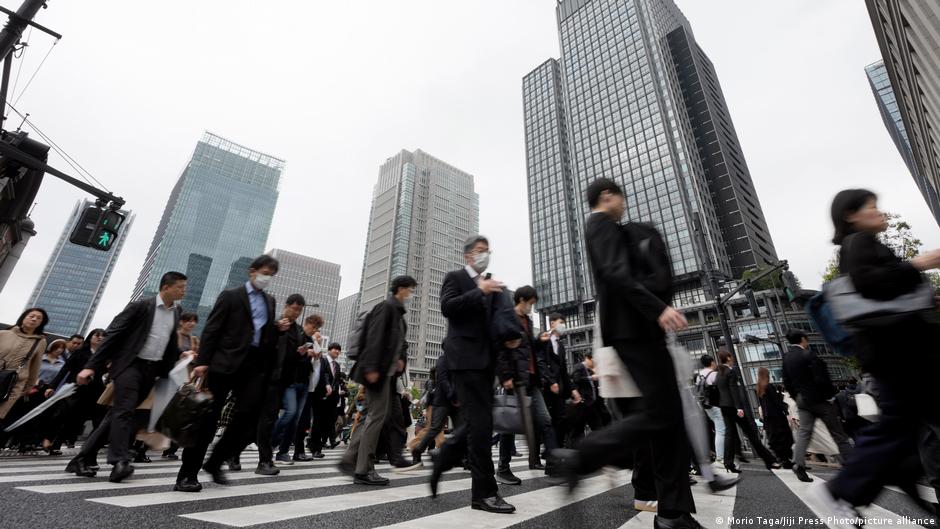
Resignation agencies in Japan help employees leave their jobs seamlessly in just 15 minutes. Young people are especially eager to use their services.
https://p.dw.com/p/5MN4SLike ghosting in dating, Japan's bakkure refers to suddenly vanishing from a job Image: Morio Taga/Jiji Press Photo/picture allianceAdvertisementFor Y.M., a Japanese man in his early 20s, his first job out of university at a real estate sales firm quickly turned into a daily trial of endurance. Among his colleagues, he was always the one being screamed at.
According to his testimony featured on the website of Leadbrain, a Tokyo-based labor and human resources consulting firm, he sought a quiet way out because he was wary of how colleagues perceived him. He was reluctant to burden his parents and determined to avoid workplace conflict, which is a common attitude among working Japanese.
Rather than submitting his resignation in person, he opened his phone and began searching for a resignation proxy service, a third-party agency that could help him quit without direct interaction with his employer.
In Japan, vanishing from a workplace without notice is known as bakkure, a concept somewhat parallel to "ghosting" in modern dating. For many foreigners, leaving a job without notice would be considered an irresponsible and hurtful act. But within the logic of Japanese social interactions, vanishing is a way to avoid direct conflict and maintain harmony — at least on the outside.
Demand for these resignation agencies is booming. Albatross, one of Japan's leading businesses of this kind, helps about 450 people quit without confrontation every month. They charge roughly €120 ($138.5) per client working a full-time job. The majority of these clients are young professionals in the service industry and manufacturing. The process can be completed within 15 minutes.
"The reasons why people requested us to resign for them range from physical violence to sexual harassment," said Yuka Hamada, the CEO of Albatross. "They are vulnerable in this case, and they are not brave enough to quit their job."
Around one in three people reported experiencing some form of harassment at work, according to a survey of Japanese workers aged 20 to 49 by consulting firm Shikigaku.
Traditional Japanese corporate culture originated during the post-World War II economic boom and relies heavily on the "lifetime employment" system. In this culture, loyalty is regarded as the highest virtue, and bosses often view resignations as insults, so many young employees fear resigning in person.
"Announcing one's intention to resign can feel not merely like ending a contract, but like disappointing others or betraying expectations that one has previously continued to meet," said Hiroki Nakamori, an associate professor at Rikkyo University's Graduate School of Social Design Studies.
Japan is a non-confrontational culture, and people are expected to fall in line when making certain commitments to the company and its culture.
"Those who disturb the harmony are not appreciated, so someone leaving might feel they should just disappear without making too much of a fuss," said Hiroshi Ono, a professor of Human Resources Management at Hitotsubashi University Business School.
"Acting in a collective and acting in harmony is a sign of strength."
This cultural compulsion to avoid conflict runs deep. Even Japan's 17-Article Constitution, the 7th century foundation of modern Japanese governance, explicitly states: "Harmony should be valued and quarrels should be avoided."
But you can also politely ghost a job. "Clients may not say goodbye or express their gratitude directly to the company. In such cases, the agency can deliver these words on their behalf," says Albatross CEO Hamada.
It is the ultimate paradox of Japanese workplace culture: Even when ghosting, the employee feels compelled to abide by meiwaku — the social obligation to minimize trouble for others and preserve collective order above all else. This also applies to removing their personal items from the workplace.
"Even if a client intends to completely vanish from their job, we still advise them to clear off their desk" before leaving, added Hamada.