play Live Sign upShow navigation menuplay Live Click here to searchsearchSign upEXPLAINERNews|ExplainerUS says it’s clearing Hormuz traffic: Why are oil futures beyond $100?Brent crude crosses $107 as Hormuz disruptions and Saudi pipeline shutdown threaten global oil supply.
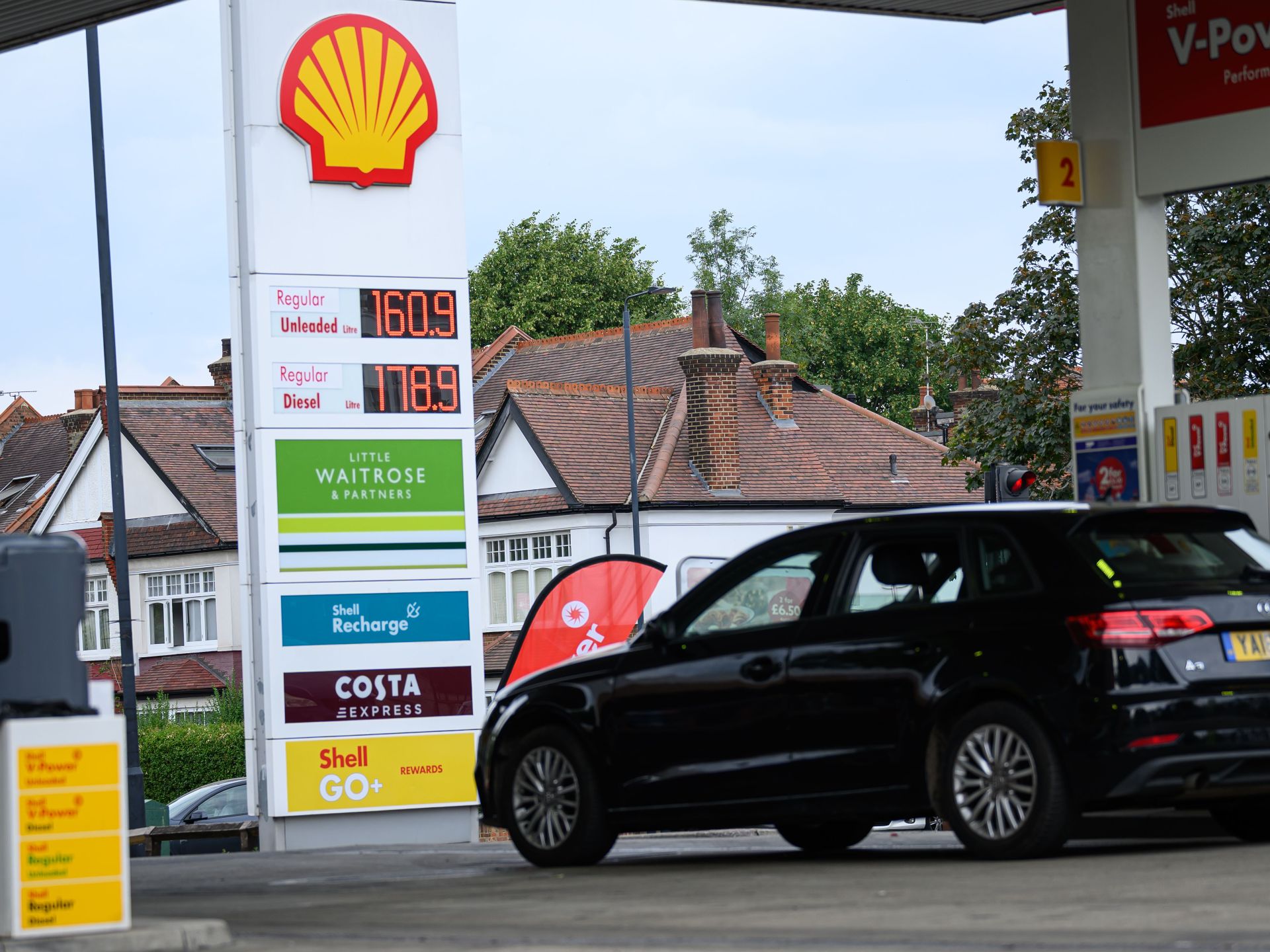
xwhatsapp-strokecopylinkgoogleAdd Al Jazeera on GoogleinfoFuel prices are displayed on a digital board at a petrol station in London, UK [File: Leon Neal/Getty Images]By Al Jazeera StaffPublished On 14 Sep 202614 Sep 2026President Donald Trump says the United States is making progress in reopening the Strait of Hormuz and escorting more oil through the waterway, yet oil prices have jumped in recent days.
The recent attacks on shipping in the Strait of Hormuz and Saudi energy infrastructure have also pushed crude prices up, with Brent crude rising $3.21 to $107.82 a barrel.
The apparent contradiction between US claims and surging oil prices shows the reality on the ground is complicated at best.
So, what do we know about shipping traffic in the Strait of Hormuz, and where are oil prices headed?
Washington says traffic through Hormuz has been improving despite the two sides being in a diplomatic deadlock.
US Energy Secretary Chris Wright on Sunday said 10 million barrels of oil per day, on average over the past week, were passing through Hormuz, adding that “we’re back to two-thirds or north of two-thirds of the previous flows.
“So the world oil markets are tighter than we’d like today, but they’re not overly tight,” Wright added, according to US media outlet Bloomberg News.
President Trump has made similar claims, stating that the US is in “total control” of the strait and asserting that its forces are escorting ships carrying millions of barrels of oil through the waterway, through which a fifth of global oil and gas passes.
Iran has, however, disputed the US claims. Tehran says it controls access to Hormuz and has warned ships against using routes it has not authorised. Last week, Iran announced a new restricted shipping zone around the crucial waterway.
Shipping data from tanker trackers also suggests traffic remains well below normal levels. Preliminary ship-tracking data shows vessel transits through the Strait of Hormuz falling to single digits a day over the weekend, remaining well below the 10-day average of 14 a day, the Reuters news agency reported.
Reuters said a total of 14 vessels transited the waterway, with four exiting the Gulf and 10 entering it.
More than 100 vessels passed through the strait daily, carrying an estimated 20 million barrels of oil, before the US and Israel launched the war on Iran in February.
The data is preliminary and subject to updates, as some vessels navigate the passage with their Automatic Identification System transponders switched off, meaning they are excluded from the official counts, Reuters added.
Oil prices jumped more than 3 percent on Monday after an Iranian ship was attacked on Sunday in the Strait of Hormuz and Saudi Arabia’s critical East-West oil pipeline was damaged in a drone attack.
Brent crude rose $3.21 to $107.82 a barrel, while US West Texas Intermediate gained $3.17 to $103.22.
The rise came after Saudi Arabia’s East-West oil pipeline was temporarily shut by a drone attack originating from Iraq, according to Saudi officials.
Riyadh has been using the pipeline to export oil via the Red Sea amid the Iranian blockade of the Strait of Hormuz. Four percent of the global oil supply will be threatened if the pipeline remains shut.
A series of missile and drone attacks by Yemen’s Houthi group on southern Saudi Arabia in recent days has further added to the uncertainty about oil supply originating from the world’s largest oil producer.
On Tuesday, the Yemeni group hit civilian and economic sites in the cities of Abha, Khamis Mushait, Jizan and Najran, injuring 73 people, among them women and children.
The assault on the kingdom marks a sharp escalation in Yemen’s long-running war, which flared up again in July after nearly four years of relative calm under a United Nations-brokered truce.
Chris Beauchamp, chief market analyst at IG Group, says oil prices are likely to remain under upward pressure as disruption in the Strait of Hormuz continues, despite US claims that it is clearing traffic through the waterway.
“Despite US claims to the contrary, Hormuz is not under its control, and oil is not flowing freely,” he said.
Beauchamp says passage through Hormuz remains severely limited and ships continue to face attacks, while Houthi attacks on infrastructure have added another source of concern for energy markets.
“Near-month futures continue to trade at a premium to the spot price, a recognition that disruption is expected to continue, ratcheting up the pressure on the global economy,” he added.
Early on Sunday, the United Kingdom Maritime Trade Operations centre said a vessel was struck by an unknown projectile while transiting Hormuz.
Meanwhile, Iran’s Islamic Revolutionary Guard Corps on Monday said it had intercepted and destroyed an advanced MQ-1 drone that was flying over the Strait of Hormuz.
“With no one in a hurry to talk, it seems that oil prices will continue to rise, and a return to March’s highs seems to be a matter of when, not if,” Beauchamp said.
A meeting in Oman between Gulf countries and Iran to discuss possible agreements on the Strait of Hormuz, which had been scheduled for Monday, was postponed, further delivering a blow to diplomatic overtures to end the six-month war.
Iran on Monday said the planned meeting was postponed by Saudi Arabia over the recent events in Yemen.
US Energy Secretary Wright also poured water over any hopes for a diplomatic breakthrough, saying “counting on a consensual agreement with Iran today is certainly not a good bet,” according to Bloomberg.
Meanwhile, Abdul Khalique, head of the Liverpool John Moores University Maritime Centre, said the Houthi group’s growing presence along Yemen’s western coast, next to the Bab al-Mandeb strait, was also a reason for a surge in oil prices.
“The Bab al-Mandeb strait is now largely under Houthi control,” Khalique told Al Jazeera, referring to the vital shipping route connecting Asia with Europe.
“Having already taken the port of Mocha and the islands of Hanish and Zuqar earlier in the week, Iran-aligned Houthi forces seized the strategically vital Perim (Mayyun) Island and the mainland town of Dhubab, giving them effective control of Yemen’s entire Red Sea coastline.”
Khalique added that war risk insurance for Hormuz transits, which stood at about 0.25 percent of hull value before the war, has climbed as high as 3 to 10 percent of hull value, depending on the vessel and route.
“For a $100m tanker, that range translates to a war risk premium of $3m to $10m for a single transit, before cargo cover and freight costs are added on top,” he said.
“The US may hold substantial military control over the battlespace, but it has not restored the conditions needed for a resumption of normal commercial shipping, and that gap is precisely why oil prices continue to climb even as Washington declares victory.”