play Live Sign upShow navigation menuplay Live Click here to searchsearchSign upOPINIONOPINION, Opinion|ElectionsBangsamoro’s parliamentary election is a turning pointIt is a milestone of the self-determination struggle in this region of the Philippines. It must be kept peaceful and fair.
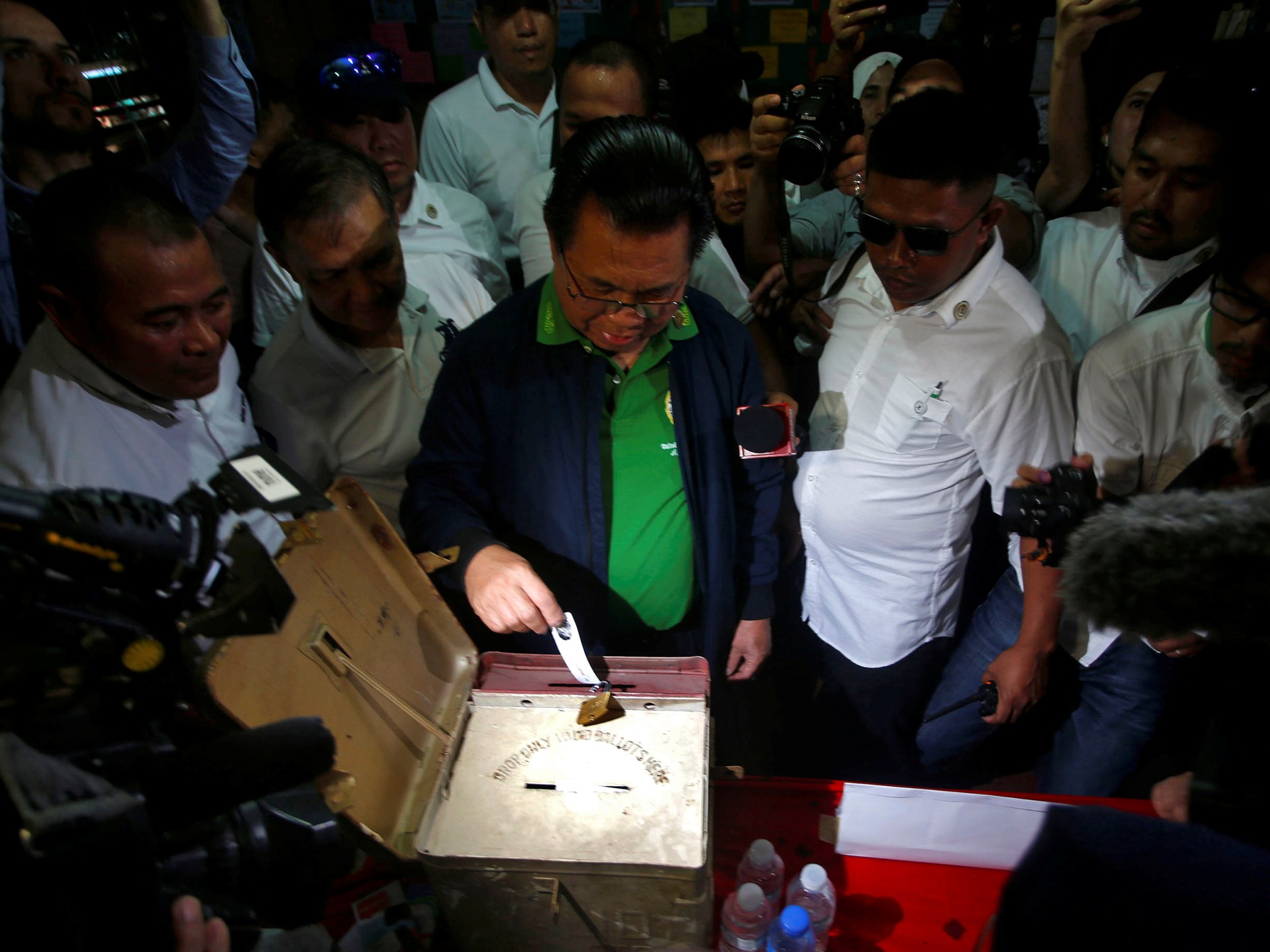
xwhatsapp-strokecopylinkgoogleAdd Al Jazeera on GoogleinfoAl Haj Murad Ebrahim, Chairman of the Moro Islamic Liberation Front (MILF), casts his vote during the plebiscite on the Bangsamoro Organic Law at a voting precinct in Sultan Kudarat, Maguindanao province, Philippines on January 21, 2019 [File: Marconi B Navales/Reuters]On Monday, the Bangsamoro Autonomous Region in Muslim Mindanao (BARMM) in the Philippines will hold its first parliamentary election since it was established in 2018. The vote will officially mark the end of the transition period under the Bangsamoro Transition Authority (BTA), an interim regional government appointed in 2019.
The election is a significant milestone in the Bangsamoro struggle. It is the outcome of decades of armed conflict and negotiations between the Moro Islamic Liberation Front (MILF) and the government of the Philippines.
The vote will test the Philippine government’s commitment to the peace process and the MILF’s commitment to the democratic process.
BARMM is located on Mindanao, the second-largest island in the Philippine Archipelago, and it covers roughly the territories inhabited by the Moro people, a native Muslim-majority group. For centuries, the Moro enjoyed self-governance in independent states and resisted Spanish colonialism. Following the Philippines’s independence in 1946, they continued their struggle for self-determination.
In 1989, the Autonomous Region in Muslim Mindanao (ARMM) was created by Manila to give some devolved rights to the Moro. However, ARMM largely failed to address local grievances and demands due to its weak structural power. It was given limited autonomy in political and fiscal decision-making, but it did not manage to improve socioeconomic conditions in the region. The MILF continued the armed struggle.
In 2012, President Benigno Aquino III recognised the ARMM as a “failed experiment”. Under his administration, the Framework Agreement on the Bangsamoro was signed between the government and the MILF, paving the way for a new political entity.
Six years later, under President Rodrigo Roa Duterte, the Organic Law for the Bangsamoro Autonomous Region in Muslim Mindanao was promulgated. This legislation granted the region greater fiscal autonomy, a regional government, a parliament, and a justice system.
Then the Comprehensive Agreement on the Bangsamoro was concluded to outline the mechanism of transition from ARMM to BARMM and set up the MILF-dominated BTA to lead it. All of this is culminating in the parliamentary election, which will determine the makeup of the region’s first legislative body.
The vote comes at a time of heightened tensions in BARMM and internal divisions within the MILF. Two camps have emerged within the movement – one loyal to MILF Chair Al Haj Murad Ebrahim and another supporting Chief Minister Abdulraof Macacua.
Last month, Macacua joined the newly formed Bangsamoro Federalist Party (BFP), which will compete in the elections against the MILF’s political wing, the United Bangsamoro Justice Party (UBJP). Shortly after, his convoy was attacked, but he survived unscathed.
In early September, Macacua and 40 commanders were dismissed from the MILF’s military wing for alleged insubordination.
These tensions have prompted increased public anxiety about possible post-election unrest. There are other factors that could overshadow the vote.
In past elections, vote-buying was widespread, election-related violence was rampant, and electoral fraud and manipulation were pervasive. If these practices repeat at a large scale, the electoral outcome may not necessarily provide a straightforward measure of the will of Bangsamoro’s people. It may also not be an accurate reflection of whether they are satisfied with the transitional government or not.
The MILF presents itself as a champion of moral governance. If it is to retain this label, it should not give in to widespread vote-buying and electoral manipulation. It should also not let internal rivalries turn violent.
But there are already some alarming signs. Prominent MILF figures have conveyed that if the UBJP, the front’s political wing, sees manipulation and fraud, its members are ready to fight. They have also suggested that since the MILF led the transition, it should remain in power. On social media, some citizens have condemned the MILF camp’s threats, calling such tactics un-Islamic.
Before the vote, Manila has deployed military forces in key areas. This has heightened people’s fears that fighting with the MILF may erupt. The tense situation might lead to a low voter turnout.
Under these circumstances, the future of the Bangsamoro is riddled with uncertainties.
Whatever happens in the election, we must remember that the future of BARMM is a shared responsibility. The Philippine government and the Bangsamoro parties are duty-bound to honour the peace agreement. In addition, the people must exercise their civic rights and responsibilities to help sustain the peace achieved after a long and painful armed conflict and to move toward a prosperous Bangsamoro land.
The views expressed in this article are the author’s own and do not necessarily reflect Al Jazeera’s editorial stance.