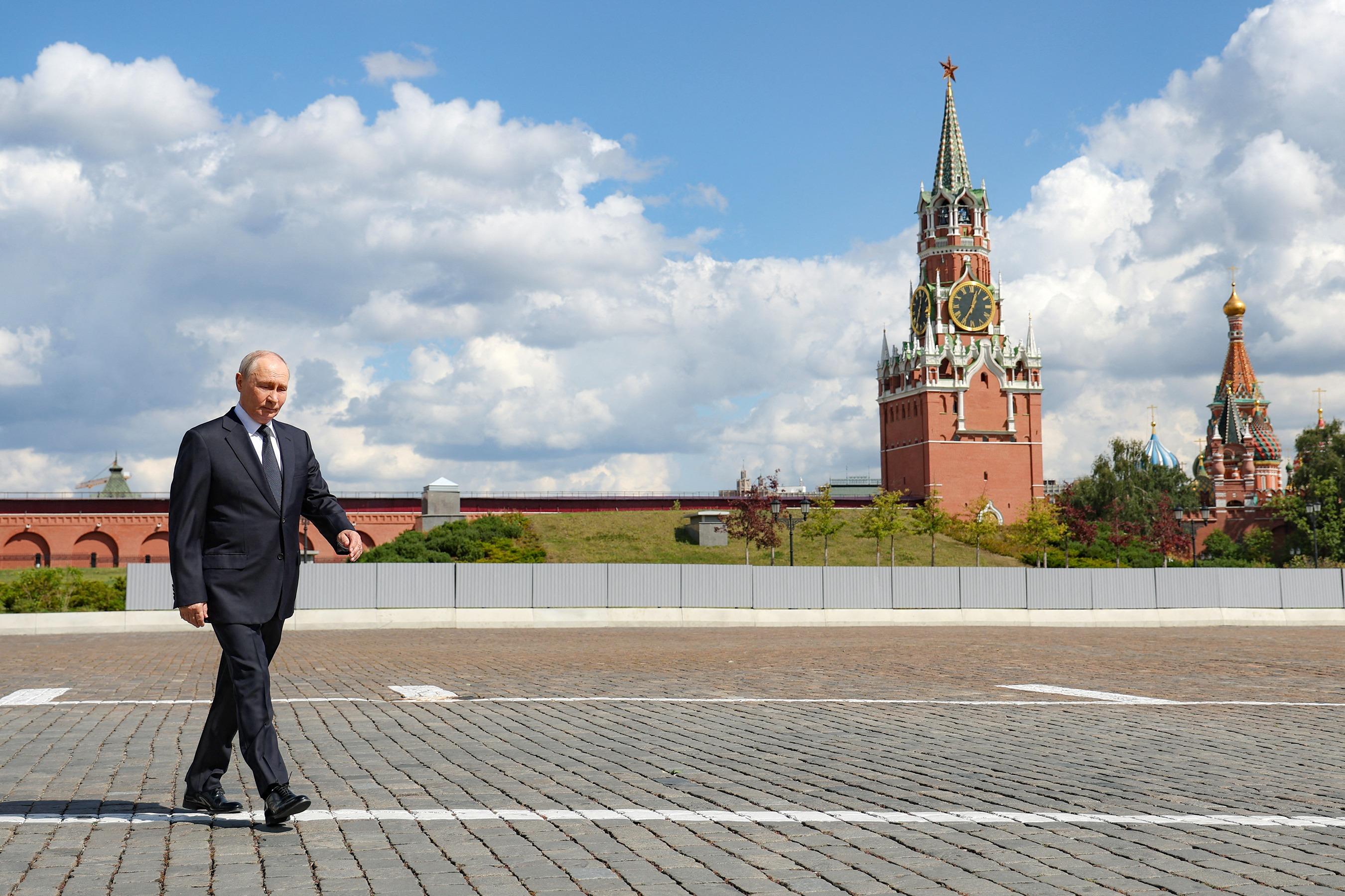
Add The New York Post on Google In keeping with Russia’s imperial history, President Vladimir Putin will spend the next week erecting a countrywide Potemkin Village.
On Sept. 18-20, the man wanted by The Hague for war crimes will put on a sly smirk and attempt to fool the world with the country’s “elections.” All 450 seats of the Duma — Russia’s legislative body — will ostensibly be up for grabs, but the outcome is preordained. It will be a grotesque, choiceless farce.
The Kremlin will manufacture the numbers; in all likelihood, it already has. Russians will show up at the polling stations and turn in their ballots, but will be choosing nothing other than humiliation and indignity of living in a participatory autocracy. The majority of seats will go to United Russia, Putin’s war-loving party. Even the mildest dissent proved too much: Yabloko, Russia’s only registered anti-war party, was barred from running.
The English language lacks a word for the obscenity about to unfold. So let’s coin one: call it a poll-temkin. All facade, no substance.
To vote is a revered right and duty of citizens worthy of self-rule. This is one place where Ukraine and Russia have long differed. In December 1991, as Soviet occupation of Ukraine drew to an end, over half a million people, or two-thirds of eligible Crimeans, turned out for the referendum to restore Ukraine’s independence. More than 54% said yes.
Russified by Moscow after the mass deportation of its native Kirimli population, Crimea chose a free Ukraine when its political will actually mattered. Two decades later, Russia came knocking again. Or, rather, kicked down the door.
In 2014, troops in unmarked uniforms seized Ukraine’s Black Sea peninsula, and Moscow hurriedly staged its own new “referendum” at the barrel of a gun. The invaders did not even offer Crimeans the option of remaining part of Ukraine.
The result? An astonishing 97% supposedly “voted” for Russian reunification, on a turnout of 83%.
Regrettably, these numbers survived the absurdity that produced them. The unfounded notion that Crimeans “want to be under Russian rule” has since found its way into the lexicon of people who should know better.
In this month’s election, Moscow will extend its fraud onto sovereign Ukrainian land when it conducts polls in parts of Ukraine it has stolen. The people in these lands have suffered torture, disappearances, kidnapped children and war. Now they have to deal with this insult.
Imagine the Kremlin declaring Alaska “historically Russian” and therefore rightfully the property of Putin. The idea isn’t so farfetched when you remember that Moscow owned the state until 1867. If old imperial maps confer modern sovereignty, Fairbanks is fair game.
Now imagine Putin acting on the claim and launching passportizatsiya — the distribution of Russian passports — for Alaskans. (The fact that Russian has a word for handing out passports in someone else’s country tells you plenty.) When Moscow runs its scam in Donetsk, my hometown, it is no different than doing the same in Anchorage.
Americans would find the proposition preposterous. Ukrainians are forced to live with it.
Kremlin-appointed local officials have reportedly been tasked with producing at least 70% for Putin’s party with turnout between 61% and 67%.
And then will come perhaps the most cynical trick of all. Moscow will point toward Kyiv and ask: Russia voted during wartime. Why can’t Ukraine?
This is especially poignant given that Ukraine’s former Defense Minister Mykhailo Fedorov has called on President Volodymyr Zelensky to hold elections, which haven’t happened since the war started.
But the answer is simple: Ukraine can’t go to the polls because Russia invaded Ukraine.
The Ukrainian constitution prohibits national voting under martial law. Millions have been driven from their homes, swaths of the country remain occupied and hundreds of thousands are defending it.
Still, political competition in Kyiv without elections is far more robust than it is in Moscow. Fedorov is popular throughout the country for his work driving Ukraine’s wartime technological modernization. Had a similar figure gained popularity in Russia and challenged that country’s president so directly, Putin would have had him poisoned. Fedorov, meanwhile, speaks openly to the people
And Ukraine’s anti-corruption institutions continue to assert themselves and demonstrate that no one is above the law. Ukrainians are showing extraordinary political maturity: They are united in resisting genocidal aggression while continuing to demand accountability from their leaders. In Russia, citizenship comes with neither meaningful rights nor responsibility for the state’s actions.
By staging these rigged elections and setting the terms of the argument, Putin is practicing an old KGB trick: reflexive control. This psychological trap forces an opponent into an impossible position where any response is a loss. If the US ignores Russia’s poll-temkin, the free world will be letting it slide. But if the US debates whether the vote was “free and fair,” then Russia will turn around and slam Ukraine for refusing to have one.
American officials can avoid this trap by pre-bunking Putin’s pre-cooked election. We don’t need to wait for the unbelievable results to come through the wire to declare the whole thing a fraud.
Andrew Chakhoyan is an academic director at the University of Amsterdam and previously served in the US government at the Millennium Challenge Corporation.