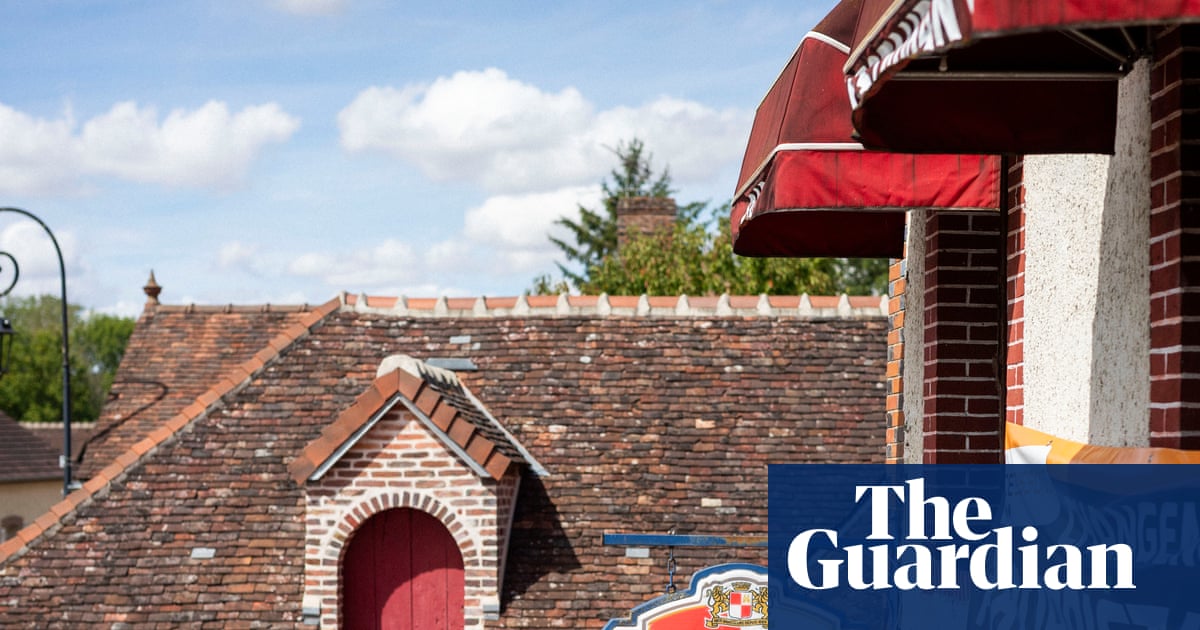
‘People seem really happy it’s open again.’ The Au Bon Accueil restaurant in Saint-Martin-sur-Ouanne. Photograph: Ed Alcock/The GuardianView image in fullscreen‘People seem really happy it’s open again.’ The Au Bon Accueil restaurant in Saint-Martin-sur-Ouanne. Photograph: Ed Alcock/The GuardianThe battle to save the dying heart of rural France: the village bistroOnce central to rural life, cafe-bistros are closing in the face of depopulation and falling alcohol consumption, but campaigners are seeking new ways forward
It is just past noon on a midweek day, and already every table at Au Bon Acceuil cafe-bistro in the northern Burgundy village of Saint-Martin-sur-Ouanne is taken.
The three-course lunch menu today – including a choice of a hefty chunk of steak with chips or a meaty lasagne – is just €18, but villagers are not only here for the food.
After an eight-month closure, the bistro, previously called Café de la Gare, recently reopened – and locals want it to stay that way.
“It’s so important to have a cafe-bistro in a village like this. We couldn’t let it stay closed,” said Nadia Letellier, the new manager. “And we’re doing well, as you can see. People seem really happy it’s open again.”
View image in fullscreenNadine Letellier, the new manager of the Au Bon Accueil restaurant in Saint-Martin-sur-Ouanne. Photograph: Ed Alcock/The GuardianHervé Chapuis, a farmer and the village mayor, is part of the local council team that saved Saint-Martin’s last public-facing business since the boulangerie across the road closed eight years ago.
“People come here every morning to have a coffee and a chat,” he said. “Our aim is to keep this kind of business open to support the social fabric. It’s part of village life and people missed it. Now, village life has returned to its proper rhythm.”
France’s celebrated cafe-bistros are in trouble. In 1900 there were an estimated 500,000 such establishments; by the 1960s more than half had closed. Today, only about 30,000-40,000 remain and even they are reportedly shutting at a rate of two a day.
Alain Fontaine, who runs Le Mesturet bistro near Paris’s stock exchange, and who is president of France’s Association of Bistros and Cafes, says the closures leave rural communities deserted and villagers, especially elderly people, isolated.
“Every day, the art of living we enjoy in our bistros is gradually disappearing from our communities,” Fontaine said. “Villages are being left like deserts with no shops, no businesses, nothing. In losing our local bistros, cafes and restaurants, we are losing part of the French life balance.”
The reasons for the closures of what the 19th-century writer and statesman Léon Gambetta called “salons de la démocratie” or “people’s parliaments”, are economic and sociological. The number of people living in rural areas has declined over the last half a century, television and devices encourage more people to spend their evenings at home, and the average French person now drinks about 80 litres of alcohol a year compared with 200 litres in the 1960s.
Finding people willing to run bars, cafes or bistros is also a problem, says Fontaine, who is campaigning for the government to submit the establishments to Unesco for intangible cultural heritage listing, arguing this recognition would encourage more people to consider taking them on.
“Without a cafe or bistro, communities are effectively deprived of any social life. We cannot resign ourselves to this trend,” he said. “In bistros and cafes, people don’t just eat and drink, they catch up with each other, meet new people, debate, laugh, read, write and sometimes fall in love.
“This is a way of life and an expression of freedom unique to France, something that tourists from all over the world come to seek out in Paris, in other major cities, and our villages.”
View image in fullscreenCustomers in the Au Bon Accueil restaurant in Saint-Martin-sur-Ouanne. Photograph: Ed Alcock/The GuardianSolène Joucla, whose family have run the historic Le Grand Café at Camplong, in the Hérault near Montpellier, since 1898, faced having to let it close or give up her job as a high-school English teacher when her father, Pierre, retired. Instead, she and her sister, Katell, set up an association to run it.
“We closed for three years after Covid, which was a difficult period, and opened in September last year. We wanted to find someone to take it over and run it, but it’s a small village of 220 people and it was complicated. Now we run [it] with volunteers,” Joucla said.
“Our aim is to encourage people to go out so they are not isolated, and so we know how they are doing. People come here for a chat, to have a laugh, listen to music … we are the cultural centre of the village.
“My sister and I grew up in this bar and have plenty of memories here. We’re fighting to keep its place at the heart of the village, but it’s a daily challenge just to stay open. And not just for us; this is a battle that’s happening all over France.”
View image in fullscreenCustomers at the bar of the Au Bon Accueil restaurant. Photograph: Ed Alcock/The GuardianA report submitted to the French senate in 2023 suggested the government should ease regulations on small rural café-bistros, hotels and restaurants. It pointed out the negative impact of the widespread closure of such places on rural communities, concluding their presence contributed to “economic vitality and social cohesion”.
The National Federation of Country Bistros says “rural bistros are unique as places for socialising, building community ties, exploring new experiences and fostering local cultural life. Often, these bistros are the only local service providers still operating in villages.” It adds: “Supporting the village bistro means helping to keep it alive, so the heart of our countryside continues to beat.”
A recent report by Oxford Economics, examining the economic and social contribution of bars and pubs to communities in five markets, including the UK and US, concluded they had “a central role … in bringing people together and supporting social connection”.
In France, the 1,000 Cafés association was set up in 2020 to combat the “social fracture” highlighted by the gilets jaunes protest movement by helping communes of fewer than 3,500 people save their cafes or open new ones. It found more than 60% of people in rural villages had no local commerce, and this left many feeling abandoned and ignored.
Camille Sebaux, the director of 1,000 Cafés, told France Info radio the association had worked in more than 300 communities, often helping cafes to diversify by stocking food essentials, or becoming drop-off points for online shopping deliveries.
“Cafes have been closing in villages for the last 50 years, and we don’t have any magic wand or miracle answer,” Sebaux said. “Plus, running a village cafe is not an easy job. Our aim is to help small communities find solutions.”
View image in fullscreenPeople dining in a square in the village of Collobrières, in the Provence-Alpes-Côte d’Azur region. Photograph: niceartphoto/AlamyAurélien Pécot, the mayor of the 14 villages and small towns, including Saint-Martin-sur-Ouanne, that make up the Charny-Orée-de-Puisaye commune in the Yonne department, ran a bistro for seven years before being elected this year. He says he believed they are essential in a rural community.
“I noticed the same people would come in every morning at the same time, take the same table, the same coffee or a glass of white wine. The cafe-bistro was their point of reference. If it disappears, there is nothing for them,” he says.
His local authority owns five properties in the area – the Saint-Martin bistro, a restaurant and three boulangeries – and spent €25,000 on essential works at Au Bon Acceuil before it reopened. Local officials also advised Letellier on setting up the business.
Pécot says many recall a time when almost every village had a bar, cafe, bistro and boulangerie, but says this is no longer realistic or economically viable in many cases.
“It’s taxpayers’ money we are spending saving these places, so people have to see it’s being well spent. Not every village can have its own bistro,” he says.
View image in fullscreenLeft to right: Local politicians Hervé Chapuis, Nicole Deviterne, and Arnault Meric in front of the Au Bon Accueil restaurant in Saint-Martin-sur-Ouanne. Photograph: Ed Alcock/The GuardianOver an aperitif at Au Bon Acceuil, Nicole Deviterne, the mayor of a neighbouring village without a cafe-bistro, said: “It’s an element of village life that’s extremely important. It’s a way of combating rural isolation, but there has to be a real willingness of local people and local councils to save these places, to make villages live again.”