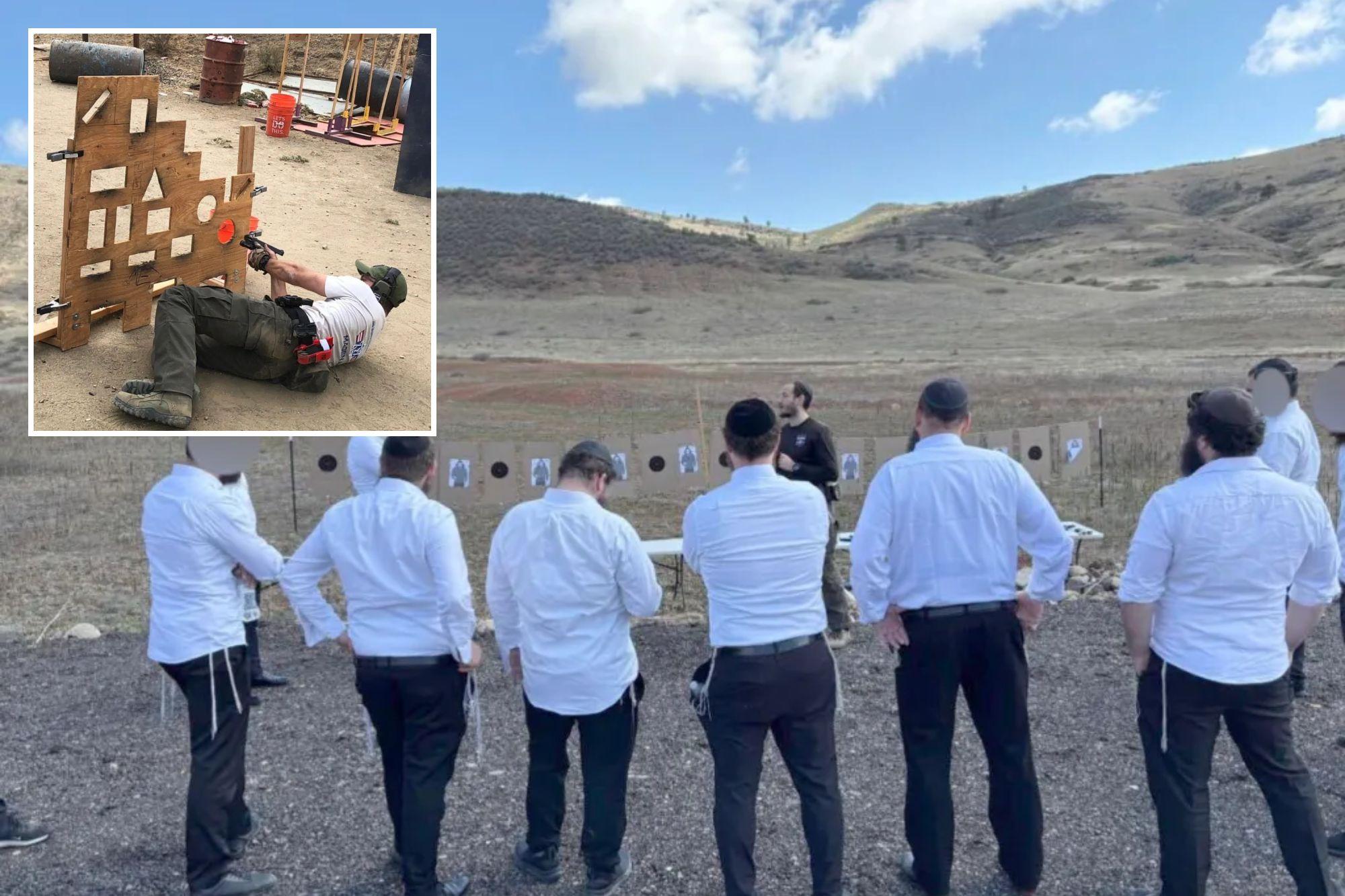
A host of rabbis recently participated in a five-day “summer camp” featuring extensive firearms training as Jewish leaders from across the US prepared for the High Holidays.
The pilot program, run by Los Angeles-based Jewish security organization Magen Am USA, brought together 20 Chabad Hasidic rabbis from 12 states for an intensive crash course designed to help them respond to potential threats at their synagogues and in their communities.
The program, which also included emergency medicine and security training, took place in August in Los Angeles. It came as Jewish communities across California and the country grapple with heightened security concerns and rising fears about attacks on Jewish institutions.
For Rabbi Yossi Eilfort, the founder of Magen Am, the answer isn’t simply putting more guns in religious leaders’ hands.
“Lots of people, lots of guns, little training,” Eilfort told the California Post. “That can be bad for the community.”
Magen Am is a registered nonprofit and California-licensed security company whose stated mission is to train and empower Jewish communities to establish security teams within their own institutions.
The Anti-Defamation League recorded 6,274 antisemitic incidents nationwide in 2025, including assaults, harassment and vandalism.
California ranked second in the country with 817 incidents, while the Los Angeles region recorded 419. Although the overall number of incidents in LA declined from 532 in 2024, assaults jumped 22% — the highest number ever recorded locally, according to the ADL.
Eilfort said the organization works with community members, government officials and law enforcement to build security programs, while also offering firearms education to members of the public.
The rabbi-specific program was created after Jewish religious leaders began approaching Eilfort for advice about firearms and security at their houses of worship.
“We’re visibly Jewish and we walk down the street and dozens of rabbis have people yell things at them,” Eilfort said, adding that rabbis have increasingly been targeted with hate speech and protests.
A donor who asked to remain anonymous stepped forward to fund the pilot so participating rabbis would not have to pay for the training. The response was immediate.
Thirty-seven rabbis applied for just 20 spots, according to Magen Am.
Organizers prioritized applicants based on their security needs and the existing protections available to their communities. Some participants had never handled a gun before. Others already owned firearms but did not feel comfortable carrying them, while some were experienced gun owners looking for additional training and guidance.
The rabbis came from states including Alaska, Montana, Arizona, Florida, New York and Missouri, with California participants stretching from San Diego to Santa Barbara.
The five-day pilot ran from morning through evening, with Magen Am handling meals and hospitality as well as the training itself.
The curriculum included responsible firearm ownership, situational awareness, emergency medical procedures and coordination with law enforcement.
Eilfort declined to mention what specific law enforcement agency was involved in the training.
Participants also received instruction on suspicious-activity reports and how such reports are handled by fusion centers.
“It’s not all about the gun,” Eilfort said. “It’s all about community safety.”
The trainers themselves were members of the Jewish community, with some who had served in the Israel Defense Forces (IDF) . Eilfort, who has a background as a rabbi, is also a licensed and certified firearms instructor and a former MMA fighter.
“I’m not a security professional who found the Jewish community,” he said. “I’m a Jewish community member who realized we need more security in our community.”
For Eilfort, firearms provide only one layer of defense.
He emphasized safe storage, insurance, proficiency, licensing and compliance — and rejected the idea that the program was intended to encourage vigilante behavior.
“I’m not calling for vigilantism,” he said. “I believe in doing things right.”
One Los Angeles rabbi who participated in the pilot said the organizers packed what would normally be weeks or months of instruction into just five days.
The rabbi, who asked not to be identified, said participants began their days with morning prayers and breakfast before heading into classrooms or onto the shooting range.
The schedule mixed religious life with intensive security instruction, including lessons on stopping severe bleeding.
At the range, participants learned how to safely handle and holster a firearm, draw it, aim and respond to different emergency situations. They were also taught what to do if a firearm malfunctioned, the rabbi said.
“Every day they were building on the previous day’s learning,” he added.
The experience was particularly significant because it was the rabbi’s first time firing a gun.
“Some participants were very good,” he said. “They wanted to become excellent. And then there was someone like me that never touched a gun.”
By the end of the program, participants had moved from classroom instruction to a “FBI-style,” practical exercises at an indoor shooting range, where they faced a test designed to demand a high level of accuracy and firearm proficiency.
“It was a high level of being accurate and to know what you’re doing with a firearm,” the rabbi said.
The program also appears to have tapped in to a growing appetite among rabbis for this kind of preparation.
After the pilot ended, dozens more rabbis applied to join the program, with roughly 40 people placed on a waitlist, according to Eilfort.
Magen Am is now discussing additional funding and hopes to run another four to six programs next year, potentially expanding to as many as 10 to 12 programs the following year.
The organization has already begun expanding its broader security operations, including a new San Diego team.
But the biggest question for some rabbis is what role, if any, firearms should play in their religious responsibilities.
For the Los Angeles rabbi, completing the program did not immediately translate into a decision to carry a gun.
He said he is still considering whether firearm ownership is right for him and plans to undergo additional training before making that decision.
“I’m still in the journey with it,” he said. “My biggest takeaway is now I know how to use a firearm. God forbid, if it’s a case of an emergency, as a rabbi, I’m prepared.”
He also wrestled with the religious implications of carrying a firearm.
But Jewish law, he said, places a clear emphasis on protecting human life.
“If it’s a matter of life and death, you have to do all that you can to save a life,” he said. “So this could save a life.”
His hope, ultimately, is that the training never has to be used.
“If we would all be able to get along and respect each other’s differences, that will really make a community and a city and a country so beautiful,” he said.
California Post News: Facebook, Instagram, TikTok, X, YouTube, WhatsApp, LinkedInCalifornia Post Sports Facebook, Instagram, TikTok, YouTube, XCalifornia Post Opinion California Post Newsletters: Sign up here!California Post App: Download here!Home delivery: Sign up here!Page Six Hollywood: Sign up here!