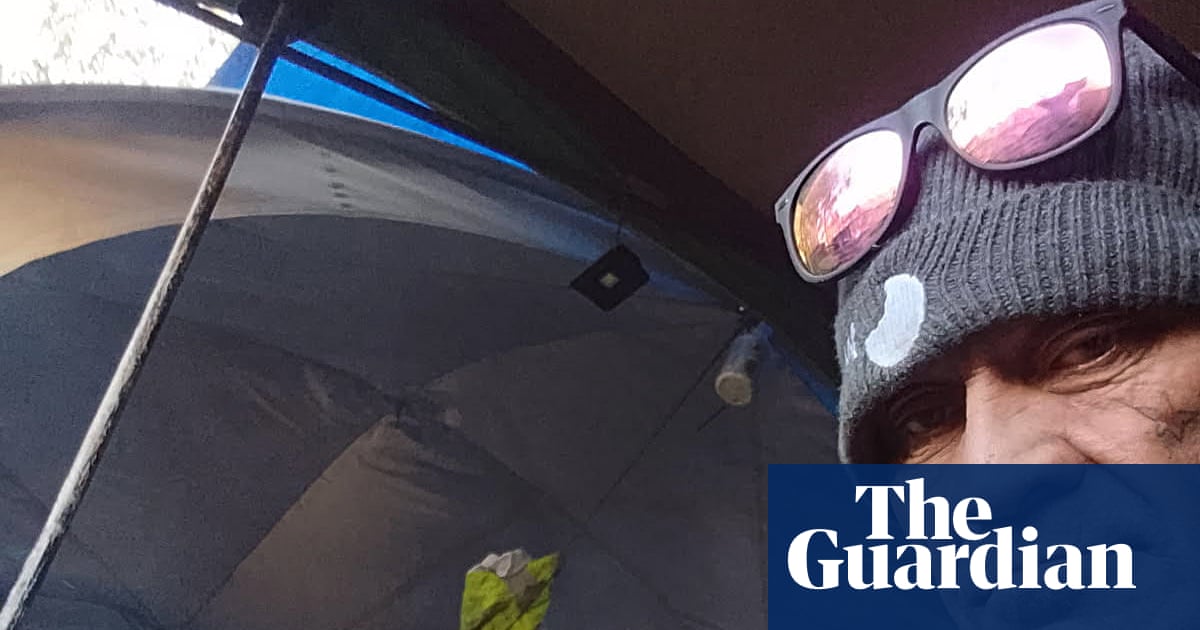
Mark Hudson in Wagga Wagga. Homes NSW repeatedly offered him a flight back to New Zealand. Photograph: suppliedView image in fullscreenMark Hudson in Wagga Wagga. Homes NSW repeatedly offered him a flight back to New Zealand. Photograph: suppliedNSW government paid for homeless man to be sent back to New Zealand instead of offering housingLocal council and state government attempting to move on residents living in an encampment by the river in Wagga Wagga
Get our breaking news email, free app or daily news podcast
The New South Wales government paid for a homeless man in Wagga Wagga to be sent back to New Zealand instead of offering him temporary accommodation, in an attempt to move on residents living in an encampment by a river.
The local council and state government have been attempting to clear out the encampment for several months after a newborn baby died in May when its mother gave birth to twins in a tent.
Residents of the encampment have faced increasing pressure to move on, including “compliance action” requests for them to leave or be fined up to $1,100. Advocates said at least four people have been fined about $110 for not moving on in time. The council has denied fining people “on the basis of where they are staying”.
Mark Hudson, 53, said he has permanent residency in Australia and is therefore entitled to temporary accommodation. He arrived 18 years ago, but does not have a Visa Entitlement Verification Online – to prove permanent residency. Despite this, Homes NSW repeatedly offered him a flight back to New Zealand, where he has not lived for over 18 years.
“They kept pressuring me,” Hudson said. “[The Homes NSW officer] offered it to me first, like six, seven times. She just kept on … ‘You want the flight? You want the flight?’”
This week, they booked the flight to Sydney and then Auckland, at a cost to the taxpayer of $1,797. On Thursday the international flight was cancelled by the airline, and Hudson, who has a girlfriend in Wagga, and is about to take custody of his granddaughter, is still in Wagga. He also has a dog he does not want to leave.
“They were chasing me all day yesterday to try and sort it out. They were like, we’ll sort the tickets out, we’ll arrange it again … But I’ve got my granddaughter now.”
On Friday, after Guardian Australia contacted the NSW government, Hudson was offered accommodation, which he is expected to move into next week.
“I didn’t want to leave Wilks [Park],” Hudson said. “I wanted to stay in Wagga. And it was just the approach was always bully tactics,” he said.
A spokesperson for Homes NSW said it has been working with people facing housing insecurity in the area since April. It confirmed travel costs, including air fares, were one of the support options available.
“Where a person is not eligible for social housing or other support services in New South Wales and requests assistance to return to their home country, Homes NSW may assist with that request as part of an individual support plan,” the spokesperson said.
“Homes NSW have been working with Mark, a New Zealand citizen, who initiated discussions about returning to New Zealand where he has family.
“If he has decided not to return to New Zealand, Homes NSW will continue to work with him to identify alternative accommodation, noting he is not eligible for social housing.”
In April, a Guardian Australia investigation revealed that former international student, 32-year-old Nepali born Bikram Lama, Sydney’s “birdman”, died at central Sydney’s St James station in December where he had been sleeping rough.
His death exposed a gap in federal and state responses to homelessness for people who lose their visa status or are unable to prove permanent residency.
NSW residents need to prove permanent residency to access social housing, normally through Centrelink payments. If permanent residents have been in Australia for more than 10 years, they can receive six months’ worth of payments. Hudson was previously receiving Centrelink payments for six months, before being cut off. New Zealand citizens on special category visas are also entitled to emergency housing.
Housing advocate Timothy Verhoef said it was a failure of the state government to offer Hudson a flight before offering him a home.
“It has been a failure because they’ve paid $1,700 and nothing’s happened. It’s pushing the problem around.”
Hudson has worked most of his life in Australia, as a truck driver and farm manager in Western Australia. He moved to Wagga to be closer to family in the area. He was not able to find work, so has been living in a tent by the river for almost two years, while getting help from family and eating at charities. Asked how he managed to survive, Hudson said “faith”.
“You just rely on [public] showers and Vinnie’s to get through, and mates.
“I would take temporary housing, but because I didn’t get on the plane, I guess they’ll hate me … I want to get some sort of housing first. Yeah, some sort of help.”
Verhoef said the council, state government and local authorities had failed to provide genuine solutions for the people living along the river encampment.
“The reality is that they haven’t worked together on anything substantial – they are just pushing a narrative to make it look like they are addressing the issue.”