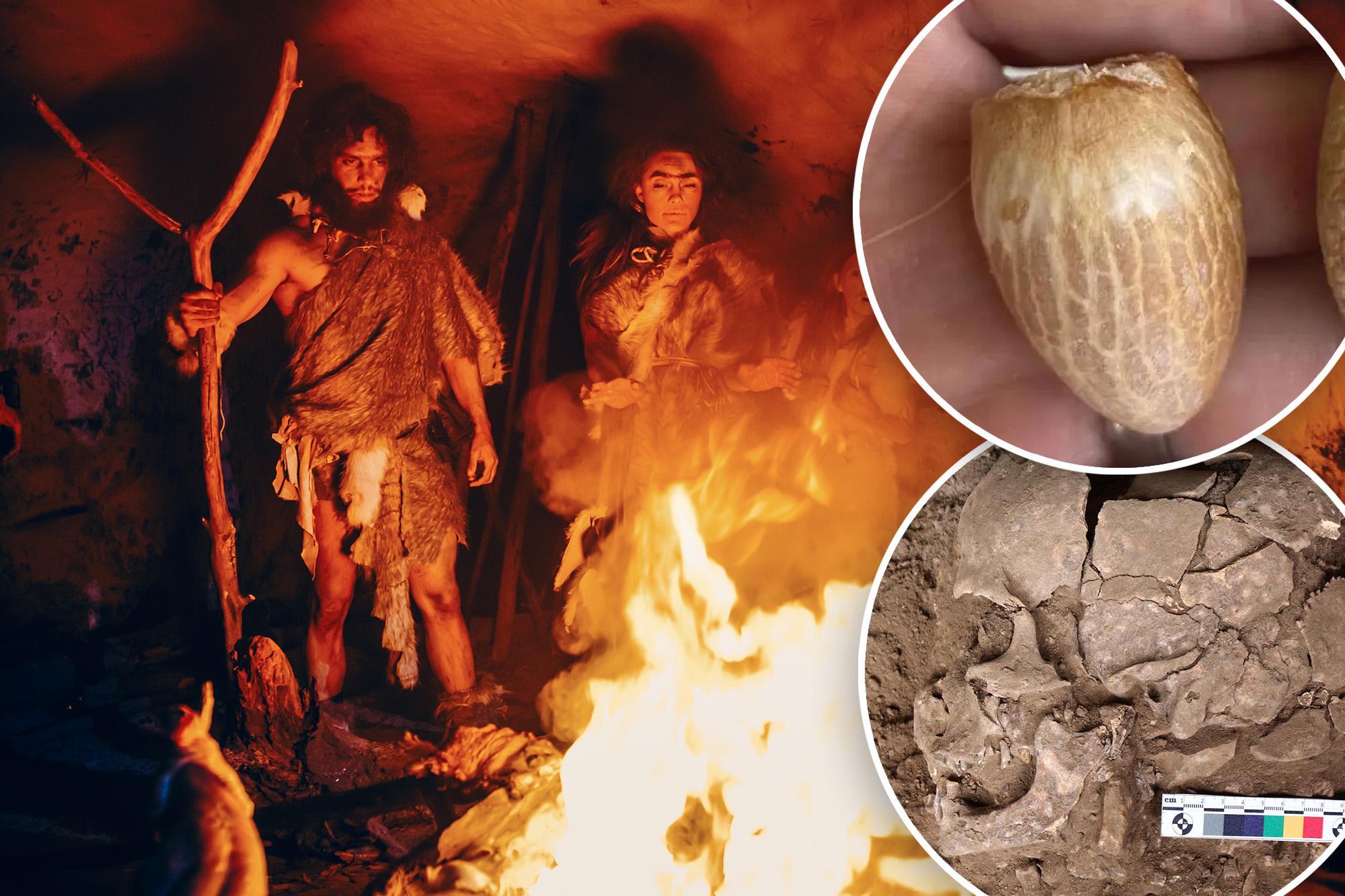
Analysis of dental remains in Indonesia has revealed that we were taking psychoactive substances as far back as 25,000 years ago -- thousands of years earlier than previously thought. Gorodenkoff - stock.adobe.com See more of our coverage in your search results.
Add The New York Post on Google It’s a trip back in time.
We walked upright starting 7 million years ago, but when did we take our first 12 steps? Analysis of caveman remains in Indonesia reveals that we might’ve taken mind-bending drugs thousands of years earlier than once thought, per a psychoactive study in the journal Science Advances.
Researchers from Griffith University in Australia reported the discovery of skeletal remnants belonging to two inhabitants from Sulawesi, the oldest of which date back to between 16,000 and 25,000 years ago, per a press release from the institution.
Rare skeletal remains of an early human forager from the Indonesian island of Sulawesi are shown on Wednesday, October 31, 2018. Fakhri / SWNS The deceased’s chompers displayed unusual wear and tear caused by what the researchers deduced was a previously unknown behavior at the time: chewing a psychoactive plant known as a betel nut.
Known to induce mild euphoria and heightened alertness, among other effects, these psychedelic seeds are used by millions of people throughout India and the South Pacific to attain a buzz, per the report.
“It is the world’s fourth most widely used psychoactive substance, after alcohol, caffeine and nicotine,” said the study’s lead author Professor Adam Brumm.
If the researchers’ prehistoric drug test rings positive, this means we were enjoying chemically-enhanced experiences as far back as the Late Pleistocene. That far predates the previous earliest evidence of drug use — 13,000-year-old barley-based drinks from what is now modern Israel.
Betel nuts (pictured) induce mild euphoria and other effects. Griffith University “This theory fails to account for the possibility that very ancient drug-taking lies at the roots of our most commonly used psychoactive substances,” said Brumm. Unfortunately, the prevalence of betel nut usage during prehistoric times was uncertain as these seeds were rarely found at archaeological sites.
To prove that early Indonesians were indeed tripping on betel nuts, also known as areca seeds, the team first had to prove that chewing the seeds could get you high without cutting agents. Modern users achieve the desired effect by chewing on a seed that’s been seasoned with slaked lime – a fine powder made by grinding the burnt shells — because this accelerates the absorption of psychoactive compounds.
However, by subjecting betel nuts to biochemical tests, the researchers proved that the same state could be attained simply through chewing.
“Our team conducted experiments in which we soaked betel nuts in artificial saliva and tested the resultant broths against a panel of cloned human receptors,” explained Brumm. “This showed that just sucking on intact betel nuts will release arecoline (the nut’s psychoactive ingredient) in sufficient amounts to have a physiological effect, altering brain function.”
Meanwhile, further analysis revealed traces of the nuts in the skeleton’s dental tissues, suggesting that they ingested these nuts as well.
Due to the prevalence of bad teeth among these prehistoric foragers, the team suspected they might’ve chewed betel nuts to alleviate dental pain.
Unfortunately, the betel-juice likely wasn’t worth the squeeze. Using this ancient anesthetic might’ve paradoxically perpetuated the islanders’ suffering as prolonged chewing eroded away their chompers, leading to pain, difficulty eating, and tooth infections.
“So while this habit may have been a remedy for toothache, years of prolonged nut-sucking eventually caused much worse dental health problems, creating a cycle of continued habitual use,” said Brumm.
Think of it like anti-drug PSA from the Pleistocene.