The failed attempts by Congressional Democrats on Wednesday night to stop, through a War Powers Resolution vote, the President’s aerial strikes on Iran is a metaphor for everything that’s wrong with the party.
Ineffective, reactive, questionably patriotic (Iran is counting on Democratic pressure to get Trump to pull the plug early on the attacks) and temperamentally unstable (the attacks will “end in failure,” said a wishful Hakeem Jeffries).
Warren Buffett once told us you don’t have to swing at every pitch. But for Democrats, every Trump utterance seems an opportunity go unhinged in fit of smug, self-satisfied contempt for the president. A cringe stagecraft and disorderly street theater seems like the discordant musical accompaniments.
This is what they call Trump Derangement Syndrome, and it’s a real thing.
To listen to Democrats, you would think resistance 2.0 is winning, but it’s not. For sure Trump’s numbers ebbed after the Minnesota ICE shootings, but Democrats trail Republicans on nearly every major issue. Seven in 10 voters think the Democrats are out of touch according to Quinnipiac poll. Only one in four voters identify with the donkeys today.
The Democrats have two major problems. One is behavioral, the other is policy.
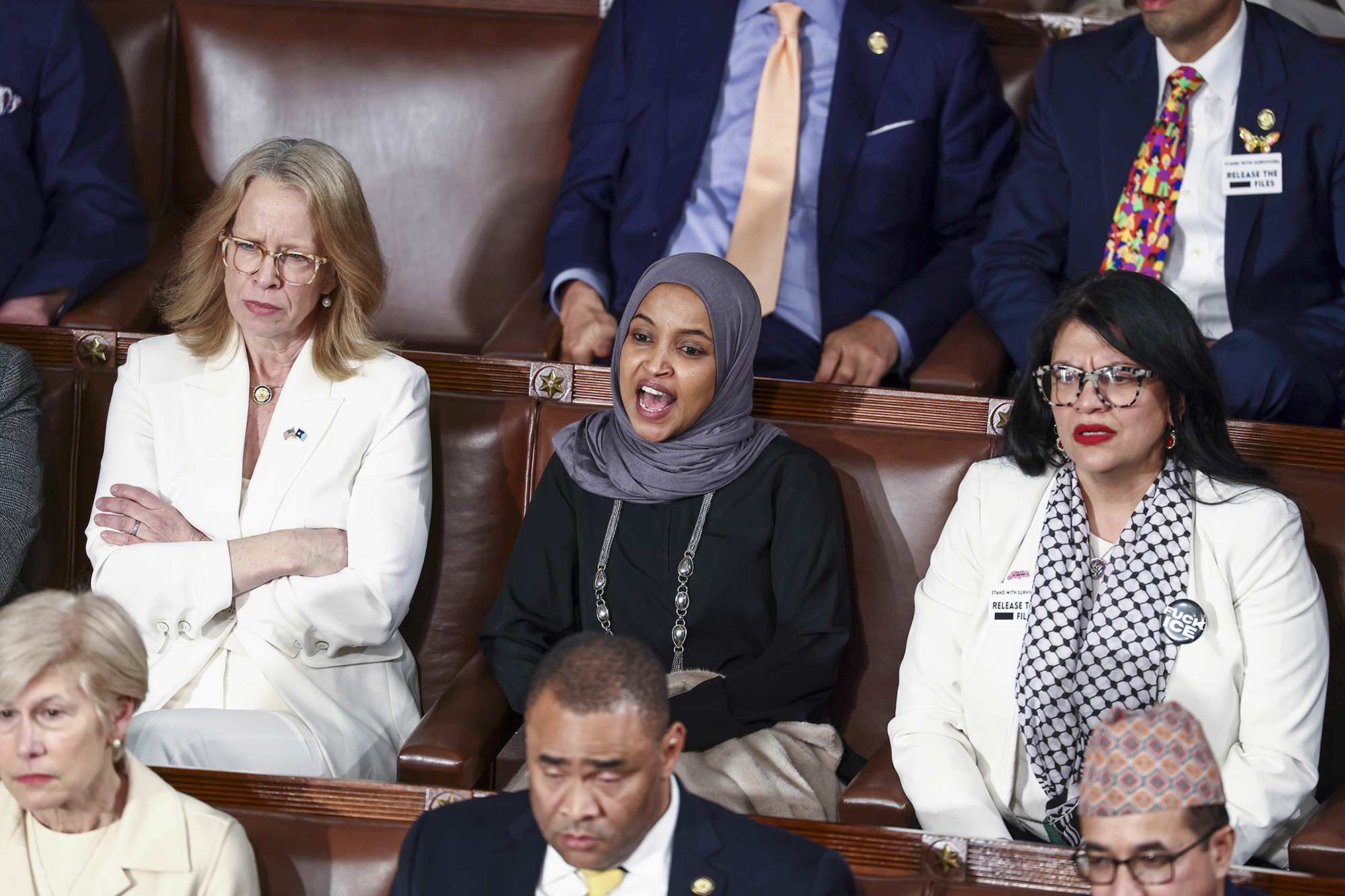
The heckling of President Trump at the State of the Union by Reps Ilhan Omar and Rashida Talib showcased a behavioral pathology. The two of them looked like Ritalin-deprived teenagers as they couldn’t restrain themselves from trap Trump laid for them. Voters respect political differences, but they hate breaches of basic decorum, especially at time-honored venerated national rituals like the State of the Union.
Senator Chuck Schumer’s daily rants against the president, with his hackneyed, staccato readings from note cards, look like a bad Saturday night skit. Rep. Jasmine Crockett’s false bravado threatening to “take down” Elon Musk is like hearing fingernails against a chalk board. Violent street protests and attacks against law enforcement are a reprise of the 1960s violence that drove voters away from Democrats.
Today, Democrats are the party that perpetually cries wolf — everything is a tantrum; everything is the end of the world. This helps drive money to the increasingly extremist, activist base — the Watermelon coalition as I written about on these pages — but it’s cringe to most voters.
The second problem for the Democrats, as I have also said on these pages for several years, is that this increasingly extreme activist base has driven the party far to the left of the median voter on nearly every single issue.
“Donald Trump is for you, Kamala Harris is for They/Them” roared the GOP attack ad highlighting just how far out of touch the Democrats were on the trans issue. David Shor, perhaps the most thorough and rigorous Democratic pollster, has shown that this extremism haunts Democrats on nearly every issue — from DEI, open borders, climate extremism, crime, the welfare state and even the economy. In most cases, the Democrats’ trust deficit is in the double digits.
Even the Johnny-Come-Lately New York Times recently ran an editorial conceding the point. Welcome to the party, NYT! It urged Democrats, belatedly after the 2024 trouncing, to find the political center. Political scientists Ruy Teixeira has argued for this consistently as well over the years. And the demographics will only get worse for Dems in the next decennial census.
Indeed, most of the political polarization in this century has come because the Democrats have moved to the extreme left, as multiple studies consistently find. The GOP has remained relatively consistent on policy over the years, moving perhaps a tad to the left on abortion and trade. Donald Trump’s positions on many major issues match up closely with those of President Bill Clinton.
So, what does this mean for Democrats? First the Democrats need less reactionaryism and more building. Swinging at every pitch only reminds voters that Democrats are impulsive, unrestrained and temperamentally ill-suited for leadership. The party needs leaders who can say no to the extremism of identity grievance and the welfare state.
Instead, the party needs to focus on building 21st century AI economy that will disrupt labor markets while creating opportunities for the prepared. On fixing the pathetic schools that teach more about pronouns than reading and math. On expanding housing and lowering health care premiums with market-based competition, recognizing that regulation has failed in each sector to bring down costs.
Voters don’t want grievance and caterwauling; they want builders. A good place to start on this would be trying to find common ground with the president on existential issues. Like the Iran threat.
Julian Epstein is the former chief counsel for the House Judiciary Democrats and the former staff director of the House Oversight Committee.